
Most companies think they have redundancy because they run several systems. But systems that look independent often share the same identity provider, the same cloud, and the same network carrier. When that shared layer fails, everything on top of it can fail together. Engineers call this a common-mode failure. Add AI agents with broad permissions and automated recovery that acts on its own, and a cascading failure can happen even when each component works exactly as designed.
Key takeaways
- A common-mode failure is when separate systems fail together because they share one underlying cause, such as an identity provider, a cloud region, or a telecom link.
- The next big incident may not be an attack. It may be an AI agent with too much access, an automated fix that makes things worse, or a hidden dependency nobody mapped.
- Every automated system needs a named person who can stop it, and a way to stop it that does not depend on the system that is failing.
- Recovery has to work without the same login, cloud, and network you use every day.
- People who know how your systems really connect are part of your resilience.
I’ve written about AI attacks already being here, in Cyber Attack Today: I Think They’re Already Here. This post is about the other half of the problem. The next big incident may not be an attack at all. It may be our own connected systems, and the automation we have given authority over them, failing in a way nobody planned for.
What is a common-mode failure?
A common-mode failure is when two or more systems that are supposed to be independent fail together, because they share one cause. The UK’s Office for Nuclear Regulation defines the broader term, common cause failure, as “failures of two or more structures, systems or components due to a single specific event or cause,” and includes common-mode failure within it (ONR glossary).
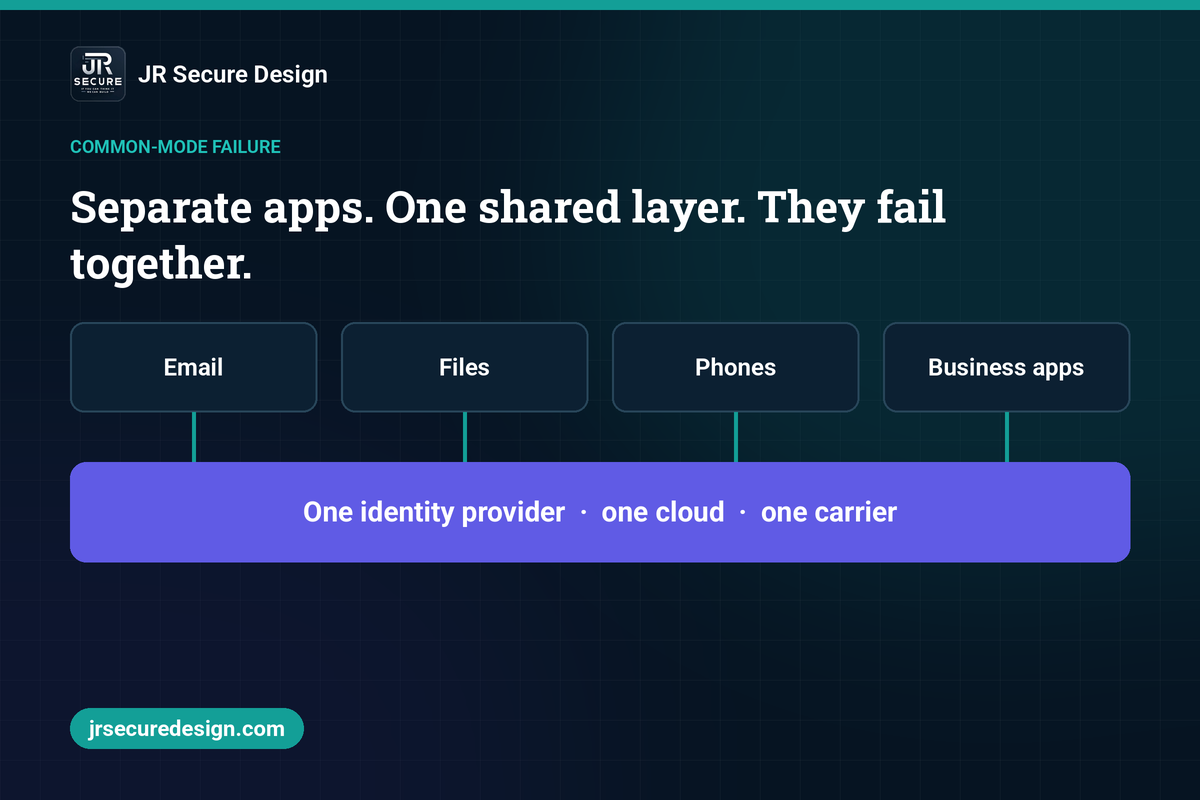
Safety engineers have planned around this for decades. Two backup pumps do not help if both run on the same power feed. In IT, the same idea applies. Two business apps do not give you redundancy if both sign in through one identity provider, both run in one cloud region, and both reach the internet over one carrier.
Why do independent systems fail together?
They fail together because the shared layer is invisible until it breaks. Your email, file storage, phone system, and line-of-business apps may come from different vendors. Underneath, they often depend on the same sign-in service, the same DNS, the same cloud provider, and the same network path.
Here is how that looks in an officially explained incident. On October 19–20, 2025, AWS had a service disruption in its Northern Virginia (us-east-1) Region. AWS’s own post-event summary says the trigger was “a latent race condition” in the automated DNS management system for DynamoDB, which left an empty DNS record for the service’s regional endpoint. Other AWS services that depended on DynamoDB were affected, including EC2 instance launches and its Security Token Service, which issues sign-in credentials. Later in the event, Network Load Balancer health-check failures led to instance terminations that left some Lambda internal systems under-scaled. AWS said it disabled the DNS automation worldwide while it fixed the issue, and is adding a “velocity control mechanism” to limit how much capacity a load balancer can remove on its own.
That was not an attack. It was automation built for resilience, with a rare timing bug, sitting under a large number of dependent services. One shared layer failed, and the effects cascaded through systems that were each working as designed.
A second example: on July 19, 2024, a CrowdStrike content configuration update for its Windows sensor caused Windows systems to crash. CrowdStrike’s preliminary post-incident report says a bug in its Content Validator let the problematic content through. Microsoft estimated that 8.5 million Windows devices were affected, under one percent of all Windows machines, and said the broad impact reflected how many enterprises running critical services used the same product. Again, not an attack. One shared component, many organizations.
For a practical checklist on what to do when a shared cloud layer fails, see Cloud Outage Business Continuity: Why Your Business Needs a Resilience Review.
Where do AI agents fit in?
AI agents add a new kind of authority to that picture. An agent that can read data, change settings, send messages, or move money is another automated actor sitting on top of your shared layers. The question is not only “can it be hacked?” It is “what happens when it is wrong, or when the systems it depends on are?”
OWASP’s guidance on excessive agency names three root causes: excessive functionality, excessive permissions, and excessive autonomy. Its fix for the last one is human-in-the-loop control, so a person signs off on high-impact actions before they happen.
In my view, the next big incident could start in any of these ordinary ways:
- an AI agent with excessive permissions acting on bad input;
- a shared identity provider failing across many organizations at once;
- an automated recovery process making things worse;
- an integration change that quietly creates a dependency nobody mapped;
- hypothetical — not a forecast, and not a description of any past event: a telecom or cloud failure that takes down the systems used to support utilities and other essential services.
None of those requires a bad actor. The last item is a hypothetical scenario, so teams can think it through. I am not predicting a utility outage. Each one gets worse when automation has more authority and fewer people understand the whole system.
Who owns the off switch?
Every automated system, including every AI agent, needs a named person who can stop it, and a way to stop it that still works when things are failing. If the only way to pause an agent is to log in to the same console, through the same identity provider, on the same cloud that is down, you do not have an off switch. You have a hope.
Write down three things for each agent or automation: who can stop it, how, and what still works if the main sign-in is down. Our AI agent permissions checklist covers how to scope an agent and test its kill switch.
People are part of resilience
Many teams are running leaner than they used to. That is my observation, not a statistic. When experienced engineers leave, the knowledge of how systems really connect, and how to bring them back by hand, often leaves with them. Documentation helps, but someone still has to have done a recovery before.
Operational knowledge and incident-response capacity are part of your resilience, the same way backups are. If the only people who understand a dependency are gone, that dependency is a risk whether or not anything is broken today.
5 steps to keep a way to recover
These steps are aligned to widely used guidance, including the NIST AI Risk Management Framework, OWASP’s excessive-agency guidance, and CISA’s ransomware and logging guidance.
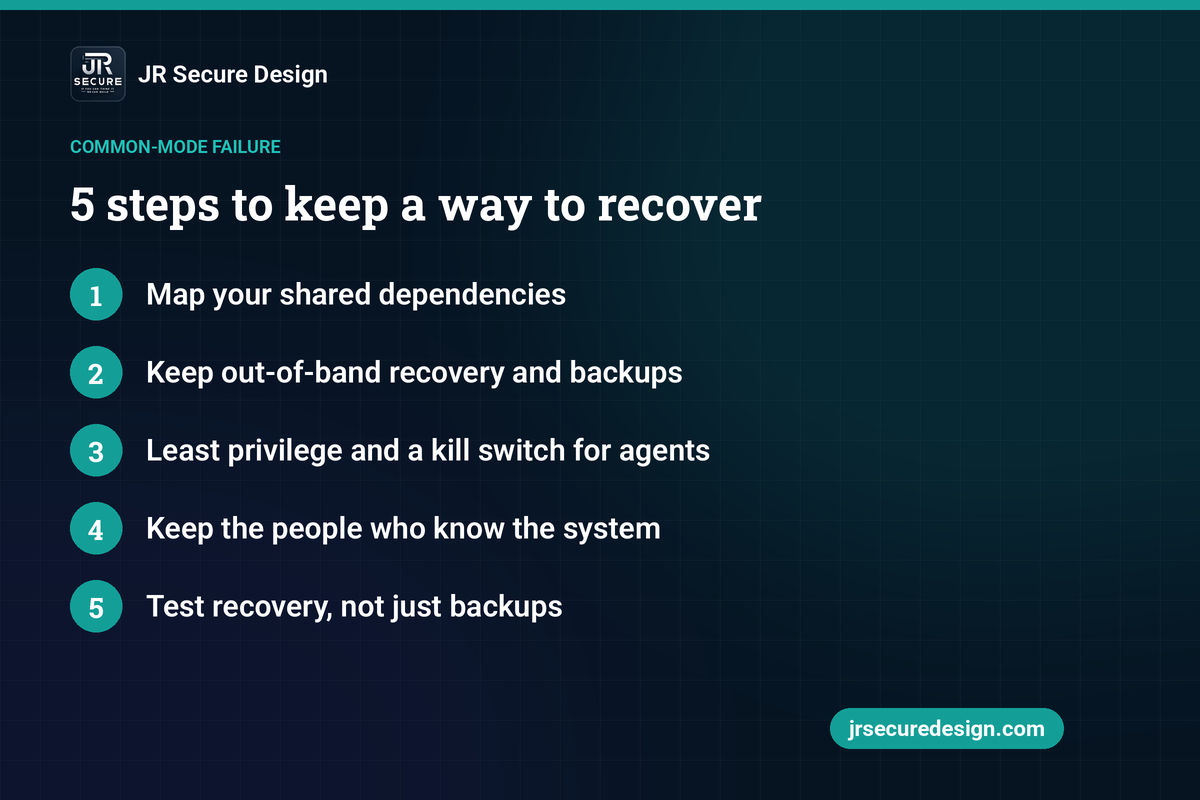
- Map your shared dependencies. For each critical system, write down its identity provider, cloud and region, DNS, and network carrier. Circle anything that appears under more than one “independent” system. That is your common-mode risk.
- Keep out-of-band recovery and backups. CISA’s #StopRansomware Guide says to “maintain offline, encrypted backups of critical data,” to test them regularly, and to keep a hard copy and offline version of your incident plan. Go one step further: make sure at least one recovery path does not use your everyday sign-in, cloud account, or network.
- Give agents least privilege and a kill switch. NIST defines least privilege as restricting access “to the minimum necessary to accomplish assigned tasks,” including processes acting on behalf of users. Apply that to every AI agent and automation. Put a person on high-impact actions, and keep the off switch reachable when the main console is not.
- Keep the people who know the system. Name an owner for each critical system and each agent. Pair newer staff with the people who have done a real recovery. Keep logs somewhere that does not fail with the system they describe; CISA’s event logging best practices treat logging as part of keeping critical systems running.
- Test recovery, not just backups. Start with one critical system and practice bringing it back with the main sign-in, cloud console, or network unavailable. Time it. Fix what breaks. Repeat on a schedule and after any major integration change.
None of this needs a big budget. It needs someone to ask where the shared layers are, and who can stop things when they go wrong. If you want a structured review of your AI tools, owners, and policies, our AI governance assessment is aligned to the NIST AI RMF.
Common-mode failure: frequently asked questions
What is a common-mode failure?
A common-mode failure is when separate systems fail together because they share one underlying cause. In IT, that shared cause is often an identity provider, a cloud region, DNS, or a network carrier. Having two systems does not give you redundancy if both depend on the same layer.
Can an AI agent cause an outage without being hacked?
Yes. An agent with more permissions than its job needs can act on bad input or a wrong assumption and change, delete, or send things at machine speed. OWASP calls this excessive agency. Limiting permissions and putting a person on high-impact actions reduces the damage.
Who should own the off switch for an AI agent?
A named person, not “IT” in general. That person should know how to stop the agent, have tested it, and have a way to do it that still works if the main sign-in or cloud console is down. Write the steps down and keep a copy offline.
What is out-of-band recovery?
Out-of-band recovery is a way to restore systems that does not rely on the same identity provider, cloud account, or network that failed. Examples include offline backups, a separate break-glass admin account, and printed contact and recovery steps.
How do we test recovery?
Choose one critical system and practice restoring it with your normal sign-in, cloud console, or network unavailable. Time it, record what broke, and fix it. Repeat on a schedule and after any major integration change, so the test matches how your systems connect today.
The question nobody wants to answer
More interconnection, more automated authority, and fewer people who know how it all fits together is the real risk. It does not need an attacker. It only needs one shared layer to fail while the systems we would use to respond sit on top of it.
So here is the question I’d ask every leadership team:
What happens when the systems responsible for detecting and recovering from a failure depend on the same interconnected infrastructure that’s failing?
Want a second look at your shared dependencies?
If you want help mapping shared layers and who can stop your automations, book a call.
JR Secure Design builds AI and security programs aligned to NIST AI RMF and ISO/IEC 42001. More at jrsecuredesign.com.