
In one mid-November week in 2026, Microsoft 365 email and collaboration tools failed for many organizations, the FAA issued a nationwide ground stop after a telecommunications problem, and JPMorgan Chase reported a software bug that slowed payments. An earlier, well-documented AWS outage is another official example of a major cloud disruption. Official statements did not blame a cyberattack for these incidents. For a small or growing business, that is the point: cloud outage business continuity is not only about stopping attackers. It is about being able to operate when a vendor you depend on is simply down.
Key takeaways
- Recent Microsoft, AWS, FAA, and bank disruptions were described by those organizations as technical, configuration, or software failures, not cyberattacks.
- A single vendor or region can stop email, payments, or a cloud app even when your own systems are fine.
- Cloud outage business continuity means knowing how you will communicate, serve customers, and recover if a provider fails.
- A short resilience and security review can map those dependencies and close obvious gaps before the next event.
What actually failed in these recent outages
The details matter, because the response to a vendor outage is not the same as the response to a breach. Here is what the official reports and reputable news accounts said, without treating every headline as a cyber incident.
Microsoft 365, November 12, 2026
Microsoft 365 services including Outlook, Exchange, and Teams were disrupted beginning Thursday, November 12, 2026. ABC News reported that the problem spanned two workdays. The Guardian reported that Microsoft said it had resolved the issue and restored service by Saturday, November 14, and that Microsoft did not attribute the blackout to a cybersecurity breach.
On Monday, November 16, Charles Lamanna, Microsoft’s executive vice president of Copilot, Agents, and Platform, said a latent defect introduced in July could cause networking gateway servers to become overwhelmed and unresponsive under certain load. A Teams-related failover increased load on the primary gateway, and more than 14% of server capacity was already unavailable because of an unrelated issue. Together, he said, those conditions triggered the latent bug during the peak U.S. traffic window. Recovery took longer than usual because returning servers were immediately overwhelmed again, and normal rollback tools could not quickly undo a months-old defect.
Amazon Web Services, October 19–20, 2025
AWS published a post-event summary of a disruption in the Northern Virginia (us-east-1) Region on October 19 and 20, 2025. The event began at 11:48 p.m. PDT on October 19 and ended at 2:20 p.m. PDT on October 20, with three distinct periods of impact. AWS said a latent race condition in DynamoDB’s DNS management system produced an incorrect empty DNS record for dynamodb.us-east-1.amazonaws.com, and the automation failed to repair it. During the first window, customers and other AWS services that depend on DynamoDB could not establish new connections. The incident later contributed to Network Load Balancer connection errors and failed or impaired new EC2 instance launches.
FAA nationwide ground stop, November 13, 2026
The FAA’s official Q&A, posted November 15, 2026, says that on November 13 at approximately 3:30 p.m. ET, a technical problem led the agency to issue a nationwide ground stop out of an abundance of caution. Instability began at 17 of 22 Air Route Traffic Control Centers. The FAA said legacy equipment became unstable when data flooded the FAA FTI network at a rate of 1,000 connection attempts every 4 to 5 seconds, disrupting aircraft communications and radar feeds. The initial investigation pointed to a radar site in Amarillo, Texas, and a radio communications site in El Dorado, Arkansas, where the network provider had been deploying a new router. After those locations were blocked, the network stabilized, and air traffic resumed at 8:15 p.m. ET the same day.
On whether it was a cyberattack, the FAA wrote: “Based on all available evidence, we have no indication that this was a cyberattack or an outside nefarious actor.” The agency said approximately 3,500 aircraft landed safely, and that operators canceled approximately 12,462 flights that day, including 9,082 by major airlines, noting that not all cancellations were directly caused by the ground stop.
JPMorgan Chase and bank payments, November 16, 2026
On Monday, November 16, 2026, JPMorgan Chase told CNBC the firm was “experiencing a temporary issue related to a software bug in on-premise hardware systems.” A spokesperson said, “There is no evidence it is cyber-related,” and described it as “not a systemic issue — other banks may have been impacted by slowness in transactions only to the extent that they were a party to a transaction with us.” CNBC reported that customers still had access to their accounts and funds. This post does not treat reports about other banks as independent outages unless the institution itself confirmed a failure on its own systems.
Outages are not the same as cyberattacks
It is reasonable to review security after a major disruption. It is not accurate to call every outage an attack. In these cases, Microsoft did not attribute its November outage to a breach, the FAA said it had no indication of a cyberattack, and Chase said there was no evidence the issue was cyber-related. AWS described a software defect in its official report.
A resilience review should still include cybersecurity, because attackers do target the same email, identity, and payment systems you use every day. The review should also include availability: backups you can restore, a way to reach customers if Microsoft 365 is down, and a plan if your cloud region or your bank is slow. Those are related disciplines, not the same event.
What this means for small and growing businesses
Large providers fail, even when no one is attacking them. If your company runs email, files, identity, or a product on one of those platforms, their outage becomes your outage. That is the core of cloud outage business continuity.
- Email and collaboration. If Outlook or Teams is down, how do you reach staff, clients, and vendors?
- Cloud applications. If a major region such as us-east-1, or a control-plane service, fails, which of your tools stop? Do you have a manual fallback?
- Payments. A software bug at one large bank can delay transactions that touch your customers or vendors, even if your own bank is fine.
- Travel and logistics. An FAA ground stop can cancel flights you need for a meeting, a delivery, or a conference, with thousands of cancellations in a single afternoon.
- Concentration risk. Many small businesses rely on a short list of vendors. A review makes that list visible before it fails in production.
JR Secure Design has 25+ years of experience helping organizations think through security and technology risk. A short, practical review is often enough to find the gaps that only show up when a vendor is down.
A practical cloud outage business continuity review checklist
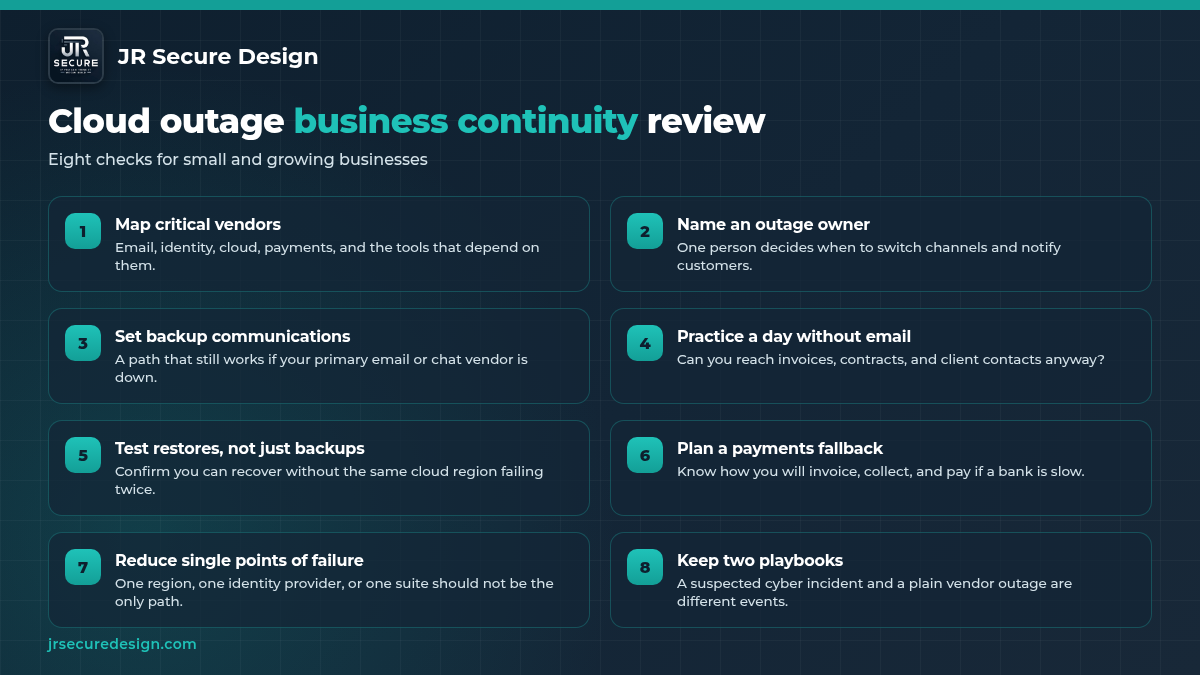
Use this as a working list, not a certification or a compliance claim.
- Map critical vendors. List email, identity, cloud hosting, payments, phone, and any AI tools. Note which ones depend on which others.
- Name an outage owner. One person should decide when to switch to backup communications and when to tell customers.
- Set backup communications. Keep a phone tree, a secondary email domain, or a messaging channel that does not rely on the same vendor as your primary email.
- Practice a day without email. Can you reach invoices, contracts, and client contacts if Outlook or your email suite is unavailable?
- Test restores, not just backups. Confirm you can recover files without waiting on the same cloud region that just failed.
- Plan a payments fallback. Know how you will invoice, collect, and pay vendors if a processor or a large bank is slow.
- Reduce single points of failure. Ask whether production and backups live in one region, one identity provider, or one collaboration suite.
- Keep two playbooks. One for a suspected cyber incident, and one for a plain vendor outage. They are not the same event, and mixing them wastes time.
If you use AI tools, include them in the same map. An AI governance assessment and an AI security assessment look at who can access models and data. A resilience review adds a further question: what happens when the provider is simply unavailable? Some teams also keep sensitive work on private AI infrastructure so a public-cloud outage does not stop every workflow. Insurers may also ask how you would operate during an outage; see our related guide on cyber insurance AI questions.
Why a review is needed now
These events arrived close together, and they affected tools many businesses treat as always on. Waiting until the next incident to invent a process is how a one-day vendor problem becomes a week of confusion.
A resilience and security review can be short. The goal is to walk through the checklist with someone who has seen these failure modes, write down the gaps, and assign owners. We can also look at related questions, such as how AI tools are governed and whether a fractional AI officer or a broader look at our services is a better fit than a one-time pass. To book that review, use the calendar below or email sales@jrsdi.com.
NEXT STEP: Want a resilience and security review of your vendor dependencies, backups, and outage playbooks? Book a free 30-min call, or start with our AI governance assessment if AI tools are part of the same stack.
Cloud outage business continuity: frequently asked questions
Were these recent outages cyberattacks?
Not according to the official statements we reviewed. Microsoft did not attribute its November 2026 outage to a cybersecurity breach. The FAA said it had no indication that the November 13 ground stop was a cyberattack. JPMorgan Chase said there was no evidence its November 16 issue was cyber-related. AWS described a software defect in its official report. A security review is still worthwhile, but an outage should not be labeled an attack unless a credible source says so.
What is cloud outage business continuity?
Cloud outage business continuity is the plan for how your company will communicate, serve customers, and recover when a cloud provider, email suite, payment system, or other critical vendor is unavailable. It covers backups you can actually restore, backup communications, payment fallbacks, and named decision-makers — not only cybersecurity controls.
How often should a small business do an IT resilience review?
At least when you add a major vendor, move a workload to the cloud, or change how you take payments — and after a widely reported outage in a platform you use. Many small teams also set a yearly review so the vendor map and playbooks stay current. The point is to assign owners and test a few steps, not to produce a long document that no one opens.
Does a backup in the same cloud region count?
It counts as a backup, but it may not help if that region or a shared control plane is the thing that failed. The AWS us-east-1 event is a reminder to ask where backups live and whether you can restore them another way. Test a restore, rather than assuming a copy exists.
What should we tell customers during a vendor outage?
Tell them what you know, what still works, and how to reach you on a backup channel. Do not speculate that the event is a cyberattack unless you have a reliable basis to say so. Have a short notice ready in advance, including a phone number or secondary email that does not depend on the same vendor that just went down.
Need a resilience and security review?
We’ll walk through your vendor dependencies, backups, and outage playbooks and leave you with practical next steps. Book a free 30-min call, or email sales@jrsdi.com.
JR Secure Design builds AI and security programs aligned to NIST AI RMF and ISO/IEC 42001. More at jrsecuredesign.com.