
People have been searching for a cyber attack today, and I understand why. This week brought big outages and real security news at the same time. The Apple, NSA, and Microsoft disruptions were reported as bugs or maintenance, not attacks. I still think automated attacks are already here. That is my view, based on the FBI’s warning about Artex AI and the Optimizely incident that reached 178 organizations through a third-party website script.
Key takeaways
- A cyber attack today is not the same thing as a service outage. This week’s Apple, NSA, and Microsoft issues were reported as bugs or maintenance, not attacks.
- I think automated attacks are already here. That is my view, not a claim that every outage was an attack.
- In FLASH-20261113-001 (Nov. 13, 2026), the FBI describes ARTEX, searched as Artex AI, as an open-source tool used to automate intrusions, with some going from targeting to privileged access in under three hours.
- On November 16, 2026, an Optimizely incident reached 178 organizations, including CNN, BBC, Zoom, and Salesforce, through third-party website scripts.
- This week, prepare with tested offline or immutable backups, a script and vendor inventory, an AI-agent kill switch, a deepfake callback rule, and an incident contact list.
I’ve been saying for years that most systems are pretty insecure, and that companies need better redundancy, security, and backup. You do not have to wait for a bigger vendor to fix that. Our pages on AI governance and cyber insurance AI questions go deeper. This post is about what is real this week, and what to do now.
What is a cyber attack?
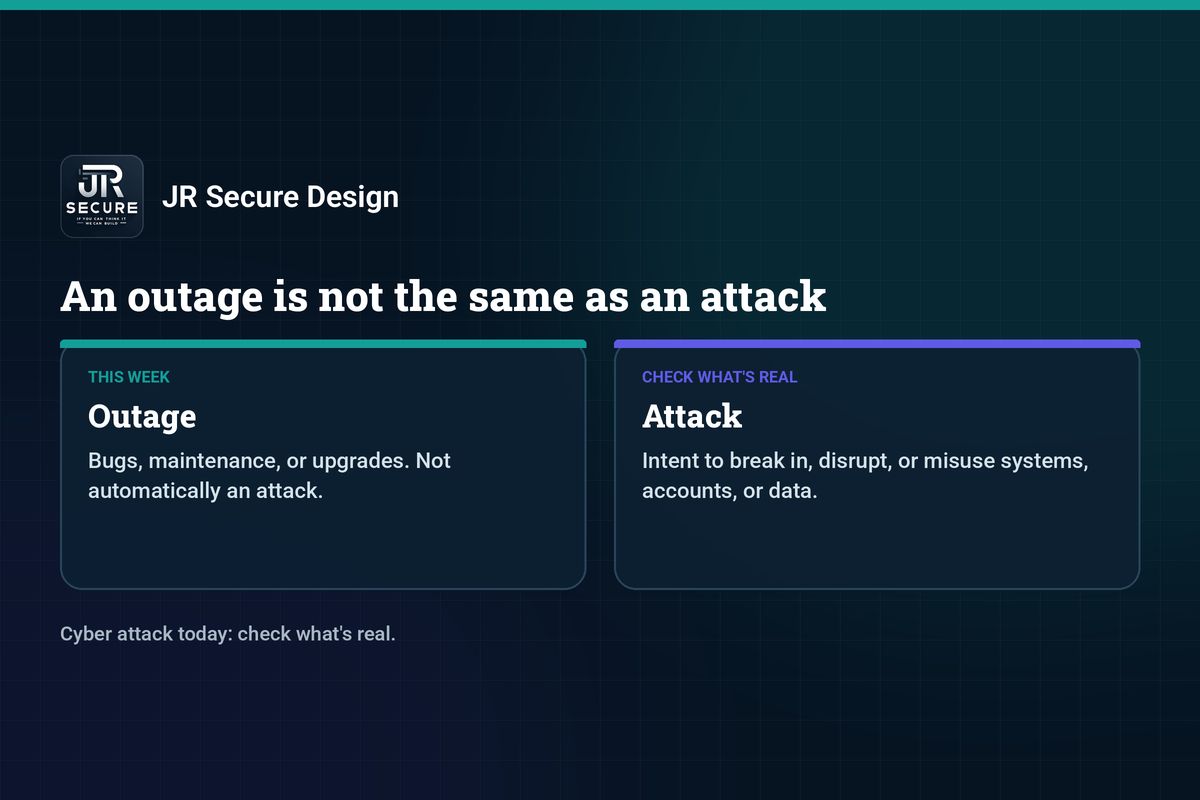
A cyber attack is someone trying to break into, disrupt, or misuse your systems, accounts, or data without permission. It can be a person at a keyboard, or a tool that automates the work. It is not the same as an outage caused by a bug or scheduled maintenance. Intent to misuse a system is what makes it an attack.
That distinction matters because “cyber attack today” and “are we under a cyber attack” are the phrases people are typing. An email outage or a slow website can feel like an attack. Sometimes it is. Sometimes it is a failed update. Start by knowing which one you are looking at.
Are we under a cyber attack today?
Not every outage or headline is a cyber attack today. This week’s Apple, NSA, and Microsoft disruptions were reported as bugs or maintenance, not attacks. There were also real incidents: the FBI warning about Artex AI, and malicious code in Optimizely files used by 178 organizations. Ask what is real, then decide what to do.
If your own email, banking, or website is acting strangely, check the vendor’s status page, check your logs, and use the incident list below. If your systems are fine, you can still use this week to tighten the basics.
What is Artex AI?
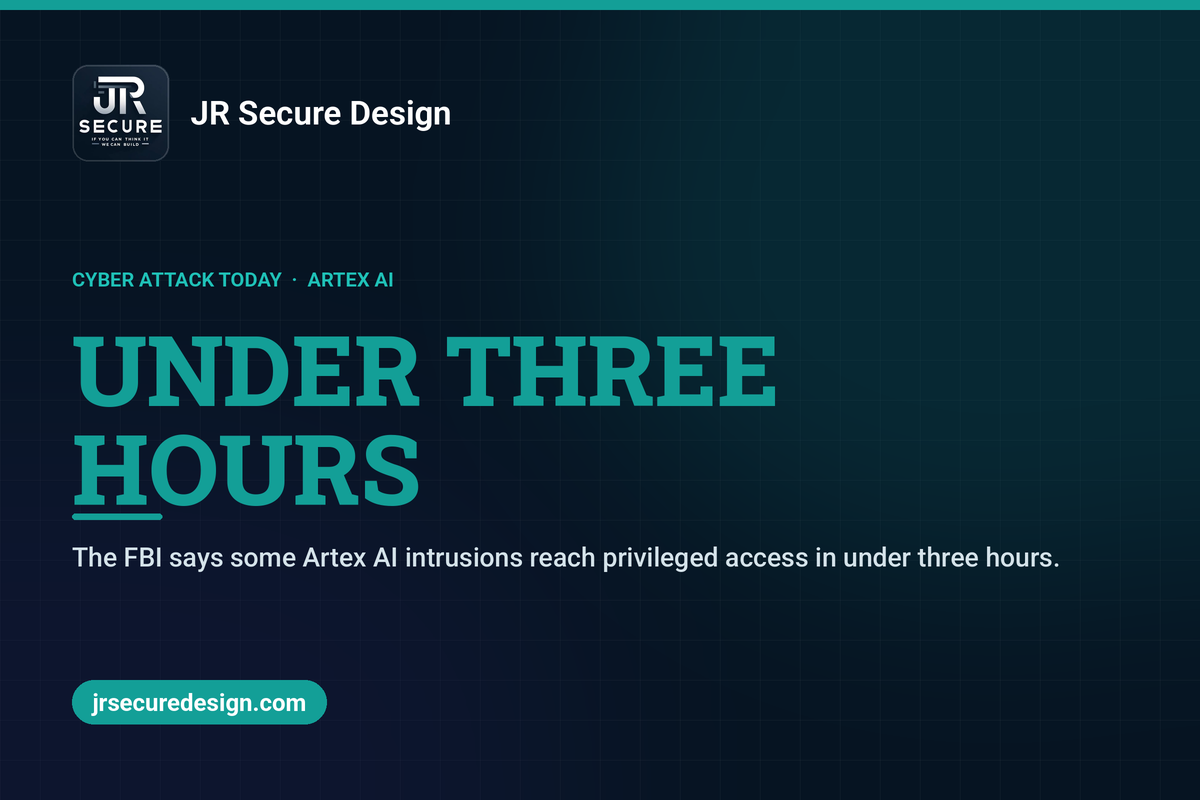
Artex AI is the name people are searching for ARTEX, an open-source AI hacking tool. In the FBI’s FLASH-20261113-001, dated November 13, 2026, some intrusions have gone from initial targeting to privileged access in under three hours. That is why I think this is already here.
The FBI writes that ARTEX is “an open-source, large language model (LLM)-driven agentic platform that threat actors have weaponized to automate multiple phases of cyber intrusions at machine speed, from reconnaissance through data exfiltration.” It has been used since at least August 2026 in financial services, government, technology, defense, healthcare, and other sectors. The FLASH also cites attacks against South Korean financial institutions involving personal information from approximately 67,000 people, and a cloud-backup vendor compromise with attempted sign-ins to more than 2,250 downstream customer tenants.
This is not Skynet, and it is not a sentient machine. It is a bad actor using an AI tool to hack more efficiently, often against systems that were already insecure. When a tool can move from targeting to privileged access in under three hours, waiting for a future “era” is the wrong frame. In my view, that era has arrived.
What happened in the Optimizely incident?
On November 16, 2026, researchers found malicious code in Optimizely files used by 178 organizations, including CNN, BBC, Zoom, and Salesforce. Optimizely is a third-party tool many sites use to test website designs. The companies’ own servers were not necessarily broken into. A trusted script became the path to visitors’ browsers.
Scott Helme and the team at Report URI checked 1,611 snippets and found the code in 188 of them, belonging to those 178 organizations. They expect the real number is higher. Malwarebytes and BleepingComputer confirmed the same incident. Optimizely said it fixed the vulnerability and removed the injected code. Report URI said the files it was monitoring were clean by late November 16.
This is a separate story from the FBI’s Artex AI warning, in the same news cycle. Together they support the point I have been making for years: our systems, and the vendors we plug into them, were already insecure.
Is 256-bit encryption still enough?
I do not believe 256-bit encryption is enough on its own, given the processing power people can get. That is my opinion, not a claim that AES-256 is broken. Official guidance still rates AES-256 as a strong cipher. In the incidents here, stolen keys, logins, unpatched systems, and third-party scripts are the usual way in.
NIST uses AES-256 as the reference for its highest post-quantum security category. The more urgent quantum issue is the public-key methods often used to exchange those keys, which is why “harvest now, decrypt later” planning matters for long-lived data. NIST’s October 2026 transition report covers that shift. My concern is a reason to start planning, not a reason to ignore the gaps being used this week.
What should a small business do about a cyber attack today?
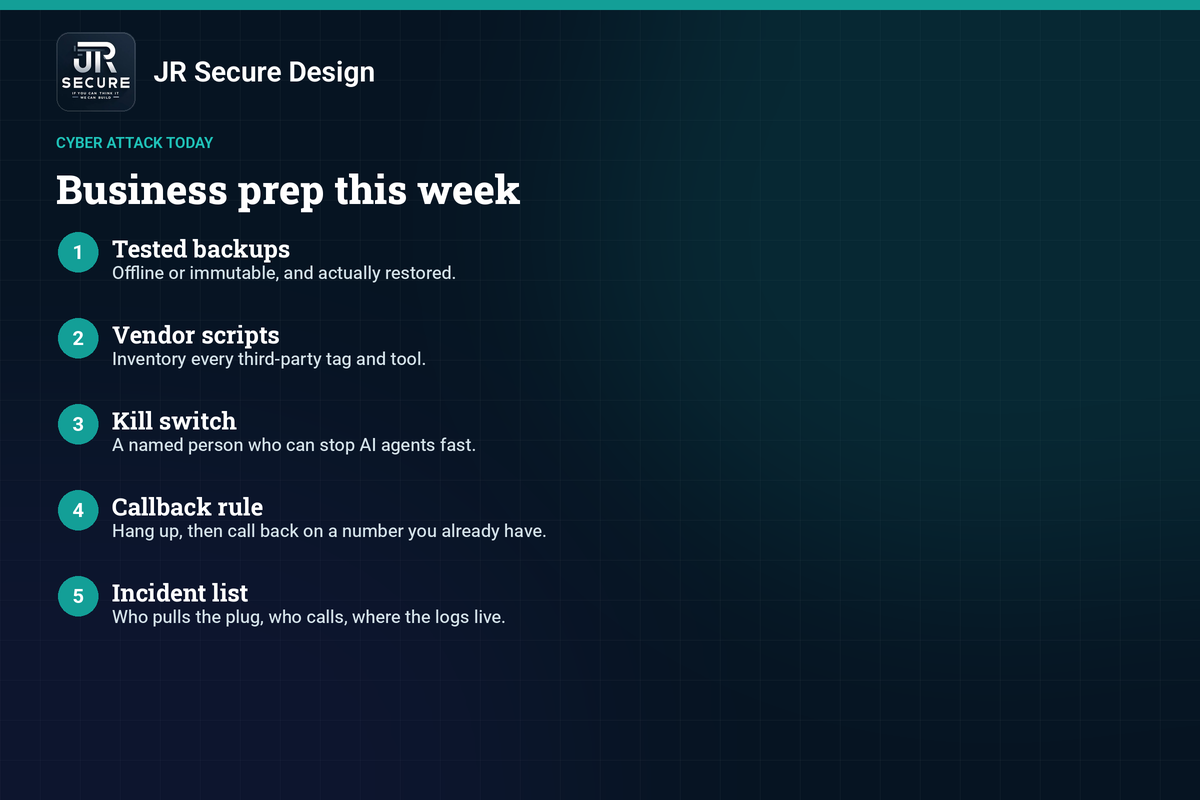
Start with five business preparations that still help, whether the next problem is a tool like Artex AI or a third-party script like the one in the Optimizely incident: tested offline or immutable backups, a script and vendor inventory, an AI-agent kill switch, a deepfake callback rule, and a short incident contact list.
Business prep this week
- Tested offline or immutable backups. A backup only counts if you have restored it. Keep a copy that cannot be quietly changed or deleted, and test a restore of one important system this week.
- A third-party script and vendor inventory. List every tag, chatbot, test tool, analytics script, and pixel on your website, plus vendors who can reach your data. Remove what you do not need, and write down who owns what remains.
- An AI-agent kill switch. Name the person who can stop agents or automations quickly, and make sure sending, paying, deleting, and changing access cannot run alone. See our AI agent permissions checklist and AI governance assessment.
- A deepfake callback rule. If a call, video, or message asks for money, a password, or a payment change, hang up. Call the person back on a number you already have, not one from the message.
- An incident contact list. One page is enough: who pulls the plug, who calls your insurer, who talks to customers, and where the logs live. If insurance paperwork is coming, start with cyber insurance AI questions.
Also apply patches quickly, turn on MFA for email, banking, cloud admin, and any AI console, and rotate cloud or AI keys that have no owner.
At home: everyday readiness
The same habits help at home, in a shorter form. Keep an offline copy of the files you cannot afford to lose, such as IDs, insurance, and tax records, and a simple list of key phone numbers that does not depend on one app. Use the same callback rule if a “family member” or “boss” asks for money on a call or video. This week’s Apple, NSA, and Microsoft issues were reported as bugs or maintenance, not a cyber attack, but a plan for when a service is down is still useful.
Cyber attack today: frequently asked questions
Are we under a cyber attack today?
Not automatically. This week’s Apple, NSA, and Microsoft disruptions were reported as bugs or maintenance, not attacks. There were also real incidents, including the FBI’s warning about Artex AI and the Optimizely script incident that reached 178 organizations. If your systems look wrong, check vendor status and your logs. If they look fine, use the week to tighten backups, scripts, and contacts.
What is a cyber attack?
A cyber attack is an attempt to break into, disrupt, or misuse systems, accounts, or data without permission. It can be manual or automated with tools such as Artex AI. A service outage caused by a bug or scheduled maintenance is not, by itself, a cyber attack. Status pages and your own logs matter before you assume the worst.
Was this week’s Apple, NSA, or Microsoft outage a cyber attack?
Not according to the public explanations those organizations gave. They described bugs, maintenance, or upgrades, not a proven attack. High search interest in “cyber attack today” shows that people were worried, and that is understandable. Worry is not the same as confirmation. Treat those outages as outages unless a later, sourced report says otherwise.
What is Artex AI?
Artex AI is how many people are searching for ARTEX, the open-source AI tool in the FBI’s November 13, 2026 FLASH. The FBI says attackers have used it since at least August 2026 to automate intrusion stages, and that some intrusions have gone from initial targeting to privileged access in under three hours. That warning is the main reason I say this is already here.
How do I know if Optimizely or another script is on my website?
Inventory every third-party script and tag on your site, including test tools, chat, analytics, and pixels. If you use Optimizely or used it recently, confirm with your web person or vendor that the snippet is current and that you still need it. Report URI lists the 178 organizations it found on November 16; not every site that uses a vendor was in that set.
Want an AI attack readiness check?
We’ll walk through backups, vendor scripts, an AI-agent kill switch, and a simple incident list. Ask Sophia, our free AI advisor, at jrsecuredesign.com/sophia/, or talk with James.
Email sales@jrsdi.com.
JR Secure Design builds AI and security programs aligned to NIST AI RMF and ISO/IEC 42001. More at jrsecuredesign.com.