
A startup pitch deck review checks whether an investor can understand your company fast. A good reviewer tests your one-sentence purpose, whether the problem and customer are specific, whether every number matches across slides, and whether the ask is clear. Run those checks yourself first, so a reviewer’s time goes to the hard questions instead.
Key takeaways
- Sequoia’s pitch guide says to start by defining your company “in a single declarative sentence.” Reviewers test that first.
- DocSend’s 2026 pre-seed guide reports investors spend an average of 4 minutes and 10 seconds on a pre-seed deck.
- Mismatched numbers are the fastest way to lose trust. Keep one source sheet for every figure.
- One honest line on how you protect customer data answers a question investors now ask.
- Fix the basics yourself, then spend a reviewer’s time on your weakest slide.
What does a pitch deck review check?
A pitch deck review checks clarity, consistency and the ask. Can a stranger say what you do after the first slide? Is the problem tied to a real customer? Do market, traction and financial numbers agree everywhere? Is it clear how much you’re raising and what it buys? Reviewers look for the gaps an investor would find.
Here’s the order most reviewers read in, and the question each slide has to answer. For what belongs on each slide, see our guide to the pitch deck slides investors expect.
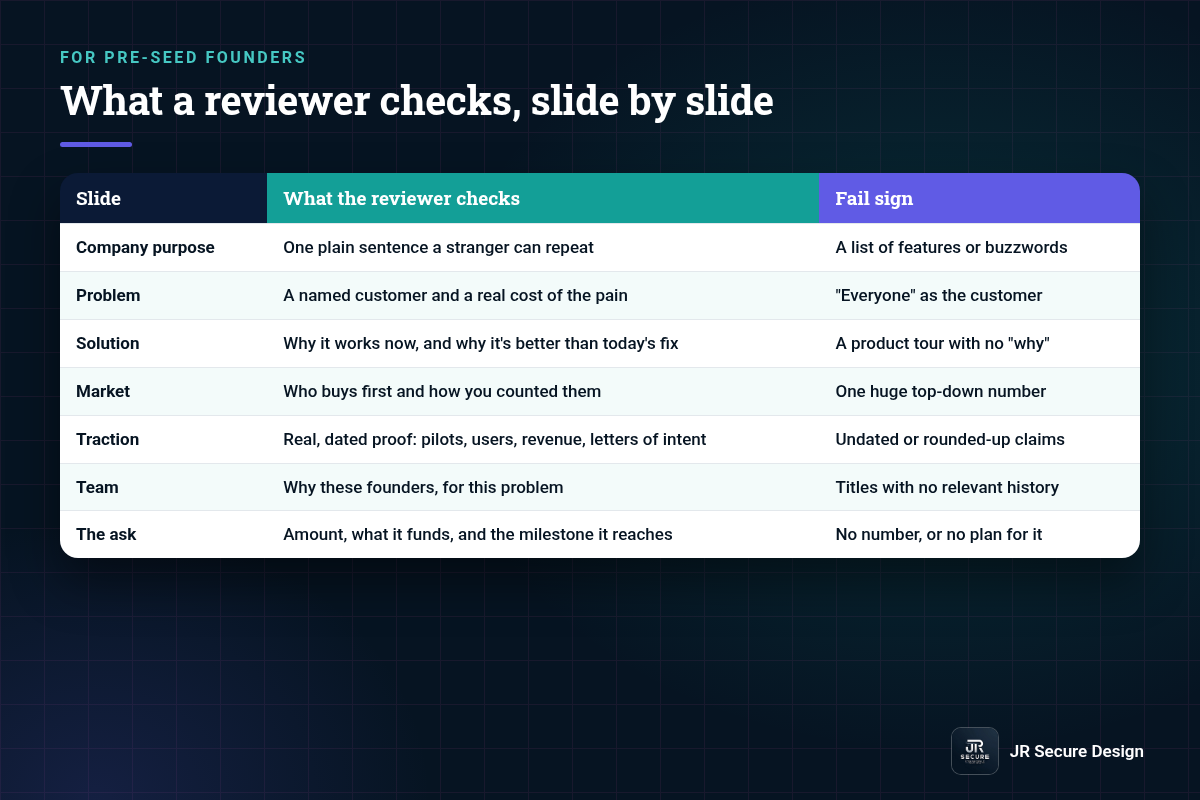
| Slide | What the reviewer checks | Fail sign |
|---|---|---|
| Company purpose | One plain sentence a stranger can repeat | A list of features or buzzwords |
| Problem | A named customer and a real cost of the pain | “Everyone” as the customer |
| Solution | Why it works now, and why it’s better than today’s fix | A product tour with no “why” |
| Market | Who buys first and how you counted them | One huge top-down number |
| Traction | Real, dated proof: pilots, users, revenue, letters of intent | Undated or rounded-up claims |
| Team | Why these founders, for this problem | Titles with no relevant history |
| The ask | Amount, what it funds, and the milestone it reaches | No number, or no plan for it |
How long will an investor spend on my deck?
Not long. DocSend’s pre-seed guide, updated February 24, 2026, reports investors spend an average of 4 minutes and 10 seconds on a pre-seed deck, and about 33 seconds on the company purpose section. So a reviewer reads your opener first and fast. If that slide doesn’t land, the rest gets less attention.
A simple test: send the PDF to someone outside your industry, give them four minutes, then close it and ask what you do. If they can’t say it in one sentence, start your fixes there. Our post on how to get pitch deck feedback covers who to ask and what to ask them.
How do I make my numbers consistent across slides?
Keep every number in one source sheet and copy from it, never from memory. Before you send, list each figure in the deck, such as market size, users, revenue, burn and the raise amount, and check it against the sheet and the other slides. Use one date for “as of” figures and say when each was measured.
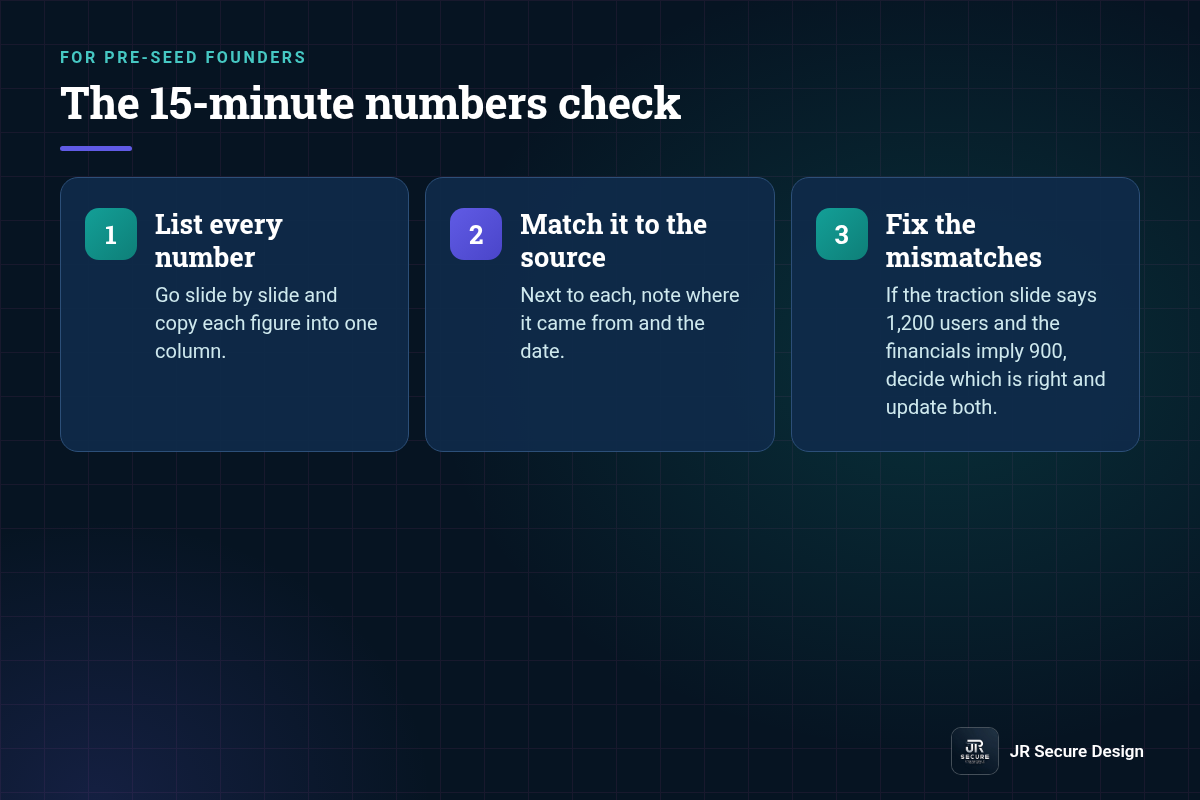
The 15-minute numbers check
- List every number. Go slide by slide and copy each figure into one column.
- Match it to the source. Next to each, note where it came from and the date.
- Fix the mismatches. If the traction slide says 1,200 users and the financials imply 900, decide which is right and update both.
Reviewers catch these because investors do. A market number that changes between slides, or a raise amount that doesn’t match the use-of-funds chart, makes the reader doubt the rest. Our list of common pitch deck mistakes has more of the errors we see most.
Should my pitch deck mention security?
Yes, briefly, if you handle customer data. One line or a short appendix slide is enough: what data you collect, where it’s stored, who can reach it, and the basic controls you have, like multi-factor login and access reviews. Keep it honest. Don’t claim a standard or audit you haven’t completed, and save detail for diligence.
This matters more for AI startups. If your product sends customer data to an AI model, an investor may ask where that data goes and whether it’s used for training. A clear answer on one slide beats a scramble in a follow-up call. Our pre-seed security checklist covers what to have in place before that question comes.
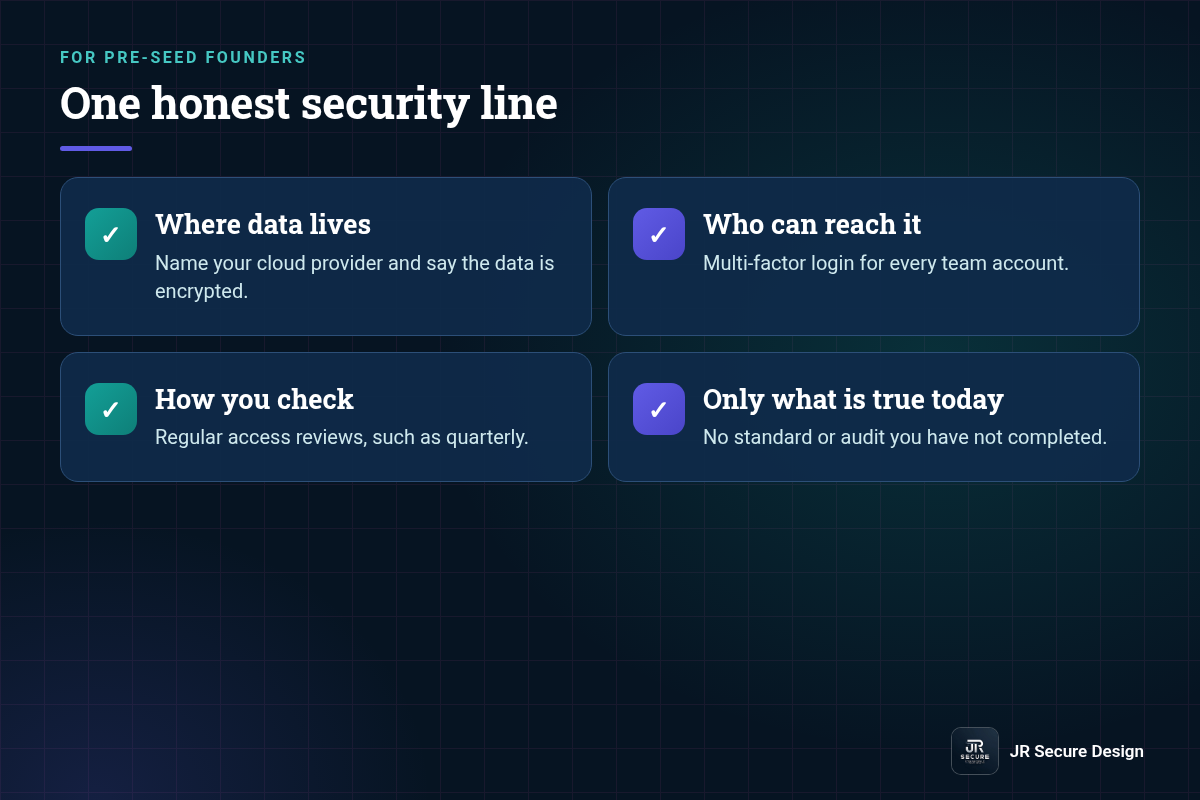
QUICK CHECK: Sample security line for a deck: “Customer data is stored in [your cloud provider], encrypted, with multi-factor login for every team account and quarterly access reviews.” Only write what’s true today.
NEXT STEP: Want a pitch deck score before a human review? Upload your deck to our AI pitch deck analyzer. Then see everything we offer founders on our startups page, including fractional CTO support.
Startup pitch deck review: frequently asked questions
What should I fix before I ask for a pitch deck review?
Fix what you can check alone: a one-sentence company purpose, numbers that match across slides, a dated traction slide and a clear ask with an amount and a milestone. Export to PDF and check it on a phone. Then a reviewer can spend their time on strategy, story and the slide you’re least sure about.
How many slides should a startup pitch deck have?
There’s no single rule. Sequoia’s pitch guide lists ten sections, from company purpose to vision, and many founders build one slide for each. What matters more is that each slide answers one question. If a slide needs a long voiceover to make sense, split it or cut it.
Is a free pitch deck review worth it?
It can be, if the reviewer has read real investor decks and gives specific notes. Ask what they’d change first and why. Sophia’s free pitch deck review is coming soon. Until then, you can ask Sophia, our free AI advisor, deck questions any time, or book a call with James.
Is it safe to upload my pitch deck for a review?
Treat your deck as confidential. Before you upload it anywhere, check who can see it, whether it’s stored and whether it’s used to train AI models. Remove customer names, private financials you don’t need and anything under NDA. Send a PDF, not an editable file, and share with a link you can turn off.
What do investors look for first in a pitch deck?
At pre-seed, investors look first for a clear problem, a team that fits it and early proof that customers care. The opener has to say what you do in one line, and the traction slide has to show real, dated evidence. Our guide to what investors look for at pre-seed covers each one.
Got a deck ready? Our free online pitch deck competition is open. Top prize: a $10,000 investment, subject to due diligence. Decks due Tue Dec 1, 11:59 PM ET. Online pitch night: Wed Dec 9, 7 PM ET. Submit your deck
Want a second set of eyes on your deck?
Ask Sophia, our free AI advisor, and use our pitch deck final checklist before you send. Prefer a person?
JR Secure Design helps founders build and secure their technology. Our AI work is aligned to NIST AI RMF and ISO/IEC 42001. More at jrsecuredesign.com.