
Two days out: edit, don’t rebuild.
- 6 final checks
- What not to do
- Decks due Sunday, Oct 25
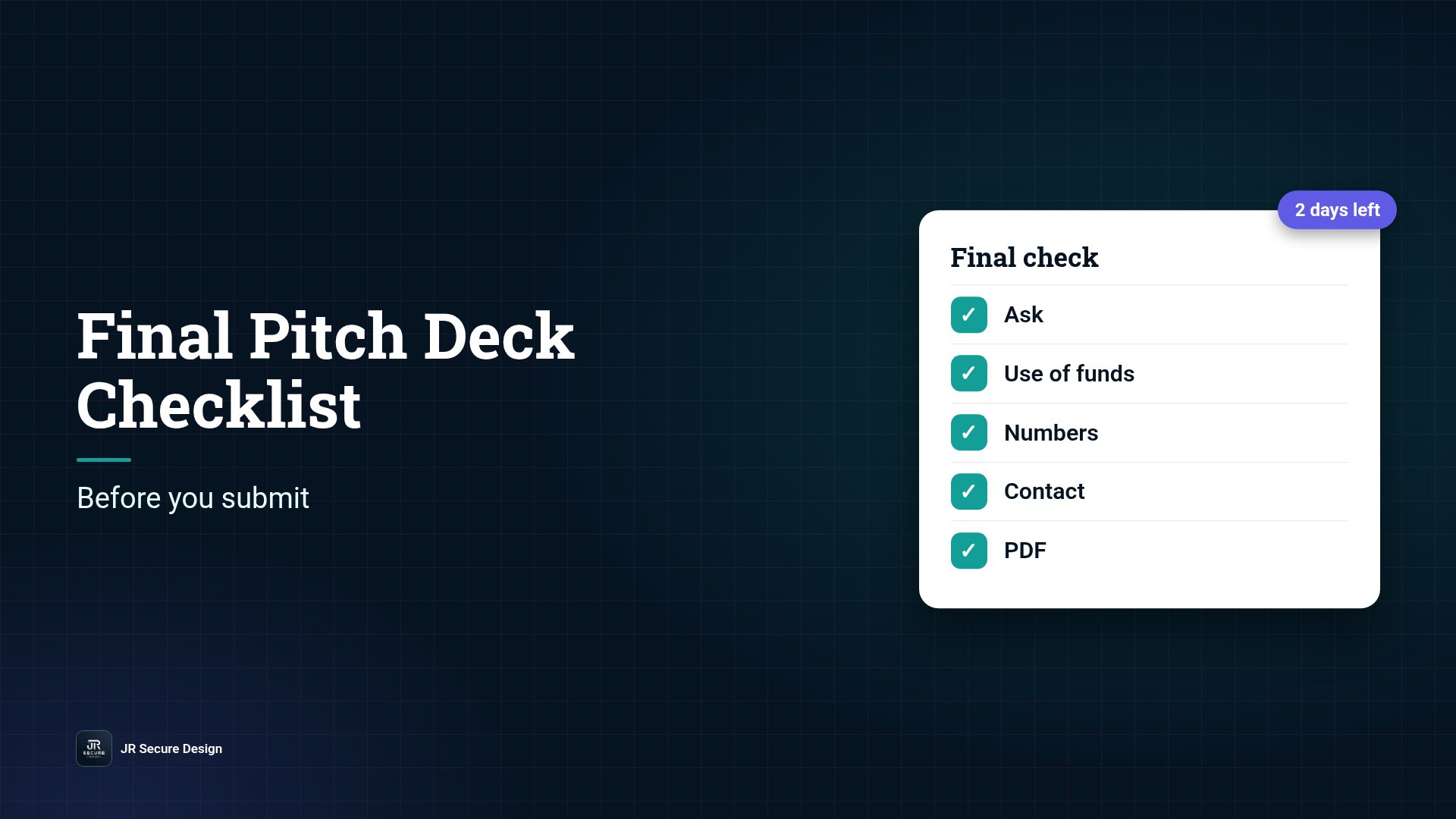
With two days to go, stop adding slides and start checking them. In the last 48 hours, focus on five things: a clear ask with a specific amount, a use-of-funds slide tied to milestones, numbers you can back up, a contact slide with your details, and a clean PDF. Fix those and your deck is ready to submit.
Key takeaways
- Two days out, edit. Don’t rebuild.
- State your ask as a specific amount, and say what it gets you to.
- Show where the money goes and which milestones it buys.
- Check every number and know where it came from.
- Put your name, email, phone and website on the last slide.
- Decks are due Sunday, Oct 25, 11:59 PM ET. Upload your PDF at jrsecuredesign.com/startups.
The last two days before a deadline are when founders do their best and worst editing. The best: tightening the story and fixing the slides investors read first. The worst: rewriting everything at midnight and introducing new mistakes. Public guides such as Y Combinator’s How to build your seed round pitch deck make the same point: clarity beats volume. Here’s a focused checklist to work through, based on 25+ years of building technology products and reviewing plans with founders.
Two days left. Is your deck ready?
Run the checks below, then upload your PDF.
Then book a 30-minute call. Or email sales@jrsdi.com.
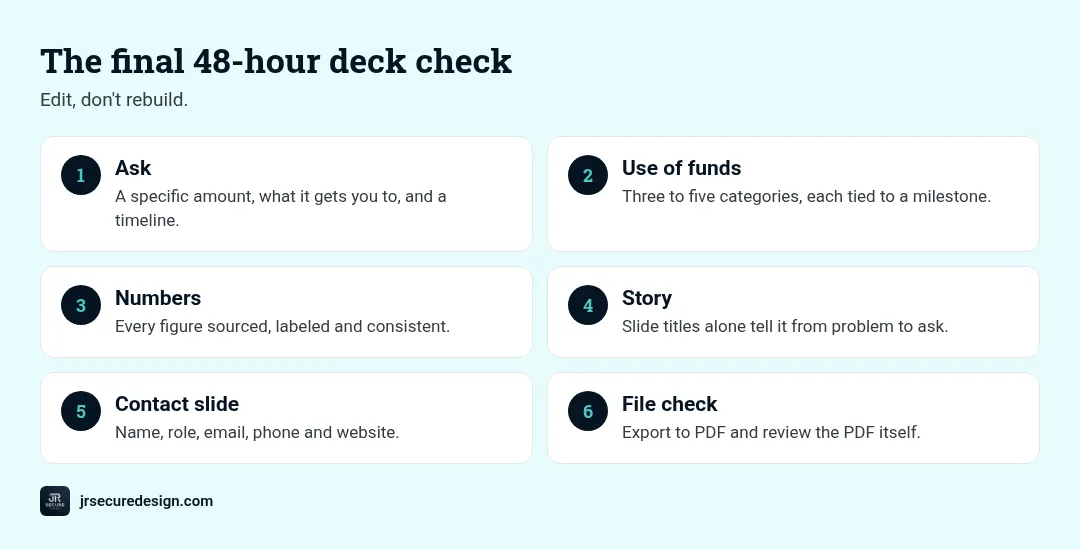
1. Is your ask clear and specific?
Your ask slide should answer one question in a few seconds: what do you want, and what will it do? Vague asks (“raising a seed round”) make readers guess. Be direct:
- State the amount you’re raising, or the specific help you need.
- Say what it gets you to, such as launch, a first set of paying customers, or your next round.
- Give a timeline, such as the number of months the money covers.
QUICK CHECK: Read your ask slide out loud. If it takes more than one breath, cut it down.
2. Does your use of funds tie to milestones?
A use-of-funds slide shows that you’ve thought about how the money turns into progress. Group spending into a few plain categories, such as product, hiring, go-to-market and operations, and connect each one to a milestone.
- Use three to five categories. More than that becomes hard to read.
- Show rough shares, such as a simple bar or pie, so the reader sees where most of it goes.
- Link each category to an outcome. “Hire two engineers to ship the first release” says more than “Engineering.”
If you can’t explain why a category is there, it probably shouldn’t be.
3. Can you back up every number?
Two days out is the right time to do a number check. Go slide by slide and ask where each figure came from.
- Market size: is it built from real customers times what each one would pay, with your math shown?
- Traction: is every metric labeled clearly and dated? Are sign-ups labeled as sign-ups, not customers?
- Financials: do the totals on your ask, use of funds and projections match each other?
WARNING: One number that doesn’t add up makes readers doubt the rest of the deck. If you can’t source a figure, cut it or label it as an estimate.
Our guide to common pitch deck mistakes covers more ways numbers go wrong, and our traction slide guide shows how to present early metrics honestly.
Numbers check done?
Upload your deck when the checklist is complete.
Then book a 30-minute call. Or email sales@jrsdi.com.
4. Does the story still flow?
Flip through the deck quickly, reading only the slide titles. Together they should tell the story from problem to ask. A simple order that works for many early decks:
- Problem
- Solution
- Why now
- Market
- Product
- Business model
- Traction
- Competition
- Go-to-market
- Team
- Financials and the ask
- Contact
If a title doesn’t move the story forward, rewrite it as a plain statement, like “Clinics lose hours each week on manual scheduling,” instead of a label like “Problem.” Our post on the slides investors expect explains what each slide should do.
5. Is your contact slide complete?
This one gets missed more than you’d think. The upload form on our Startups page asks only for the file, so your contact details must be in the deck itself. On the last slide, include:
- Your name and role
- Email address
- Phone number
- Company website
Check every detail for typos. A wrong email address can undo the work in every slide before it.
6. Run the file check
Before you call it done, export the deck to PDF and open the PDF, not the original file. Then check:
- Fonts and layout look the same as in your editor.
- Charts and small text are readable on a laptop screen.
- The file name is clear, such as CompanyName-PitchDeck-Oct2026.pdf.
- Hidden slides, speaker notes and old drafts aren’t included by accident.
Tomorrow’s post walks through exporting a PDF that anyone can open. Our pitch deck submission guide shows the upload steps.
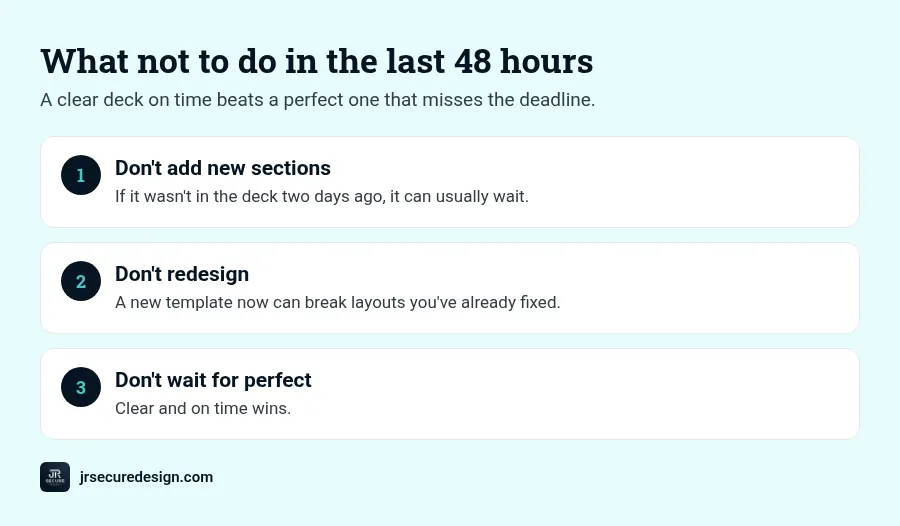
What not to do in the last 48 hours
- Don’t add new sections. If it wasn’t in the deck two days ago, it can usually wait.
- Don’t redesign. A new template now can break layouts you’ve already fixed.
- Don’t wait for perfect. A clear deck on time beats a perfect one that misses the deadline.
Get feedback before investors see it
JR Secure Design is hosting a free, online pitch deck competition on Wednesday, Oct 28 at 7 PM ET. Upload your pitch deck as a PDF at jrsecuredesign.com/startups by Sunday, Oct 25, 11:59 PM ET. Founders get feedback on story, feasibility and investor readiness from C-suite advisors, and the winner gets James DeCrescenzo as a free advisor to their company.
Need help showing the product can be built and secured? Our Fractional CTO service covers product, stack, security and AI decisions.
Frequently asked questions
What should I check before I send my pitch deck?
Check five things: a specific ask, a use-of-funds slide tied to milestones, numbers you can back up, a complete contact slide, and a PDF that opens cleanly with your fonts and charts intact.
How specific should the ask be in a pitch deck?
Specific enough that a reader knows the amount, what it pays for and what milestone it reaches. “Raising a seed round” is too vague. Name the amount and the outcome.
What goes on a use of funds slide?
Three to five spending categories, such as product, hiring and go-to-market, with rough shares and the milestone each one supports.
What should the last slide of a pitch deck say?
Your name, role, email, phone number and company website. Our upload form asks only for the file, so these details must be in the deck.
Should I keep editing my deck right up to the deadline?
Edit for clarity, not scope. In the last two days, fix the ask, the numbers and the contact slide, then export and submit. Don’t start new sections or a redesign.
Ready to submit?
Two days left. Get feedback from C-suite advisors.
Free, online pitch deck competition: Wednesday, Oct 28, 7 PM ET. Get feedback on story, feasibility and investor readiness. The winner gets James DeCrescenzo (25+ years in technology and security) as a free advisor to their company.
Upload your pitch deck (PDF) at jrsecuredesign.com/startups by Sunday, Oct 25, 11:59 PM ET.
Then book a 30-minute call. Or email sales@jrsdi.com.
Related reading: How to Submit a Pitch Deck · The Traction Slide · Common Pitch Deck Mistakes · Startups at JR Secure Design
If you can think it, we can build it securely. Artificial Intelligence · Security · Applications · Hardware