
And a quick fix for each.
- 10 common mistakes
- A 10-minute deck check
- Free deck competition Oct 28
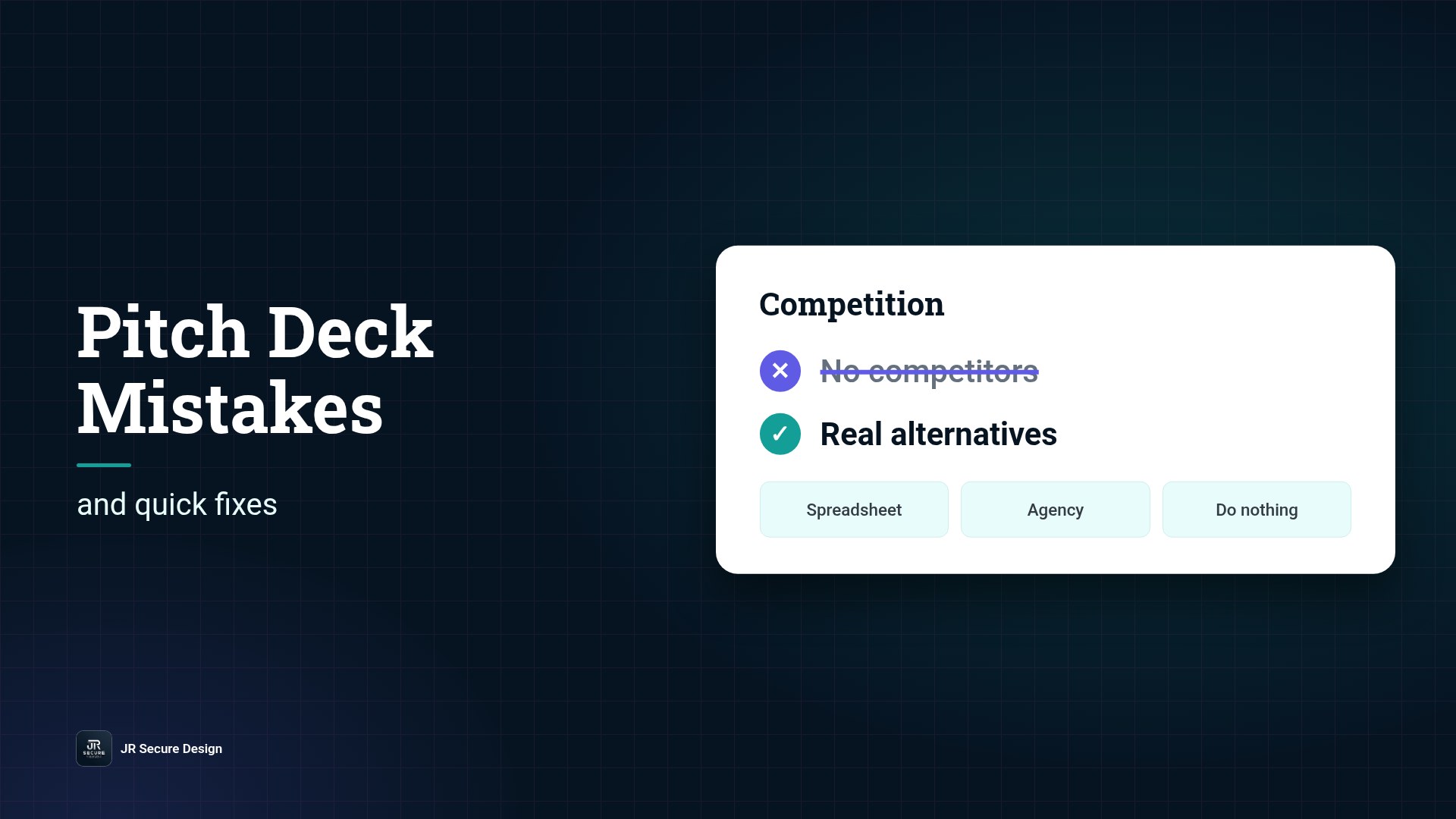
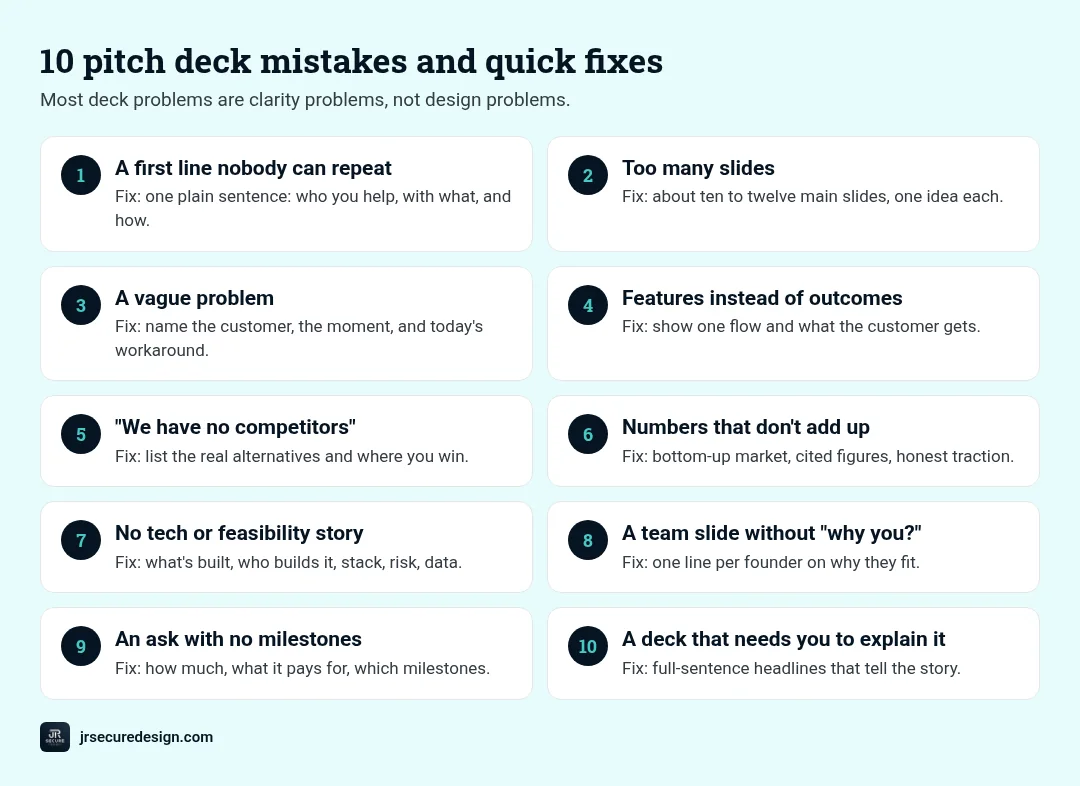
The most common pitch deck mistakes are easy to fix once you see them: a first line nobody can repeat, too many slides, a vague problem, “no competitors,” inflated numbers, a missing tech story, and an ask with no milestones. Each one has a quick fix you can make today.
Key takeaways
- Most deck problems are clarity problems, not design problems.
- Cut to about ten to twelve main slides and move the rest to an appendix.
- Never claim “no competitors,” and never inflate early numbers.
- Show how the product gets built. A missing tech story reads as risk.
- Got a deck ready? Upload your PDF at jrsecuredesign.com/startups by Sunday, Oct 25 for our free online pitch deck competition.
Investors read a lot of decks, often without the founder in the room. Small mistakes add up fast: one confusing slide makes the next one harder to trust. The list below comes from public founder guides such as Y Combinator’s How to build your seed round pitch deck and from what we’ve seen in 25+ years of building technology.
Want a second set of eyes on your deck?
Talk with JR Secure Design.
Mistake 1: A first line nobody can repeat
What it looks like: “An AI-powered platform transforming the future of work.”
Why it hurts: If an investor can’t say what you do after one slide, the rest of the deck has to work twice as hard.
Quick fix: Write one plain sentence: who you help, with what, and how. “We help small clinics book patients without a front-desk hire.” Read it to a friend. If they can repeat it back, keep it.
Mistake 2: Too many slides
What it looks like: 25 slides, three on the market and four on features.
Why it hurts: Readers skim. Important points get buried.
Quick fix: Aim for about ten to twelve main slides, one idea per slide. Move detail to an appendix. Our guide to the slides investors expect lists the core ten.
Mistake 3: A vague problem
What it looks like: “Businesses struggle with data.”
Why it hurts: Big, vague problems sound like nobody in particular has them.
Quick fix: Name the customer, the moment the problem shows up, and what they do today instead. Use a short quote from a real customer conversation if you have one.
Mistake 4: Features instead of outcomes
What it looks like: A slide of bullet points listing every feature.
Why it hurts: Investors care about what changes for the customer, not how many buttons the product has.
Quick fix: Show one simple flow or screenshot and say what the customer gets: time saved, risk reduced, or money made. Keep claims honest and specific.
Mistake 5: “We have no competitors”
Why it hurts: Every startup has alternatives, even if it’s a spreadsheet, an intern, or doing nothing. Saying “none” suggests you haven’t looked.
Quick fix: List the real alternatives customers use today and say plainly where you win and where you don’t yet.
WARNING: “No competitors” and inflated numbers are two of the fastest ways to lose trust. Both are easy to avoid.
Mistake 6: Numbers that don’t add up
What it looks like: A giant industry market size, or a hockey-stick chart with no basis.
Why it hurts: One stretched figure makes investors doubt the rest.
Quick fix: Build your market from the bottom up (customers × price) and cite any outside figure. Show the traction you actually have, even if it’s small, and a simple 12–18 month plan.
Is your tech story the weak spot?
We can help you plan the build and answer investor tech questions.
Mistake 7: No tech or feasibility story
What it looks like: A row of tool logos, or nothing at all about how the product gets built.
Why it hurts: Investors quietly ask whether this team can build this product, on this budget, safely. Silence reads as risk.
Quick fix: Add a short section covering what’s built today, who builds it, your stack in one line, your biggest technical risk, and how you protect customer data, especially if you use AI tools that touch it.
Mistake 8: A team slide that doesn’t answer “why you?”
What it looks like: Headshots and job titles.
Quick fix: For each founder, add one line on why they fit this problem. Say who builds the product. If you don’t have a technical co-founder, say how the build is covered (see Do You Need a CTO at Pre-Seed?).
Mistake 9: An ask with no milestones
What it looks like: “Raising to grow the business.”
Quick fix: Say how much you’re raising, what it pays for, and which milestones it reaches, such as launch or the first paying customers.
Mistake 10: A deck that needs you to explain it
What it looks like: Slides with one word each, built to be presented live.
Why it hurts: Many decks are read before any meeting.
Quick fix: Make every headline a full sentence that states the point. Then read only the headlines in order. They should tell your whole story.
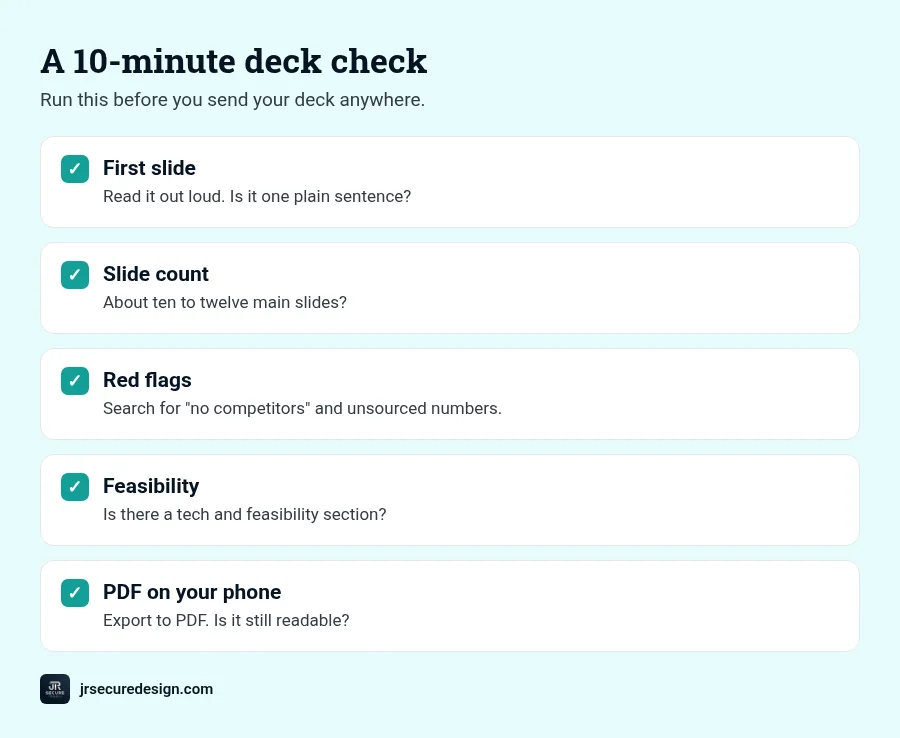
A 10-minute deck check
- Read your first slide out loud. Is it one plain sentence?
- Count your main slides. Are there about ten to twelve?
- Search for “no competitors” and big unsourced numbers. Fix them.
- Check you have a tech and feasibility section.
- Export to PDF and open it on your phone. Is it still readable?
Our pitch deck submission guide shows how to export and upload a PDF.
Get feedback before investors see it
JR Secure Design is hosting a free, online pitch deck competition on Wednesday, Oct 28 at 7 PM ET. Upload your pitch deck as a PDF at jrsecuredesign.com/startups by Sunday, Oct 25. Founders get feedback on story, feasibility, and investor readiness from C-suite advisors, and the winner gets James DeCrescenzo as a free advisor to their company.
If your tech story is the weak spot, our Fractional CTO service can help.
Frequently asked questions
What are the most common pitch deck mistakes?
A vague first line, too many slides, a fuzzy problem, feature lists instead of outcomes, claiming no competitors, inflated numbers, no tech story, a weak team slide, an ask with no milestones, and slides that only make sense when presented.
How long should a pitch deck be?
About ten to twelve main slides works for most early-stage decks. Put extra detail in an appendix.
Should I include financial projections in a pre-seed deck?
Yes, but keep them simple and honest: current traction, a basic 12–18 month plan, and what the round pays for.
Is it bad to say you have no competitors?
Yes. Every product has alternatives, even “do nothing.” List them and explain where you win.
How do I get feedback on my pitch deck?
Ask founders who have raised, advisors, and potential customers. You can also upload your PDF at jrsecuredesign.com/startups by Sunday, Oct 25 for feedback from C-suite advisors in our free online competition.
Ready to submit?
Fixed the mistakes? Put your deck in front of C-suite advisors.
Free, online pitch deck competition: Wednesday, Oct 28, 7 PM ET. Get feedback on story, feasibility, and investor readiness. The winner gets James DeCrescenzo (25+ years in technology and security) as a free advisor to their company.
Upload your pitch deck (PDF) at jrsecuredesign.com/startups by Sunday, Oct 25. Then call or book a 30-minute call.
Or email sales@jrsdi.com.
Related reading: The Slides Investors Expect · What Investors Look For at Pre-Seed · How to Submit a Pitch Deck · Startups at JR Secure Design
If you can think it, we can build it securely. Artificial Intelligence · Security · Applications · Hardware