
Tools, data, review and accountability, in a few pages.
- Core policy sections
- 10-question board checklist
- Free template
A nonprofit AI policy is a short document that says which AI tools staff may use, what information must never go into them, who checks AI-made work, and who is accountable if something goes wrong. You don’t need to write it from scratch. Start with a template, adjust it for your mission and data, and have your board review it with a simple checklist.
Key takeaways
- About 70% of nonprofits report AI use, but only 12% have org-wide guidance (AI Equity Project 2026).
- Only 21% have a formal process for who is accountable if AI causes harm.
- 22% say staff pay for AI themselves without reimbursement.
- A useful policy fits on a few pages and covers tools, data, review and accountability.
- Your board’s job is oversight: ten questions get you there.
AI is already inside most nonprofits. The question is whether anyone decided how it should be used. The AI Equity Project 2026 from Namaste Data surveyed 880 organizations, mainly in the US and Canada, between May and July 2026. Nearly 70% reported some organizational AI use. Only 12% said that use was guided by organization-wide practices or expectations, and just 21% had a formal process establishing who would be accountable if AI caused harm (Namaste Data, AI Equity Project 2026).
The same research found 22% of organizations have staff paying for AI tools personally without reimbursement. That’s a sign of commitment, and also a sign that AI is entering through personal accounts the organization doesn’t control. When those accounts hold donor lists, case notes or grant drafts, the risk belongs to the nonprofit, even if the account doesn’t.
Need an AI policy your board can review?
Book a 30-minute call and we will walk through the template with you.
Or call (202) 892-7189. Or email sales@jrsdi.com.
Why nonprofits need their own AI policy
Nonprofits hold some of the most sensitive data there is: donor records, beneficiary details, health and case information, and stories shared in trust. They also run lean, so staff reach for free tools to keep up. A policy doesn’t slow that down. It tells people what’s safe so they can move faster without guessing.
A policy also helps with funders. The AI Equity Project found 31% of organizations would put new funding toward AI governance policy development if it were available. Having a policy in place shows funders and partners that you take responsible use seriously.
What to include: the core sections
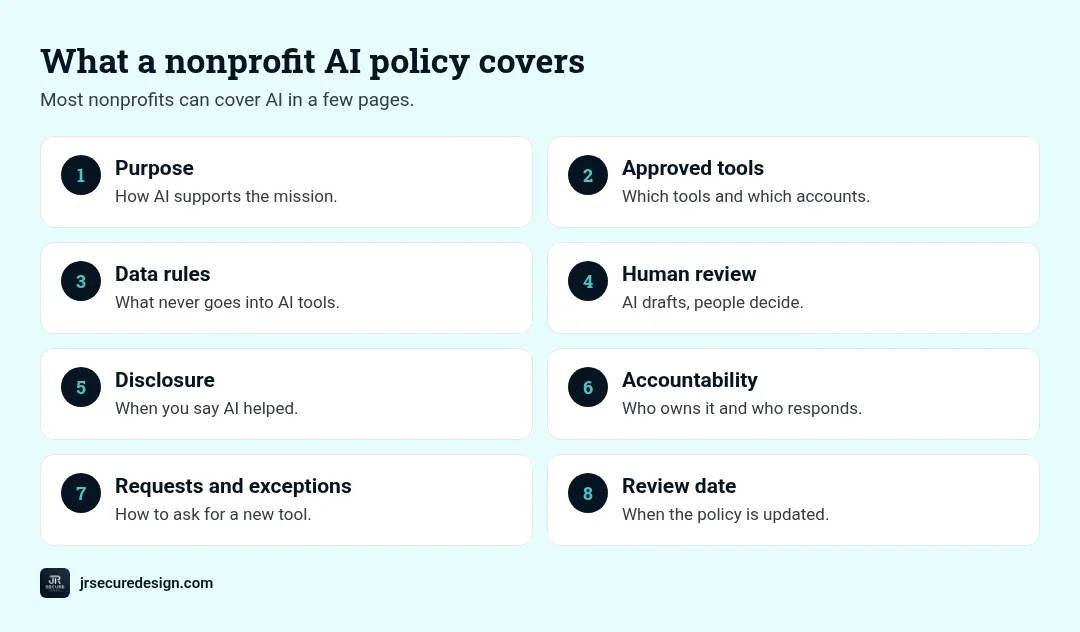
Keep it short and plain. Most nonprofits can cover AI in a few pages with these sections:
- Purpose. Why the organization uses AI and how it supports the mission.
- Approved tools. Which AI tools staff may use for work, and which accounts (organization accounts, not personal ones, where possible).
- Data rules. What must never go into AI tools: donor personal details, beneficiary and case information, health data, passwords and anything shared in confidence.
- Human review. AI drafts, people decide. Anything public, financial or about a person gets checked by a staff member first.
- Disclosure. When you tell donors, partners or the public that AI helped create something.
- Accountability. Who owns the policy, who approves new tools, and who responds if something goes wrong.
- Requests and exceptions. How a staff member asks to use a new tool.
- Review date. When the policy will be updated.
Our free AI acceptable use policy template covers these sections in editable form. Add your mission language, your data types and your approval contacts, and you have a working first version.
QUICK CHECK: Could a new volunteer read your AI policy in ten minutes and know what’s off-limits? If not, shorten it.
A 10-question board checklist
Boards don’t need to approve every tool. Their job is oversight. Bring these ten questions to your next board meeting:
- Do we have a written AI policy, and when was it last reviewed?
- Which AI tools do staff use today, including personal accounts?
- Is any donor, beneficiary or health information going into AI tools?
- Who on staff owns AI decisions and approves new tools?
- Who is accountable if AI causes harm, and how would we find out?
- Do people review AI-generated content before it goes public?
- Are staff paying for AI tools themselves? Should the organization provide approved accounts instead?
- Have we checked the data terms of the tools we rely on most?
- Do our funders or partners ask about AI use, and can we answer?
- Have staff had basic training on safe AI use?
If the board can’t answer half of these, that’s not a failure. It’s the start of a plan.
Want help getting your policy board-ready?
We review where AI is used today and map out what your board should see.
Or call (202) 892-7189. Or email sales@jrsdi.com.
Making it stick
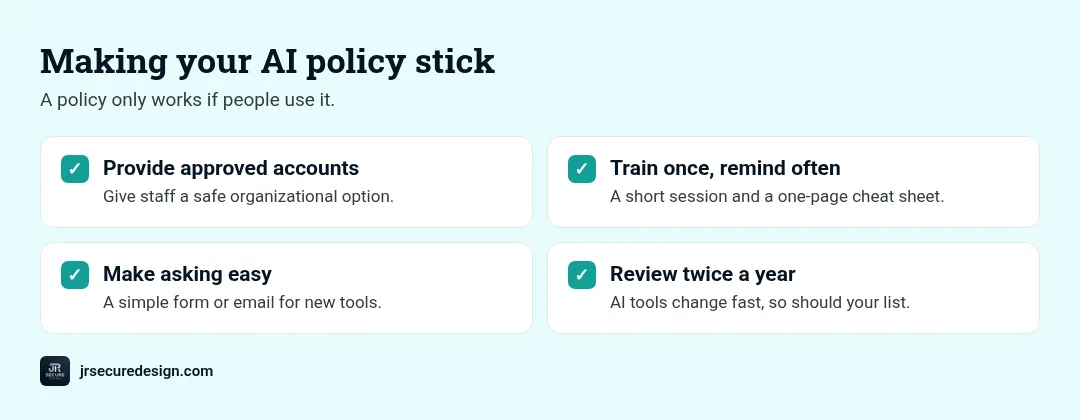
A policy only works if people use it. A few habits help:
- Provide approved accounts. If staff are paying out of pocket, give them a safe organizational option.
- Train once, remind often. A 30-minute session and a one-page cheat sheet beat a long document nobody reads.
- Make asking easy. A simple form or email for “can I use this tool?” keeps AI out of the shadows.
- Review twice a year. AI tools change fast. So should your list of approved tools.
Aligning with recognized frameworks
You don’t need a badge on the wall to govern AI well. A practical policy, aligned to frameworks like the NIST AI Risk Management Framework, covers what most funders and partners ask about. With 25+ years in technology and security, we help nonprofits build policies that fit their size and mission without turning them into a compliance project. For a broader view, see our AI governance framework guide.
Frequently asked questions
Does my nonprofit need an AI policy?
If anyone on staff uses AI for work, yes. Research shows most nonprofits use AI, but few have org-wide guidance. A short policy protects your data and your donors’ trust.
What should a nonprofit AI policy include?
Approved tools, data rules, human review, disclosure, accountability, a way to request new tools, and a review date.
Who approves a nonprofit AI policy?
Usually the executive director drafts or owns it, and the board reviews it as part of its oversight role.
Can nonprofit staff use free AI tools?
They can, within clear rules. Keep sensitive data out of free and personal accounts, and use approved organizational accounts where possible.
How often should we review our AI policy?
At least twice a year, and whenever you adopt a major new AI tool.
Need help getting your policy board-ready?
Get your nonprofit’s AI policy board-ready.
Book a free 30-minute call. We’ll review where AI is used today, walk through the template with you and map out what your board should see.
Start with our free AI acceptable use policy template.
Or call (202) 892-7189. Or email sales@jrsdi.com.
Are you a 501(c)(3)? Eligible nonprofits can use our AI Strategic Advisor free. See if your nonprofit qualifies.
Related reading: AI Acceptable Use Policy Template · AI Governance Framework · Signs of Shadow AI in Your Company · AI Policy for Employees
If you can think it, we can build it securely. Artificial Intelligence · Security · Applications · Hardware · jrsecuredesign.com