
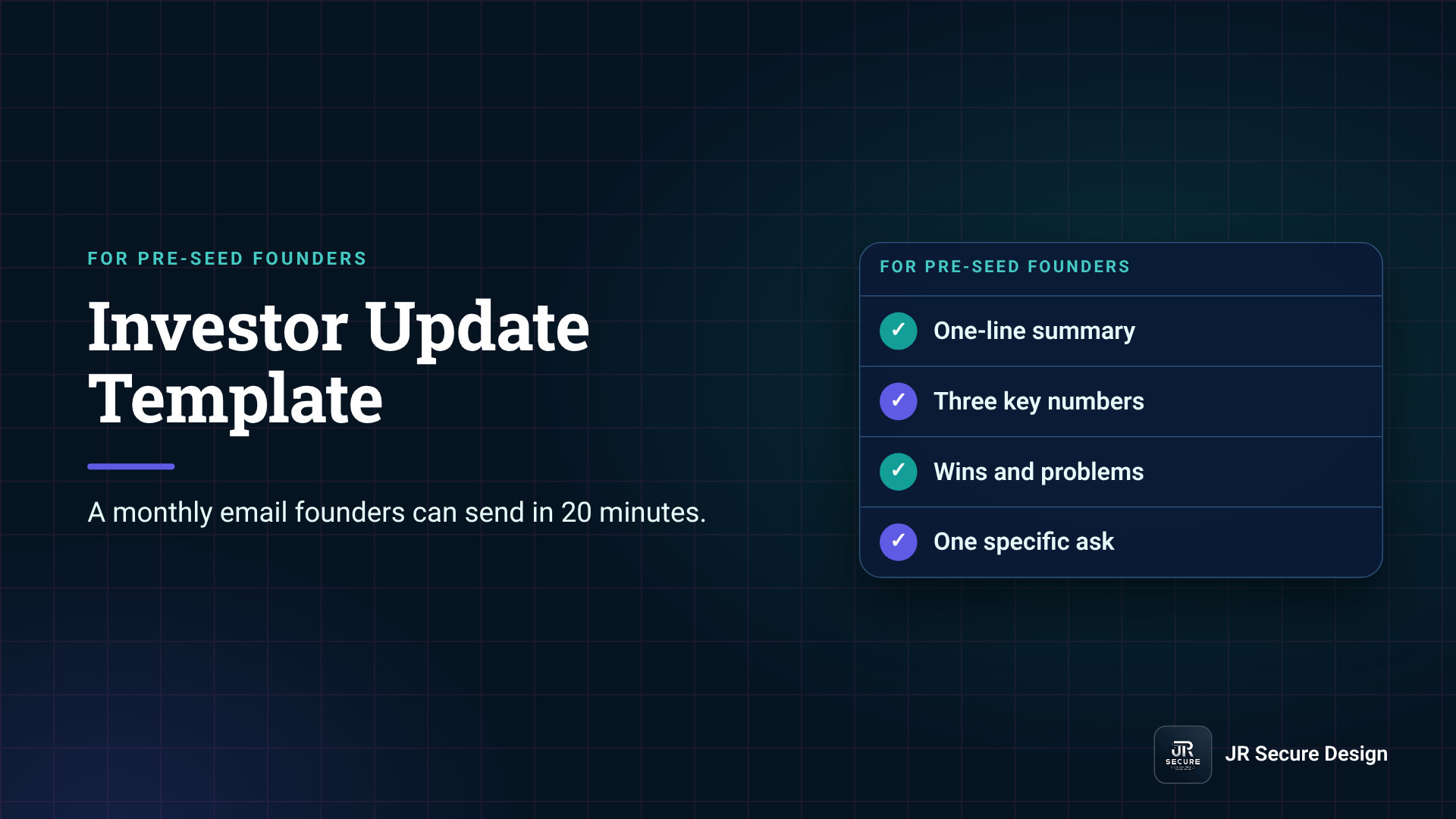
An investor update template is a short, repeatable email that tells investors and supporters how your startup is doing. Keep it to five parts: a one-line summary, three key numbers, wins, problems, and one specific ask. Send it monthly, on the same day, even when the month was hard. Consistency builds more trust than polish.
Key takeaways
- Five parts: summary, key numbers, wins, problems and one ask.
- Use the same three to five metrics every month so trends are easy to read.
- Share bad news early, with what you’re doing about it.
- One specific ask, like an introduction to a named company, gets more help than “let us know if you can help.”
- Never paste customer data, passwords or private contracts into an update.
What should a monthly investor update include?
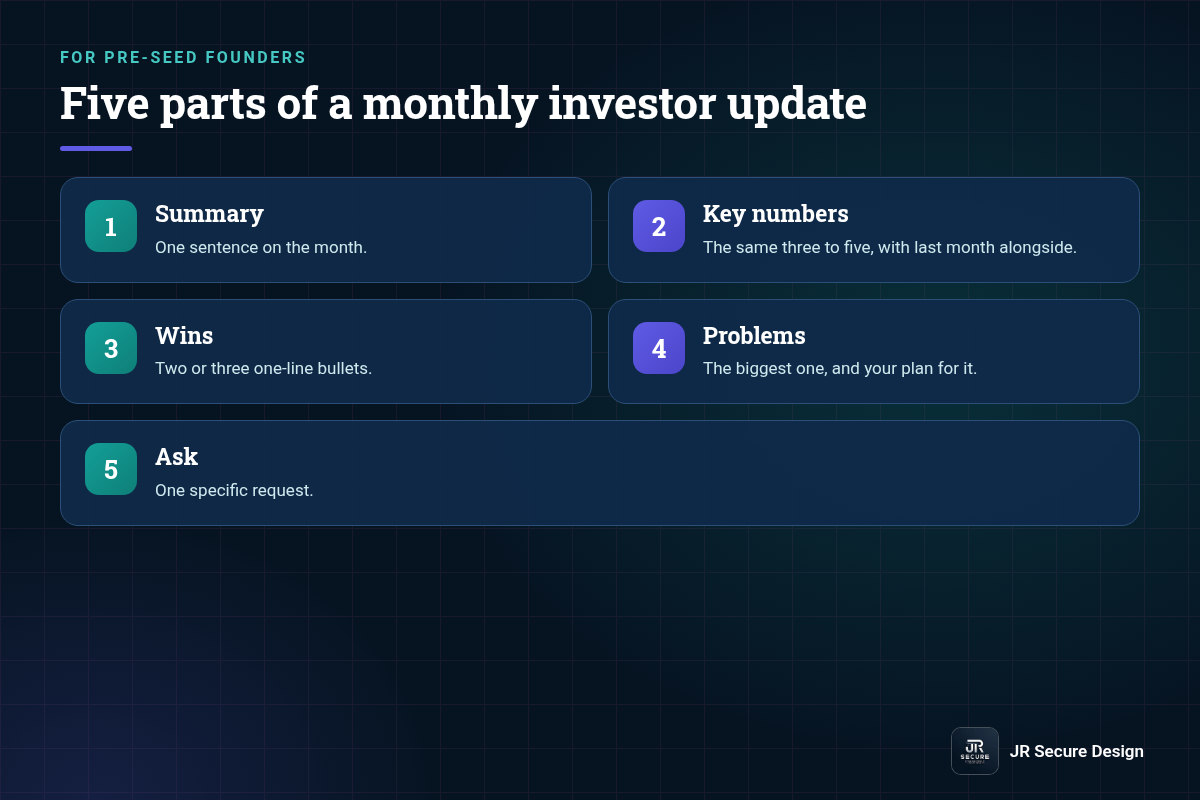
A monthly investor update should include a one-line summary of the month, the same three to five key numbers every time, your biggest wins, your biggest problem and what you’re doing about it, and one clear ask. Keep it short enough to read on a phone in two minutes. Link to detail instead of pasting it.
Here’s a template you can copy. Replace the brackets with your own details.
Copy this investor update template
Subject: [Company] update, [Month Year]: [one-line headline]
Summary: One sentence on the month. Example: “We signed our second paying pilot and pushed launch two weeks to fix onboarding.”
Key numbers (same ones every month, with last month in brackets):
- [Metric 1, such as monthly revenue]: [this month] ([last month])
- [Metric 2, such as active users]: [this month] ([last month])
- [Cash runway in months]: [this month] ([last month])
Wins: Two or three bullets, each one line.
Problems: The biggest one, and your plan for it.
Ask: One specific request. Example: “An intro to an operations lead at a regional logistics company.”
Thanks: Name anyone who helped last month.
How long should an investor update be?
Short. Aim for something a reader can finish on a phone in about two minutes, roughly 200 to 400 words. Lead with the summary and numbers, since many readers stop there. If you need charts or detail, link to a dashboard or a shared PDF with access you control instead of attaching large files.
How often should a startup send investor updates?
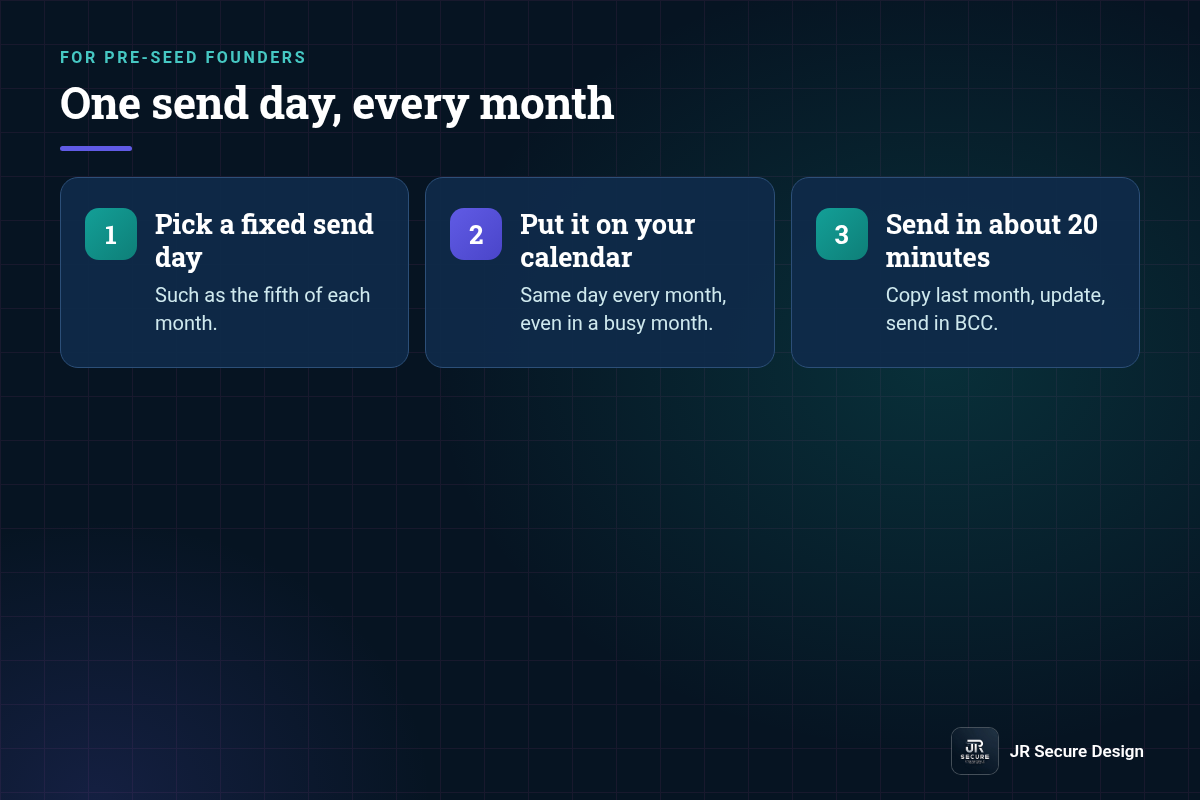
Monthly works for most early-stage startups, because things change fast and a regular note keeps investors close without extra meetings. Some founders move to quarterly after a larger round. Whatever you choose, set a fixed day, like the fifth of each month, and keep it. A skipped month gets noticed more than a slow one.
Send updates to prospective investors too, not only current ones. A founder who sends a steady, honest update for six months has shown the thing a pitch can’t: follow-through. Our guide to what investors look for at pre-seed covers the other signals they weigh.
The 20-minute routine
- Minutes 1–5: Copy last month’s email. Update the numbers.
- Minutes 6–12: Write the summary, wins and problem.
- Minutes 13–17: Write one specific ask.
- Minutes 18–20: Check the send list, remove anything sensitive, send with recipients in BCC.
What should you never put in an investor update email?
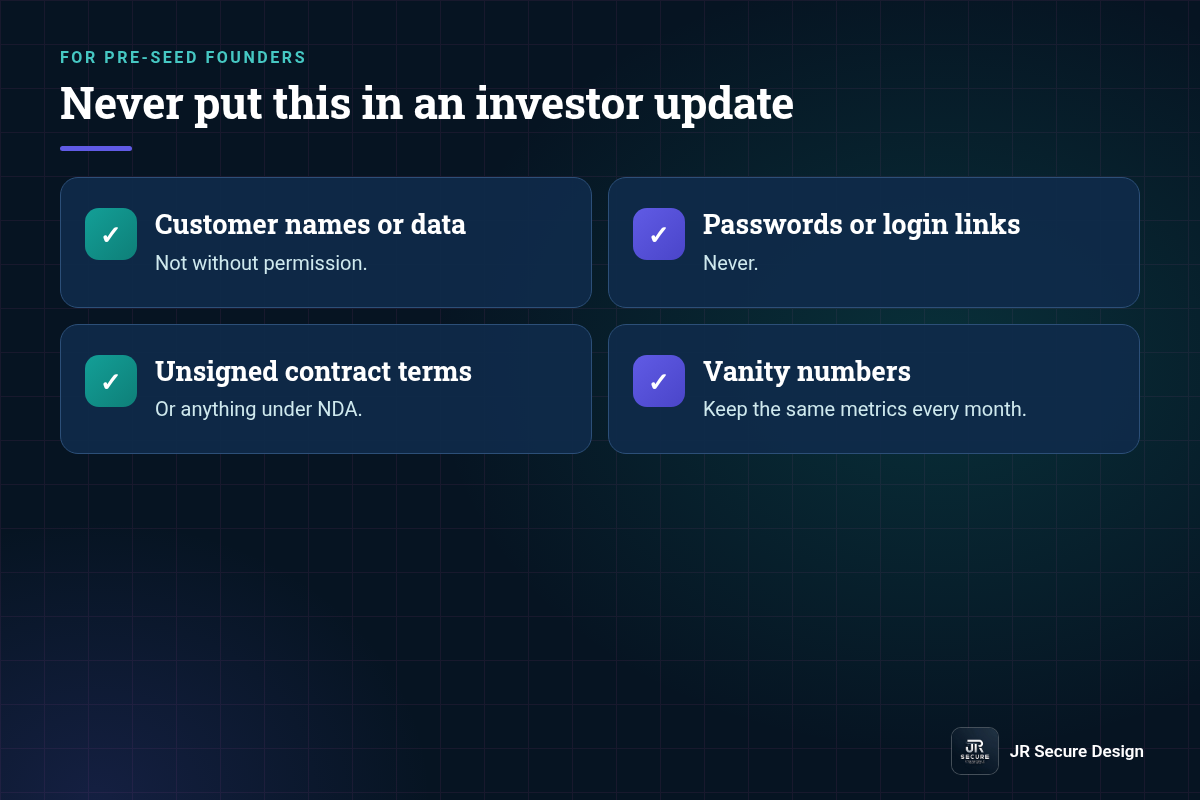
Never put customer names without permission, customer data, passwords, login links, unsigned contract terms, or anything under NDA in an investor update. Updates get forwarded. Also skip vanity numbers that change month to month just to look good. Assume any update could be read by someone you didn’t send it to.
This is where security habits help founders. Use BCC or a mailing tool so you don’t expose everyone’s address. Keep the list current, and remove people who’ve asked to stop. If you share a dashboard, use view-only access you can turn off. Our pre-seed security checklist covers the basics investors ask about in diligence.
QUICK CHECK: Before you hit send, search your draft for “@”, “password”, “contract” and any customer name. Each hit is a line to cut or rewrite.
Investor update template: frequently asked questions
Should I send investor updates when things are going badly?
Yes. A hard month is when updates matter most. Say what went wrong, what you learned and what you’re changing, in plain words. Investors would rather hear bad news from you early than discover it later. A clear problem with a plan often brings more useful help than a month of good news.
Who should get my investor updates?
Send them to current investors, advisors and investors you’ve pitched who asked to stay in touch. Ask before adding anyone new. Keep separate lists if some people should see more detail than others, and use BCC or a mailing tool so nobody sees the full list. Remove anyone who asks to stop.
What metrics should a pre-revenue startup share?
Share the numbers that show progress toward your first revenue: pilots signed, active users, waitlist growth, letters of intent and cash runway. Choose three to five and keep them the same each month. Our post on the pitch deck traction slide covers which early proof points investors find most credible.
Should I use an email tool or a plain email for investor updates?
Either works. A plain email with recipients in BCC is fine for a small list. A newsletter or investor update tool helps once the list grows, because it handles unsubscribes and shows who opened it. Whichever you use, turn on multi-factor login for the account, since it holds your investor contacts.
What’s the best day to send an investor update?
There’s no single best day. What matters is sending on the same day every month so investors expect it. Many founders send in the first week of the month, once the prior month’s numbers are final. Choose a day you can keep even in a busy month, and put it on your calendar.
Got a deck ready? Our free online pitch deck competition is open. Top prize: a $10,000 investment, subject to due diligence. Decks due Tue Dec 1, 11:59 PM ET. Online pitch night: Wed Dec 9, 7 PM ET. Submit your deck
Raising soon?
We help founders get their technology and security ready for investor questions. See our work for startups.
JR Secure Design. More at jrsecuredesign.com.