
Where data leaks, and which plan protects it.
- Where data leakage happens
- Business vs Plus vs Enterprise vs private AI
- 7-step checklist
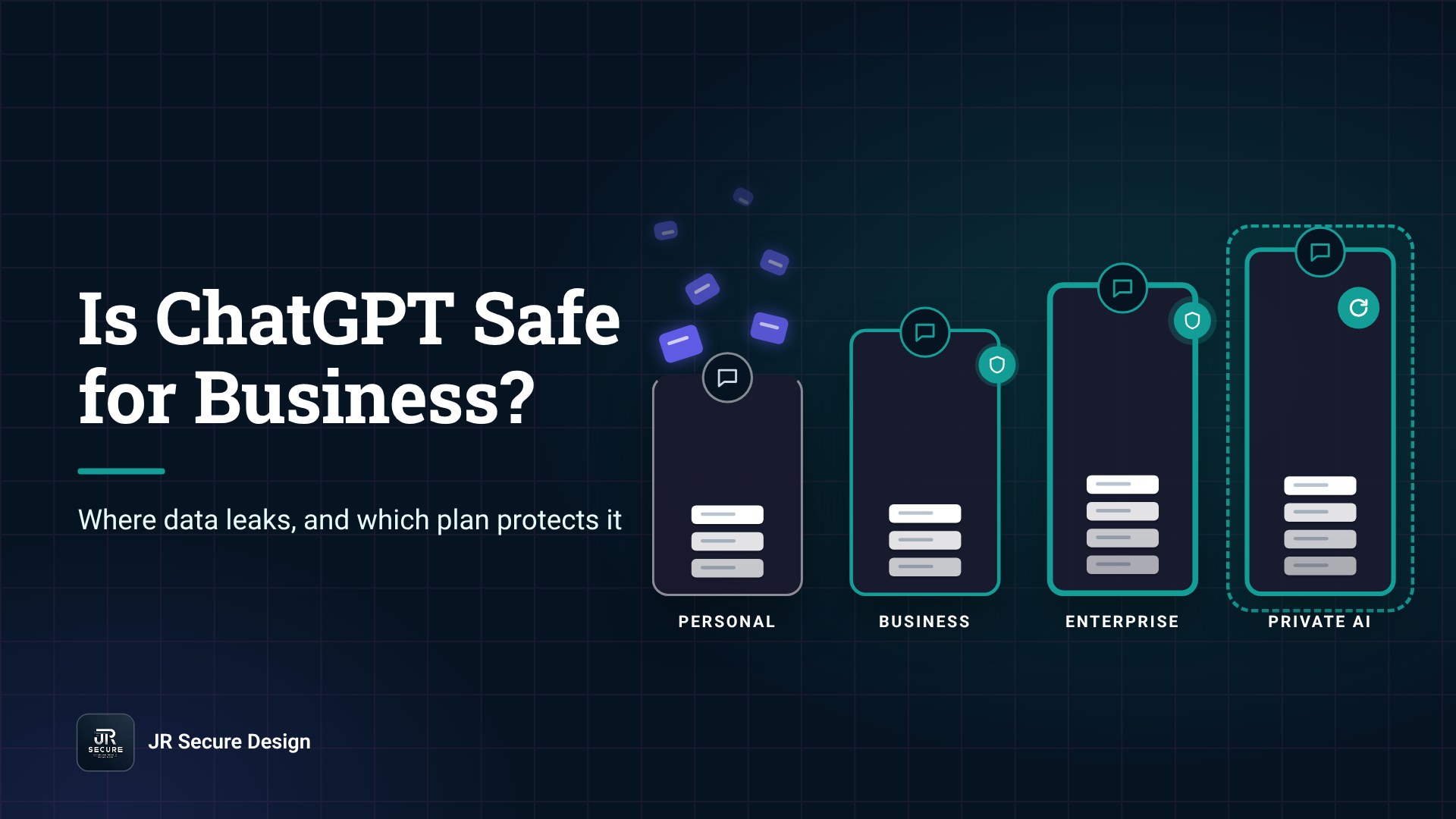
ChatGPT can be safe for business if you use the right plan and set clear rules. The biggest ChatGPT data leakage risk is not hackers. It is staff pasting company or client data into personal accounts your business cannot see or control. Business-grade plans, a short AI policy, and limits on connected apps close most of that gap.
Key takeaways
- Personal ChatGPT accounts used for work are one of the most common ways company data leaks.
- OpenAI says it does not train on ChatGPT Business, Enterprise, or API data by default.
- Individual plans (Free, Go, Plus, Pro) may be used for training unless the user opts out.
- ChatGPT Team is now called ChatGPT Business, and OpenAI does not offer a HIPAA BAA for it.
- Data that must never leave your environment belongs in a private AI deployment.
This guide explains where ChatGPT data leakage actually happens and how the plans differ on data handling, using only OpenAI’s own published information. It also covers when a private AI deployment makes more sense.
Not sure which ChatGPT setup is right for your data?
Talk with JR Secure Design.
Is ChatGPT safe for business use?
It depends less on ChatGPT itself and more on which account your people use and what they put into it. OpenAI separates services for individuals from services for businesses, and handles data differently for each.
- Individual plans (Free, Go, Plus, Pro): OpenAI says that for its services for individuals, “we may use your content to train our models,” unless you opt out in Data Controls or use Temporary Chat (OpenAI, How your data is used to improve model performance). OpenAI’s pricing page describes Free, Go, and Plus as plans “designed to be used by individuals” (OpenAI pricing).
- Business plans (ChatGPT Business, ChatGPT Enterprise, and the API): OpenAI states that “by default, we do not use data from ChatGPT Enterprise, ChatGPT Business… or our API platform—including inputs or outputs—for training or improving our models” (OpenAI, Business data privacy, security, and compliance).
So the honest answer: ChatGPT on a business plan, with admin controls and a policy, can be a reasonable choice for many small businesses.
ChatGPT on employees’ personal accounts, with no rules, is where data leaks start.
QUICK CHECK: Do you know which ChatGPT account each person on your team uses for work? If the answer is “their own,” your company data may be sitting in accounts you cannot see, manage, or close.
Where ChatGPT data leakage really happens

1. Personal accounts and “shadow AI”
When an employee uses a personal account for work, the company has no admin console, no sign-in control, and no visibility into what was shared. If that person leaves, the chat history leaves with them.
This is one of the most common ways data leaks. It is the same “shadow AI” problem we cover in 5 signs shadow AI is already in your company.
2. Connected apps and shared content
Business plans can connect ChatGPT to tools like Google Workspace, Slack, GitHub, and Microsoft 365 (OpenAI business pricing). That is useful, but it means ChatGPT can reach whatever the connected account can reach.
Connected tools also open the door to prompt injection, where hidden instructions in an email, document, or web page try to steer the AI. Only connect what you need, with the least access possible.
3. Vendor-side incidents
No cloud service is perfect. In March 2023, OpenAI disclosed that a bug in an open-source library let some users see titles from another active user’s chat history. It may also have exposed limited payment details for some Plus subscribers during a nine-hour window (OpenAI, March 20 ChatGPT outage).
OpenAI fixed the bug and published what happened. The lesson is not “never use cloud AI.” It is “decide in advance which data is too sensitive to put in any third-party tool.”
ChatGPT Business vs Plus vs Enterprise vs private AI
The table below uses only OpenAI’s published plan information as of October 8, 2026. Plans, features, and prices change, so check OpenAI’s pricing page for current prices before you buy. We do not quote prices here.
ChatGPT plans vs private AI: how your data is handled
| Individual plans (Free, Go, Plus, Pro) | ChatGPT Business | ChatGPT Enterprise | Private AI (self-hosted) | |
|---|---|---|---|---|
| Who it is for | Individuals | Teams; starts at 2 users | Larger organizations; sales-managed | Organizations that need data to stay in their own environment |
| Used to train OpenAI models? | May be, unless the user opts out or uses Temporary Chat | No, by default | No, by default | Not an OpenAI service; you control the model and data |
| Company admin controls | No company workspace | Admin console, admin roles, SAML SSO, MFA, centralized billing, usage analytics | Everything in Business plus SCIM, role-based access controls, Enterprise Key Management, Compliance API | Whatever you build: role-based access and audit logging are up to you |
| Data retention control | User-level settings (chat history, Temporary Chat) | Custom retention not listed for Business (OpenAI lists it for Enterprise) | Custom data retention policies | Fully yours |
| Data residency options | Not listed | Region choice at checkout for eligible workspaces (rolling out; covers storage at rest) (OpenAI Help) | Offered in multiple regions | Wherever you host it |
| HIPAA BAA available? | No (consumer plans are not on OpenAI’s HIPAA-eligible list) | No (OpenAI says it does not offer a BAA for ChatGPT Business) | Only for eligible sales-managed accounts, in OpenAI’s HIPAA-eligible (Regulated Workspace) setup | Depends on your hosting and controls |
Based on OpenAI’s published plan information as of Oct 8, 2026. Prices: openai.com/chatgpt/pricing
Sources: OpenAI pricing and plan comparison, OpenAI business pricing, OpenAI Enterprise Privacy, OpenAI Business data privacy, OpenAI Help: BAA, OpenAI Help: ChatGPT Business FAQ.
A note on names: ChatGPT Team was renamed ChatGPT Business on August 29, 2025. OpenAI says it is the same plan (OpenAI Help Center). Older articles that compare “Team vs Plus” are describing ChatGPT Business.
WARNING: Health data needs a signed BAA. OpenAI says it does not offer a Business Associate Agreement for ChatGPT Business, and its consumer plans (Free, Go, Plus, Pro) are not on its list of HIPAA-eligible products. OpenAI offers BAAs only for specific offerings, such as ChatGPT for Healthcare, eligible sales-managed ChatGPT Enterprise or Edu workspaces, ChatGPT for Clinicians (for eligible individual clinicians), and the API with modified retention. Do not put patient data into ChatGPT without one.
How to choose
- A few people, low-sensitivity work (marketing drafts, public research): a business plan is still better than personal accounts. You get admin control and no training on your data by default.
- Client data, contracts, financials: ChatGPT Business at minimum, with a written AI policy, SSO, and limited connectors.
- Regulated data or strict retention/residency needs: read Enterprise terms carefully, or consider a private deployment.
- Data that must never leave your building: a private AI deployment keeps prompts and documents in your own environment, with access control and audit logging you configure.
Want help choosing the right ChatGPT setup and policy?
We can walk through it with you.
A 7-step checklist to use ChatGPT without leaking data
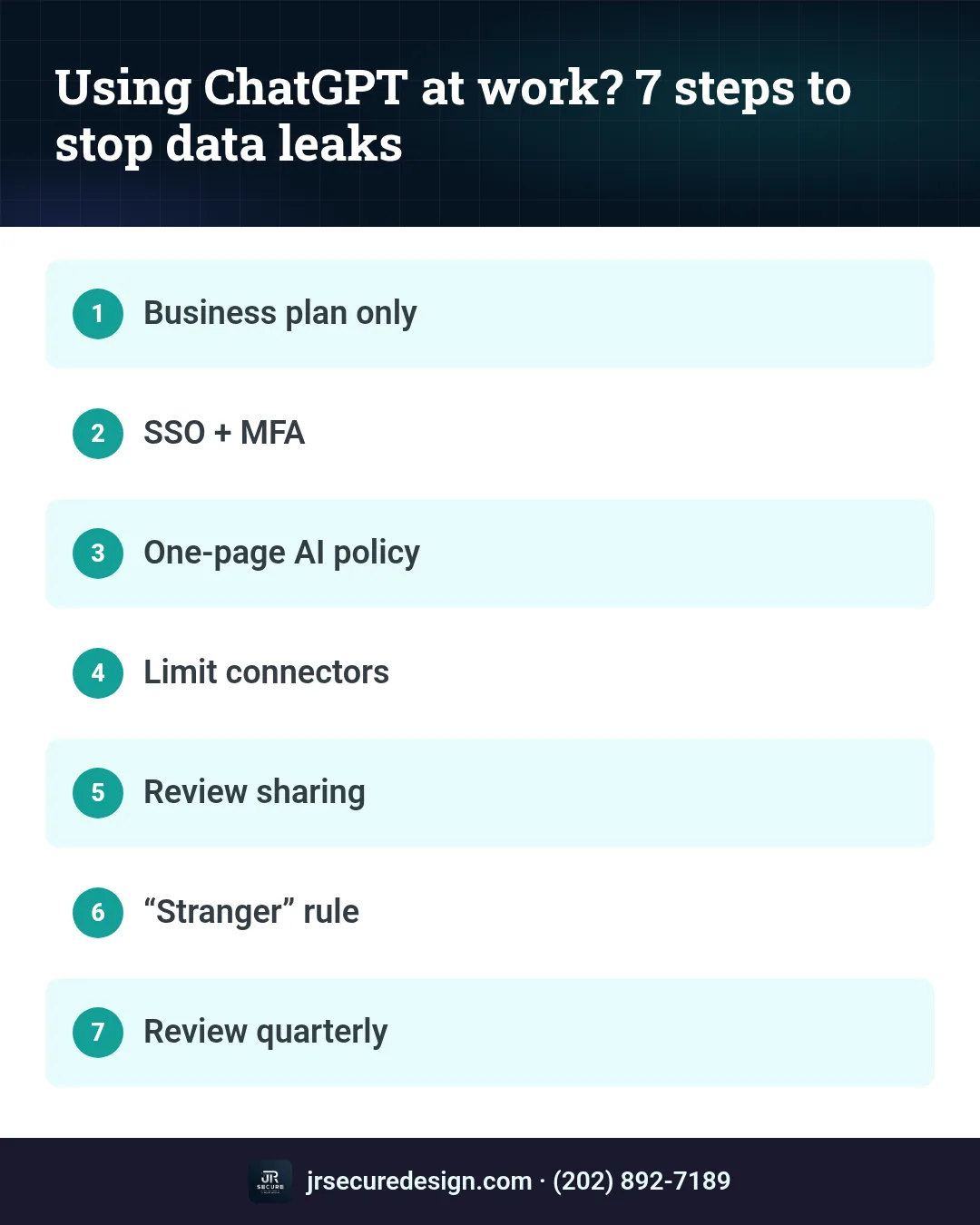
- Step 1 — Move work onto a business plan. Ban personal ChatGPT accounts for company or client data.
- Step 2 — Turn on SAML SSO and MFA. Access follows your company identity and ends the day someone leaves.
- Step 3 — Write a one-page AI policy. List approved tools, data that is never allowed (passwords, health records, full client files, payment data), and who to ask (see our one-page AI governance framework).
- Step 4 — Limit connectors. Only admins approve connections to email, drive, CRM, or code repositories, and only for a clear need.
- Step 5 — Review sharing. Check who can see shared chats, projects, and custom GPTs in your workspace.
- Step 6 — Set a sensitive-data rule staff can remember. If you would not email it to a stranger, do not paste it into AI.
- Step 7 — Review quarterly. Plans and features change often; re-check settings against OpenAI’s current documentation.
For the wider set of controls, including access, deepfake fraud, and assessments, see our guide to AI security for small business.
Frequently asked questions
Is ChatGPT safe for business use?
It can be, on a business plan with admin controls and a clear AI policy. OpenAI does not train on ChatGPT Business or Enterprise data by default. The bigger risk is employees using personal accounts for company data, where the business has no control or visibility.
Is ChatGPT safe for company data?
Only with the right setup. Use ChatGPT Business or Enterprise, require company sign-in, limit connected apps, and define which data is never allowed. For data that must stay in-house, consider a private AI deployment instead of any public service.
Is ChatGPT Business safe for confidential information?
ChatGPT Business excludes your data from model training by default and encrypts it in transit and at rest, according to OpenAI. Whether that is enough depends on your contracts, regulations, and risk tolerance. Highly sensitive or regulated data may need Enterprise terms or private AI.
Does ChatGPT Business train on your data?
No, not by default. OpenAI states it does not use inputs or outputs from ChatGPT Business, ChatGPT Enterprise, or its API platform to train its models unless the organization explicitly opts in.
Is ChatGPT Business the same as Plus?
No. Plus is an individual plan, and content may be used for training unless the user opts out. ChatGPT Business is a team workspace with admin controls, SSO, and no training on business data by default. ChatGPT Team was renamed ChatGPT Business in August 2025.
Is ChatGPT HIPAA compliant?
Not by default. OpenAI does not offer a Business Associate Agreement (BAA) for ChatGPT Business, and its consumer plans (Free, Go, Plus, Pro) are not on its list of HIPAA-eligible products. OpenAI offers BAAs only for specific products, such as ChatGPT for Healthcare, eligible sales-managed Enterprise or Edu workspaces, ChatGPT for Clinicians, and the API with modified retention. Do not put patient data into ChatGPT without a signed BAA.
Talk to JR Secure Design
Not sure which ChatGPT setup is right for your data?
JR Secure Design Inc. helps small businesses and nonprofits use AI without leaking data, from choosing the right ChatGPT plan and policy to deploying private AI. James DeCrescenzo brings 25+ years of experience, based in Fort Lauderdale, FL, and working with clients nationwide (remote). Our AI security and governance work is aligned to the NIST AI RMF and ISO/IEC 42001.
Or email sales@jrsdi.com.
Related reading: Free 30-Minute AI Setup Call: What Happens · Microsoft 365 Copilot Oversharing Check · AI Governance & Compliance for SMBs · Private LLM for Business · Free AI Acceptable Use Policy Template · What Is Prompt Injection? · AI Security for Small Business · 5 Signs Shadow AI Is in Your Company · Private AI Infrastructure for Business · JR Secure Design home