Giving Tuesday falls on Tuesday, Dec 1, 2026. The FCC warns that a charity scam may come from someone impersonating a real charity or collecting money for a fake one. Before your donors get a call, a text or a lookalike web page, tell them 4 things: where your official ways to give are, what you never ask for, how to check you, and where to report a lookalike.
When is Giving Tuesday 2026, and why does it matter for scams?
GivingTuesday lists the date as Dec 1, 2026, the first Tuesday after Thanksgiving. It is a day when donors expect to hear from charities, which makes it easy for a scammer to sound normal. The FCC says scammers may impersonate legitimate charities or create fake ones, and may use AI-generated voices, polished text messages, or realistic-looking websites and social media pages to make the pitch seem real.
The FBI said something similar in its Dec 8, 2025 holiday scam public service announcement: fraudsters use technology to create fake social media profiles, voice clones, identification documents, and videos. That announcement also said AI accounted for more than 9,000 complaints to the FBI’s Internet Crime Complaint Center in the first seven months of 2025, across all types of scams. That is a national figure for every kind of scam, not a count of charity scams, and it comes from the 2025 announcement.
1. Tell donors where your official ways to give are
Put your official ways to give on one page of your own website: your donation page, your mailing address, and your real phone number. Link to that page from every appeal, receipt and social profile. If you use QR codes or text-to-donate, list them there too. The FCC advises donors who are asked to use a QR code or text to donate to look up the charity first and then give through its website, so give them one place to look you up.
It also helps donors who get a call. The FCC tells them to hang up and use the charity’s official website to find its real phone number. Make sure yours is easy to find.
2. Tell donors what you never ask for
The FCC says real charities do not demand instant payment or ask people to give with gift cards or cryptocurrency. If that is true for your nonprofit, say it in plain words on your giving page and in your Giving Tuesday emails: you will never push someone to pay on the spot, and you will never ask for gift cards or cryptocurrency. Add any other rule that is true for you, such as never asking for a password or PIN.
A short rule like this gives a donor a quick test. A caller who breaks it is not you.
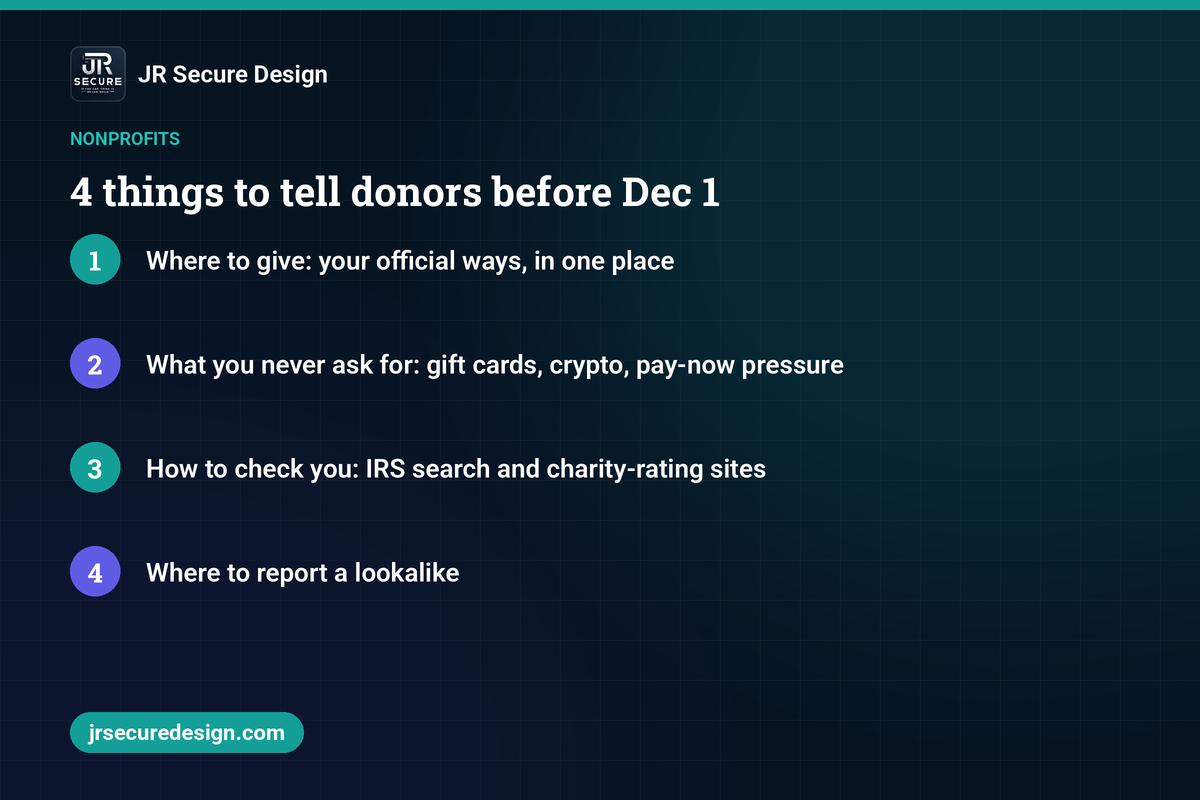
3. Show donors how to check you
Tell donors they can verify your organization before they give, and make that easy. The IRS Tax Exempt Organization Search lets anyone check an organization’s eligibility to receive tax-deductible charitable contributions. The FCC also points donors to charity-rating sites such as BBB’s Wise Giving Alliance (Give.org), Charity Navigator and GuideStar, and to the National Association of State Charity Officials to see whether a charity must be registered in your state.
Look yourself up first. Check that the legal name, website and phone number on those profiles match your giving page.
4. Tell donors where to report a lookalike, and what you will do
The FCC says that if a donor opens a suspicious message, they should not click links or open attachments. Tell them where to send it: one named inbox or phone line at your nonprofit, so you can see what is going around. For reporting outside your organization, the FCC says to contact the Federal Trade Commission about charity scams, and it takes complaints about illegal robocalls and texts. The FBI says suspicious activity can be reported at ic3.gov.
Then decide what you will do when you hear about a lookalike. A short notice on your own site and social profiles, with a link back to your official giving page, is a good start.
What should staff say when a donor calls about a suspicious message?
Give staff a short script, so the answer is the same no matter who answers the phone. A simple version: thank the donor, say you never ask for gift cards or cryptocurrency, point them to your official giving page, and ask them to forward the message to your named inbox. Keep the script next to your other written rules. If you do not have an AI acceptable-use policy yet, our AI acceptable-use policy template and AI policy for nonprofits guide are places to start, and a donor-contact rule fits alongside them. This is general guidance, not legal advice.
Giving Tuesday scams: frequently asked questions
When is Giving Tuesday 2026?
Tuesday, Dec 1, 2026, according to GivingTuesday’s own site. It is the first Tuesday after Thanksgiving.
What should a nonprofit tell donors about Giving Tuesday scams?
4 things: where your official ways to give are, what you never ask for, how to check you, and where to report a lookalike. Put them on one page of your own site and repeat them in your appeals.
Do real charities ask for gift cards or cryptocurrency?
The FCC says real charities do not demand instant payment or ask people to give with gift cards or cryptocurrency.
How can a donor check that a charity is real?
The IRS Tax Exempt Organization Search shows whether an organization is eligible to receive tax-deductible charitable contributions. The FCC also points donors to Give.org, Charity Navigator and GuideStar, and to the National Association of State Charity Officials for state registration.
Where do donors report a charity scam?
The FCC says to contact the Federal Trade Commission about charity scams, and it takes complaints about illegal robocalls and texts. The FBI says suspicious activity can be reported at ic3.gov.
Tell donors before Dec 1
Giving Tuesday is a good day for your nonprofit, and a good day for a scammer to copy you. Put the 4 things in writing now: where your official ways to give are, what you never ask for, how donors can check you, and where to report a lookalike.
Want a second look at your nonprofit’s AI and donor-contact rules?
If you want help tightening your nonprofit’s donor-contact and AI rules, book a call.
JR Secure Design builds AI and security programs aligned to NIST AI RMF and ISO/IEC 42001. More at jrsecuredesign.com.