
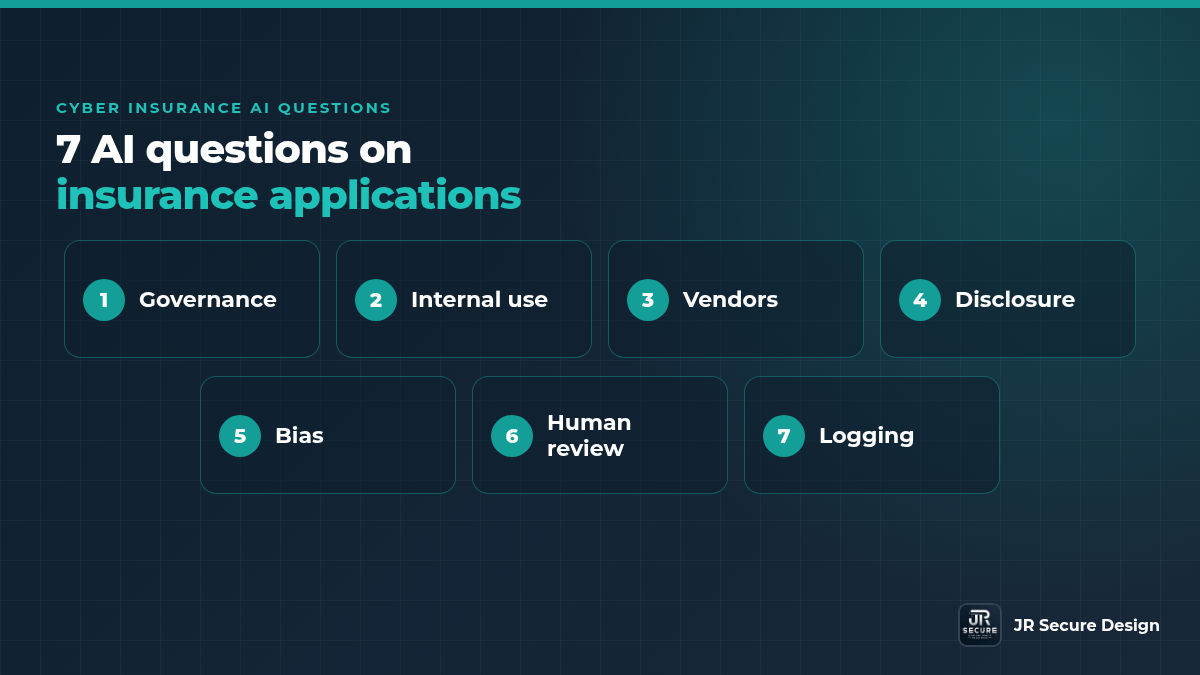
Cyber insurance AI questions now appear on applications and renewals. They cover whether you have AI governance with management oversight, whether AI use is internal only, how you check AI vendors, whether a person verifies AI output, whether AI actions are logged and how you disclose AI use. Answer each one honestly and attach evidence.
Want help putting this into practice?
Book a free 30-min call
KEY TAKEAWAYS – Broker Aon published a representative sample of AI questions carriers are developing for applications. – Some carriers now issue supplemental applications asking for an AI inventory and who’s responsible for each deployment. – A short, honest answer backed by a document beats a confident “yes” you can’t prove. – Your AI policy and AI tools register answer most of these questions. – Have your broker review your answers before you submit.
By James DeCrescenzo, founder of JR Secure Design.
Are cyber insurers really asking about AI?
Yes. Aon’s AI Fact Sheet 2026 says insurance carriers are developing AI application questions and lists a representative sample. Insurance Business reported on November 2, 2026 that some carriers issue supplemental applications on AI governance. Broker CBIZ warns carriers may restrict coverage where AI governance is weak. Expect AI questions at your next renewal.
What they’re asking, in their own words, and how a small business can answer each one, is below. Your actual form may word things differently. Answer the form in front of you.
How should you answer “Do you have an AI governance framework with management oversight?”
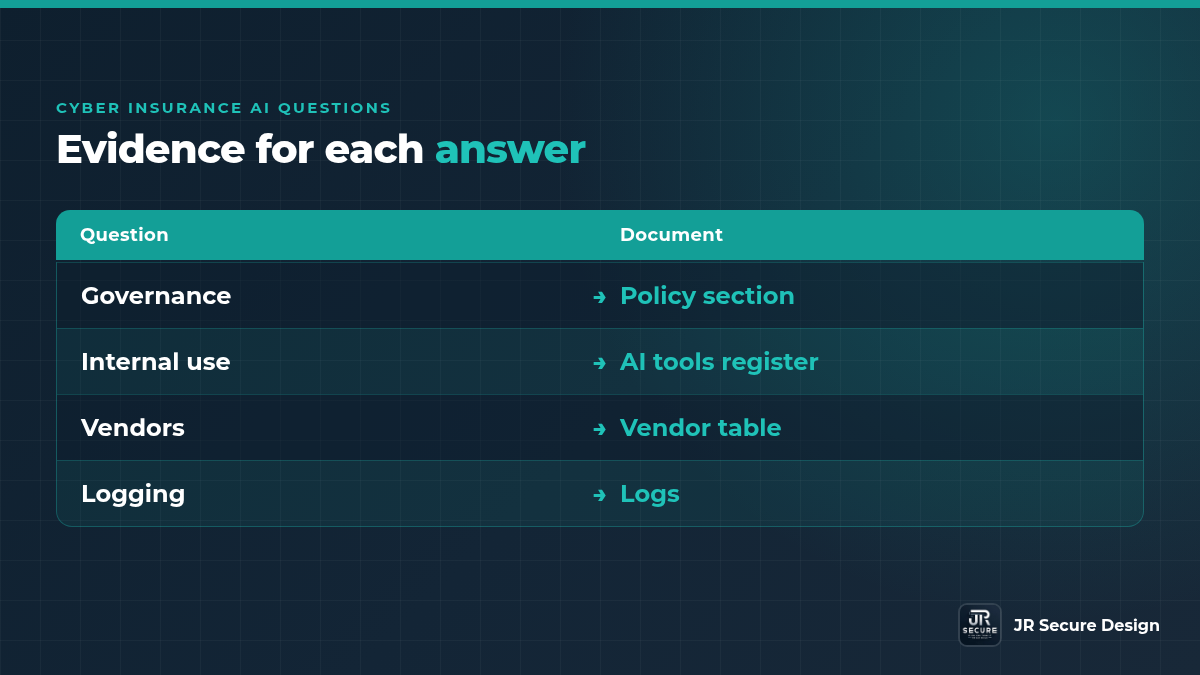
Aon’s sample asks: “Do you have an AI Governance Framework with Board/Management oversight, which includes specific use cases, restrictions and authorization policies?” For a small business, a written AI acceptable use policy signed off by the owner, listing allowed uses, banned data and how new tools get sign-off, is that framework. Attach it.
TEMPLATE ANSWER: “Yes. Our AI acceptable use policy, owned by [name, title] and reviewed every [6/12] months, lists allowed AI tools and uses, data that may never go into AI tools, and how staff request a new tool. Signed staff acknowledgements are on file.”
No policy yet? Start with our free AI acceptable use policy template kit.
How should you answer “Is your AI use for internal purposes only?”
Aon’s sample asks whether the insured is “developing and providing Generative AI solutions to customers, or is the use for internal purposes only?” Most small businesses use AI internally, for drafting, summarizing and meeting notes. Say so plainly, and name the tools. If a client-facing chatbot or AI feature exists, disclose it here rather than leaving it out.
TEMPLATE ANSWER: “Internal use only: drafting, summarizing and meeting notes in [ChatGPT Business / Microsoft 365 Copilot], company accounts only. We do not sell or provide AI products to customers.” (If you run a website chatbot, add: “Our website assistant is labeled as AI and offers a way to reach a person.”)
How should you answer the vendor AI question?
Aon’s sample asks: “Are you confirming whether any key vendors are utilizing AI, and if so, what safeguards are in place to prevent errors or bias? Have you conducted pre-contract diligence?” Answer by listing your key vendors, asking each whether AI touches your data, and recording the reply. A simple vendor table with dates is credible evidence.
QUICK CHECK: For each key vendor (payroll, CRM, accounting, IT provider), record: do they use AI on our data? Do they train on it? Who’s our contact? Date asked.
How should you answer “Does a human need to verify accuracy before AI takes action?”
This one’s straight from Aon’s sample. The honest answer for most small businesses is yes for staff use, because your policy requires people to check output before using it. If you run AI agents that send, pay or change records, say whether a person signs off on those actions, and fix it before renewal if not.
TEMPLATE ANSWER: “Yes. Our policy requires staff to check AI output before use, and AI is never the sole basis for decisions about people. [If agents:] High-impact agent actions such as sending external email or changing records need a named person’s sign-off.”
For agents, see our AI agents for small business guide.
How should you answer “Are AI actions logged so errors can be reviewed?”
Aon’s sample asks: “Are AI actions logged so potential errors can be reviewed and remediated?” Business plans of AI tools often include admin activity logs, so check yours. Answer by naming which tools keep logs, who can review them and for how long. If you can’t, that’s a sign personal accounts are still in use.
TEMPLATE ANSWER: “AI use runs through company accounts with admin logging in [tool]. [Name] can review activity. Agents log every action they take. Personal AI accounts are banned for work.”
How should you answer the disclosure and bias questions?
Aon’s sample asks, “Disclosure — are notices provided to consumers on the use of AI?” and “How do you prevent unintended bias when utilizing AI?” Answer disclosure with your client-notice rule and chatbot label. Answer bias by stating that AI is never the sole basis for decisions about people and that a person reviews each one.
TEMPLATE ANSWER (disclosure): “We tell clients when AI materially produced a deliverable, and our chatbot identifies itself as AI.” TEMPLATE ANSWER (bias): “AI is not used as the sole basis for decisions about people. A qualified person reviews and decides.”
What if a form asks whether you allow AI to draft documents?
Some professional liability forms already ask. AmTrust’s lawyers renewal application asks: “Does the firm allow for the use of Artificial Intelligence software to draft documents?” and, if yes, “please describe.” That’s not a cyber form, but it shows the pattern. Describe the allowed tools, the accounts, the data limits and the human check.
TEMPLATE ANSWER: “Yes, through company-managed accounts only. Client confidential information isn’t entered without written sign-off for that tool, and a person reviews every AI-assisted draft before it’s used.”
What if you can’t answer yes yet?
Don’t guess. A “yes” you can’t support is worse than an honest “in progress”. Write what exists today, what you’re doing and the date it’ll be done, then close the gaps before renewal: policy, AI tools register, vendor table, logging and a human check on agents. Your broker can help word it.
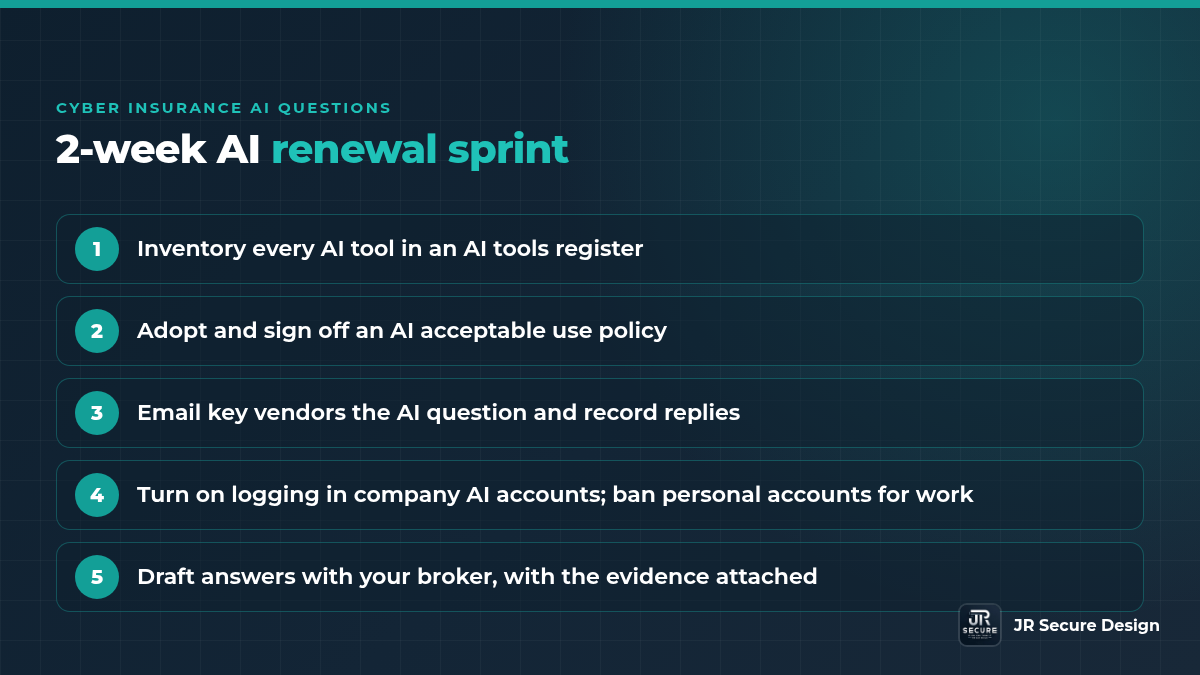
STEP: the 2-week renewal sprint 1. List every AI tool in an AI tools register (start with a 1-hour shadow AI discovery). 2. Adopt and sign off an AI acceptable use policy. 3. Email key vendors the AI question and record replies. 4. Turn on logging in company AI accounts; ban personal accounts for work. 5. Draft answers with your broker, with the evidence attached.
For the broader picture, including client and vendor security questionnaires, read our guide to answering AI questionnaires. Want it done with you? Our AI governance assessment prepares draft answers with evidence for each one.
Frequently asked questions
Do all cyber insurers ask about AI?
Not yet, and wording varies by carrier and form. Aon describes carriers as developing AI application questions, and Insurance Business reports some carriers already use supplemental AI applications. Lockton’s AI risk lead told the outlet she’d be surprised if AI weren’t a commonplace part of underwriting on every line within a year.
Can our AI use affect our cyber insurance coverage?
It can. CBIZ, an insurance broker, wrote on September 30, 2026 that where there’s evidence of a lack of AI governance and risk management, carriers may restrict coverage. Read your policy wording and any AI endorsement with your broker, and keep evidence that your AI governance is real.
What is an affirmative AI endorsement?
It’s added policy wording that expressly addresses AI-related risks. Insurance Business notes these endorsements are more visible in cyber insurance, but their value depends on what your underlying policy already covers. Ask your broker whether an endorsement adds cover you don’t already have, or simply confirms existing cover.
Should we send our AI policy to our broker?
Yes, before renewal. Your broker can check that your answers match your documents and present them well to underwriters. Send the AI acceptable use policy, the AI tools register and your vendor table. Keep a copy of everything you submit, filed with the policy, for next year’s renewal.
Is a written AI policy enough to answer insurers?
It’s the start, not the finish. Insurers also ask about inventories, vendors, human review and logging. The policy states the rules; the AI tools register, vendor table and logs prove you follow them. Together they answer almost every AI question on current sample applications that a small business is likely to see.
JR Secure Design is led by founder James DeCrescenzo, with 25+ years of building systems that can’t go down.
Prefer email? Write to sales@jrsdi.com, or send us a message.
Ask Sophia, our free AI advisor, at jrsecuredesign.com/sophia, or talk it through with James.
Book a free 30-min callFollow JR Secure Design: LinkedIn · Facebook · X · Instagram · YouTube · TikTok · Pinterest · Reddit · Medium