Pre-seed and seed, in plain English.
- Team, problem, insight, proof, plan
- Investor-ready checklist
- Free deck competition Oct 28
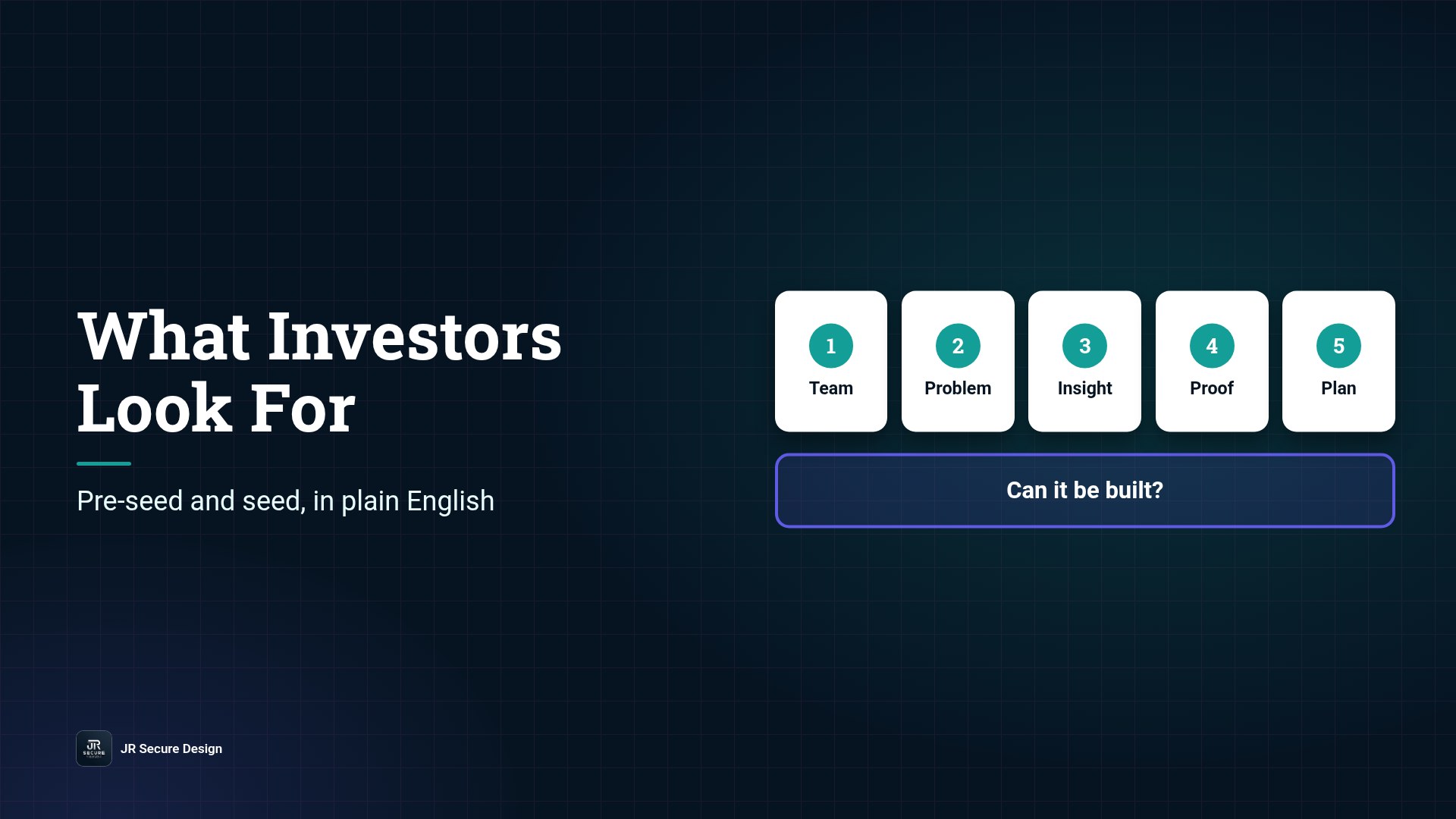
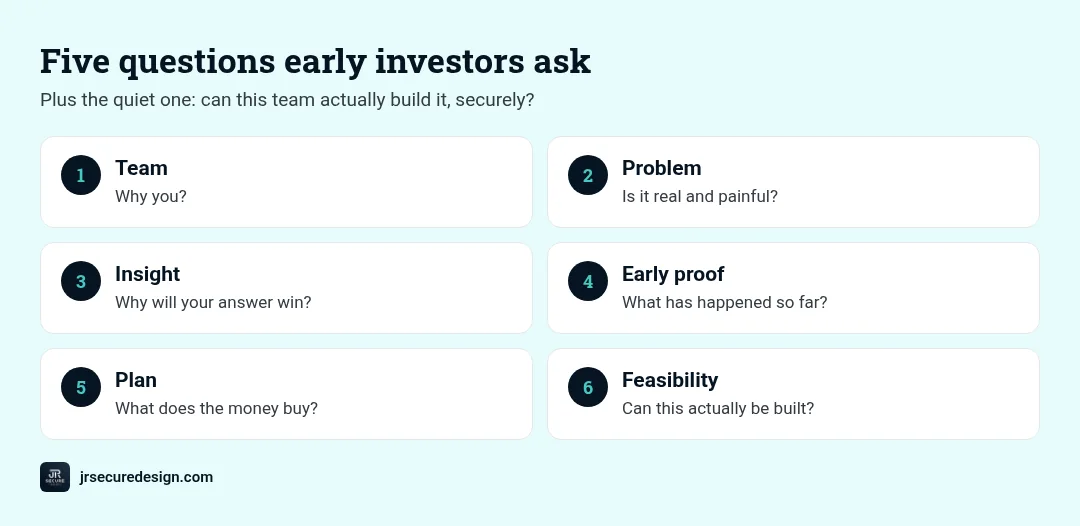
At pre-seed and seed, investors are mostly betting on people and a problem. They want a team that can build, a painful problem real customers have, a sharp insight into why your answer wins, some early proof, and a clear plan for what the money buys. You don’t need everything. You need each of those to be honest and easy to see.
Key takeaways
- Early investors judge the team, the problem, your insight, early proof, and your plan.
- Pre-seed leans on the team and the problem. Seed asks for more proof that customers want it.
- Honest, small numbers beat big guesses.
- Investors also ask a quiet question: can this team actually build it, securely?
- Got a deck ready? Upload your PDF at jrsecuredesign.com/startups by Sunday, Oct 25 for our free online pitch deck competition.
Most founders raise their first round once. Investors read decks every week. That gap makes the process feel mysterious, but the questions investors ask are fairly consistent. Public guides such as Y Combinator’s How to build your seed round pitch deck and Sequoia’s Writing a business plan point at the same core questions. Below is our plain-English version, plus notes from 25+ years of building technology.
Want feedback on your deck before you raise?
Talk with JR Secure Design.
Pre-seed vs seed: what changes
Labels vary by investor and by year, so treat these as rough guides, not rules.
- Pre-seed is usually the first outside money. You may have an idea, a prototype, or an early product. Investors are judging whether you are the right people and whether the problem is real.
- Seed usually comes once something is working. Investors still care about the team, but they want more evidence that customers want what you built: usage, pilots, early revenue, or strong retention.
Either way, the same five questions run underneath. What shifts is how much proof they expect.
1. The team: why you?
At the earliest stage, the team often matters most, because there’s little else to judge. Investors want to know:
- Why you understand this problem better than most people. Work history, personal experience, or time spent with customers.
- Whether you can build it. Who writes the code or builds the product? If that’s not a founder, who is it and how is it managed?
- How you work together. How long you’ve known each other and how you split roles.
- How fast you learn. What you’ve shipped, tested, and changed since you started.
QUICK CHECK: Can you explain in two sentences why your team is the one to solve this? If not, start there.
2. The problem: is it real and painful?
Investors look for problems that customers already feel and already spend time or money on. Be specific about who has the problem, when it shows up, and how they deal with it today. “Small clinics lose bookings when the front desk is busy” is stronger than “healthcare is inefficient.”
The best evidence is your own: notes from customer conversations, what people said in their own words, and what they’re using today instead.
3. The insight: why will your answer win?
Plenty of teams chase the same problem. Investors want to hear what you know or see that others don’t. It could be a new technology, a change in how customers buy, a regulation, or simply a much better understanding of one type of customer. This is also where “why now” lives: what changed that makes this possible or urgent today?
4. Early proof: what has happened so far?
Proof comes in many forms, and you should show whatever you have, honestly:
- Users or a waitlist
- Pilots or letters of intent
- Paying customers or early revenue
- Retention: people who keep coming back
- Customer quotes from real conversations
WARNING: Never inflate early numbers. If an investor finds one stretched figure, they start doubting the rest of the deck. One honest, small number is more convincing than a big guess.
At pre-seed, it’s fine if proof is thin, as long as you show what you learned and what you’ll prove next. At seed, expect more questions about growth and whether customers stay.
5. The plan: what does the money buy?
Investors want to know how much you’re raising, what it pays for, and which milestones it gets you to. Tie dollars to outcomes, such as launching the product, landing the first paying customers, or proving one channel works. A clear, believable plan beats a detailed spreadsheet nobody trusts.
Not sure how to answer “can this be built?”
We can help you plan the build and answer investor tech questions.
The quiet question: can this actually be built?
Behind all five questions is one more: can this team build this product, on this budget, without creating big risks? Founders often answer it with a list of tool logos, or not at all.
You can answer it in a few lines:
- What’s built today, and what isn’t
- Who builds it (in-house, contractor, agency, or a fractional CTO)
- The main pieces of your stack and why you chose them
- Your biggest technical risk and how you’ll reduce it
- How you protect customer data, especially if you use AI tools that touch it
If your product handles health, financial, or personal data, expect security questions early. Having simple, honest answers ready makes you look prepared. Our post on the slides investors expect shows where this fits in your deck.
What “investor-ready” means
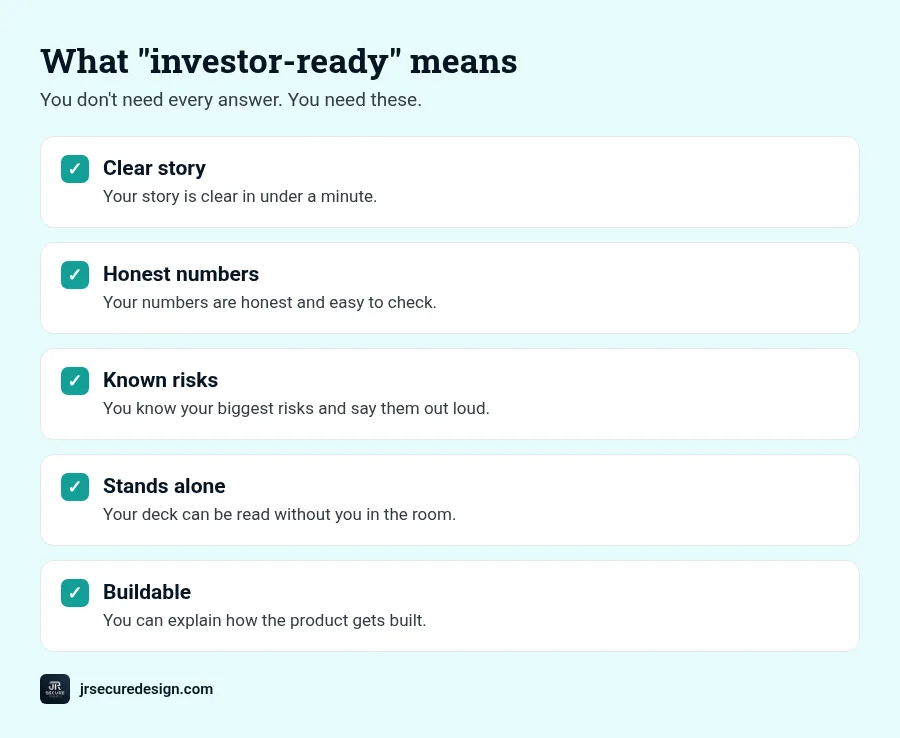
Being investor-ready doesn’t mean having every answer. It means:
- Your story is clear in under a minute.
- Your numbers are honest and easy to check.
- You know your biggest risks and say them out loud.
- Your deck can be read and understood without you in the room.
- You can explain how the product gets built.
If you’re not sure your deck says all that, getting outside feedback before you send it to investors is one of the fastest ways to find the gaps. Our pitch deck submission guide shows how to export and upload a PDF.
Get feedback on investor readiness
JR Secure Design is hosting a free, online pitch deck competition on Wednesday, Oct 28 at 7 PM ET. Upload your pitch deck as a PDF at jrsecuredesign.com/startups by Sunday, Oct 25. Founders get feedback on story, feasibility, and investor readiness from C-suite advisors, and the winner gets James DeCrescenzo as a free advisor to their company.
Need a technical co-pilot to answer the “can this be built?” question? Our Fractional CTO service can help.
Frequently asked questions
What do investors look for at pre-seed?
Mostly the team and the problem. Investors want founders who understand a real, painful problem, can build the product, and have a clear plan for what the money achieves. Early proof helps, but it can be small.
What is the difference between pre-seed and seed?
Pre-seed is usually the first outside money, often before the product is proven. Seed usually comes once something is working, so investors expect more evidence such as usage, pilots, or early revenue. Labels vary by investor.
Do I need revenue to raise a pre-seed round?
Not always. Many pre-seed companies raise before revenue. Show whatever proof you have honestly, such as users, pilots, letters of intent, or customer interviews, and explain what you’ll prove next.
How important is the founding team to investors?
Very important at the earliest stages, because there’s little else to judge. Show why you understand the problem, who builds the product, and how quickly you learn and ship.
What does investor-ready mean?
It means your story is clear, your numbers are honest, you know your biggest risks, your deck stands on its own, and you can explain how the product gets built.
Ready to submit?
Is your deck investor-ready? Find out from C-suite advisors.
Free, online pitch deck competition: Wednesday, Oct 28, 7 PM ET. Get feedback on story, feasibility, and investor readiness. The winner gets James DeCrescenzo (25+ years in technology and security) as a free advisor to their company.
Upload your pitch deck (PDF) at jrsecuredesign.com/startups by Sunday, Oct 25. Then call or book a 30-minute call.
Or email sales@jrsdi.com.
Related reading: Security Questions Investors Ask in Due Diligence · Common Pitch Deck Mistakes (and Quick Fixes) · Pre-Seed Tech & Security Checklist · The Slides Investors Expect in a Pre-Seed Pitch Deck · Do You Need a CTO at Pre-Seed? · How to Submit a Pitch Deck · Startups at JR Secure Design
If you can think it, we can build it securely. Artificial Intelligence · Security · Applications · Hardware