Short, honest, specific answers.
- 7 questions investors ask
- What each one checks
- Free deck competition Oct 28
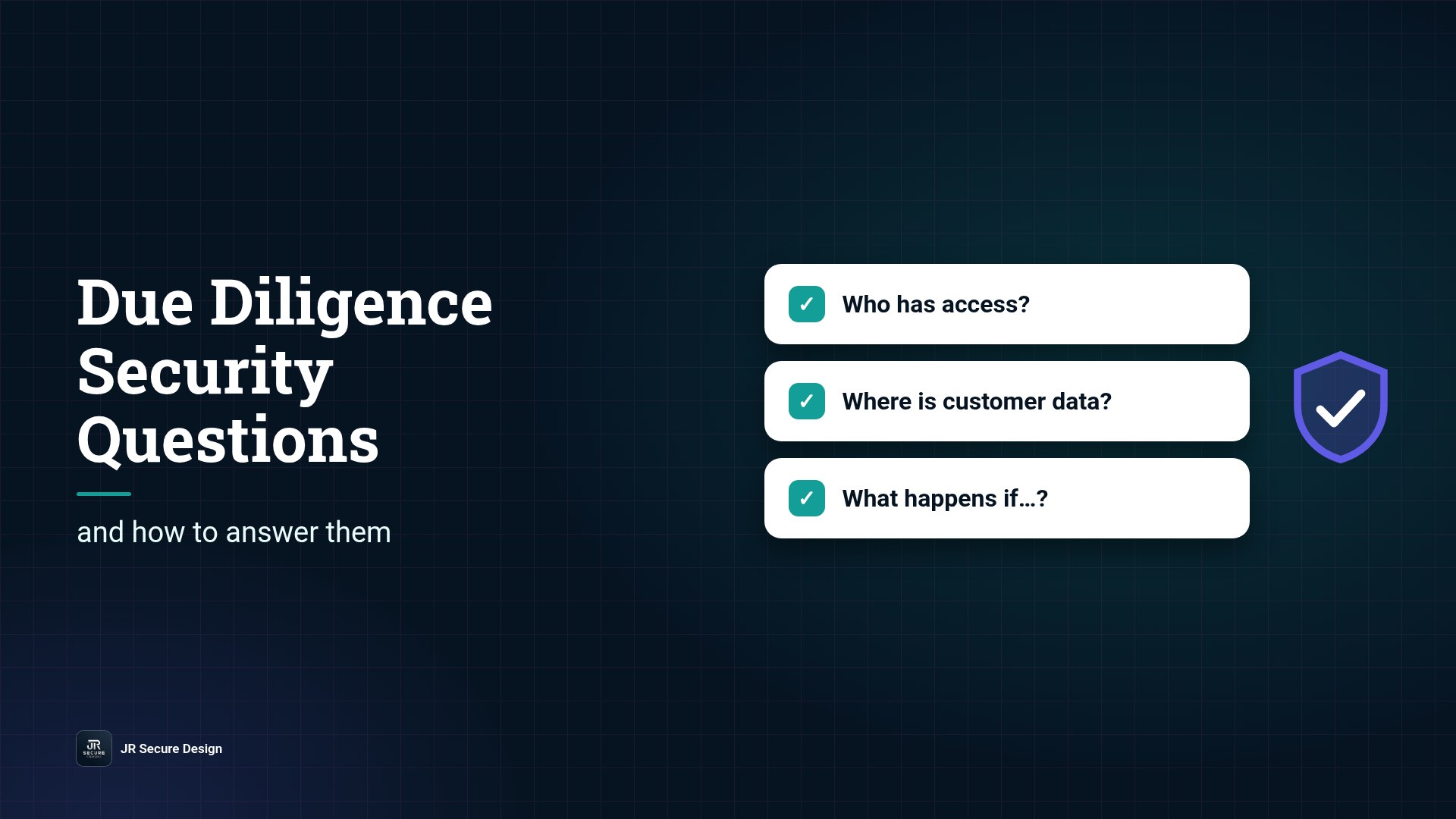
Investors and partners usually ask a handful of simple security questions: who owns your accounts and code, who has access, where customer data lives and how it’s protected, which AI tools touch it, and what you’d do if something went wrong. The best answers are short, honest, and specific, including any gaps and your plan to close them.
Key takeaways
- Security questions in due diligence are mostly about trust and basics.
- Each question is really checking one thing: control, care, or recovery.
- “We have a gap, and here’s the plan” beats “we take security seriously.”
- A one-page written summary answers most questions before they’re asked.
- Got a deck ready? Upload your PDF at jrsecuredesign.com/startups by Sunday, Oct 25 for our free online pitch deck competition.
Due diligence is how an investor checks that what you said in the pitch holds up. How deep it goes depends on the stage, the investor, and your market. A pre-seed check might be a few questions on a call. A larger round or an enterprise pilot may bring a written questionnaire. Either way, security comes up more often than founders expect, especially if you handle health, financial, or personal data or build with AI.
After 25+ years of building and securing technology, these are the questions we see most, what each one is really checking, and how to answer.
Want a technical partner beside you when the questions come?
Talk with JR Secure Design.
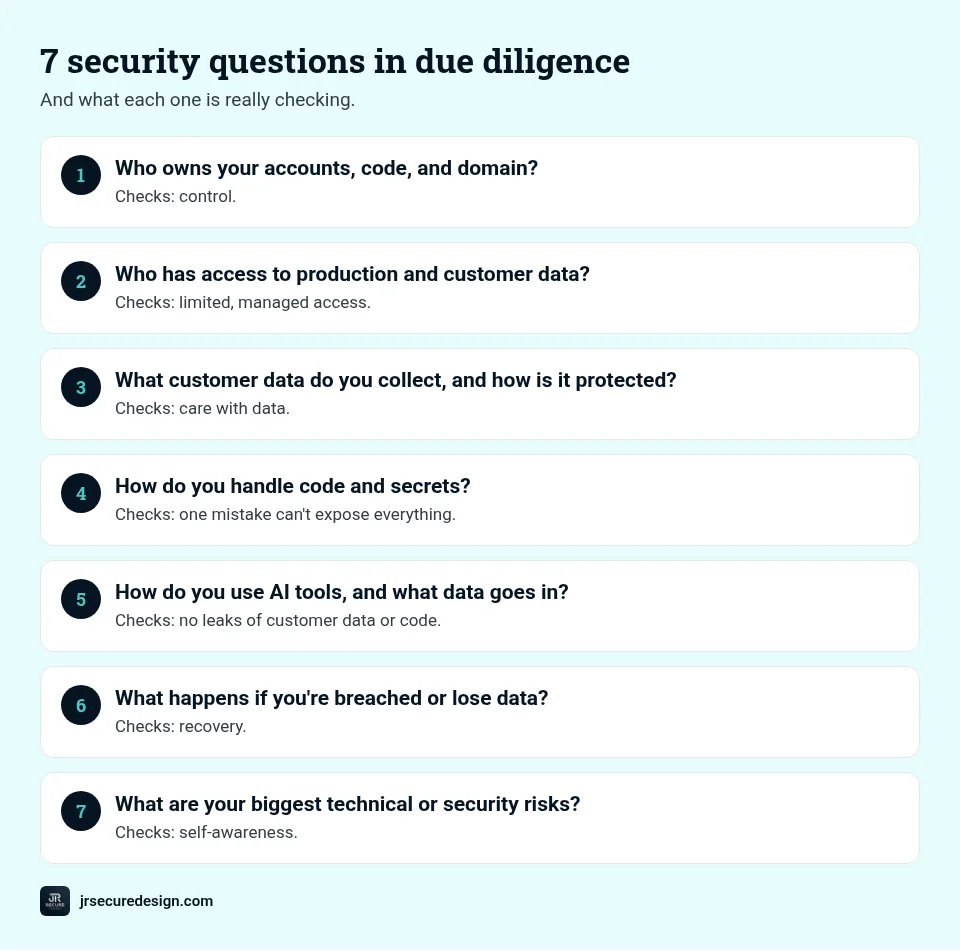
1. “Who owns your accounts, code, and domain?”
What it checks: Control. Can the company keep running if one person or contractor leaves?
Strong answer: “Everything is in company-owned accounts with at least two admins. Our contractor works inside our repository and cloud account.”
2. “Who has access to production systems and customer data?”
What it checks: Whether access is limited and managed.
Strong answer: “Three people have production access. Everyone uses multi-factor authentication and a password manager, and we remove access the day someone leaves.”
3. “What customer data do you collect, and how is it protected?”
What it checks: Care with data, and awareness of rules that may apply.
Strong answer: Name the data types, where they’re stored, that they’re encrypted, and who can see them. If health, financial, or children’s data is involved, say which rules you’ve checked and with whom. Don’t claim compliance you haven’t confirmed.
WARNING: Never overstate. Saying you’re “compliant” or “secure” without proof is a red flag if the investor checks.
4. “How do you handle code and secrets?”
What it checks: Whether a single mistake could expose everything.
Strong answer: “Keys and passwords are in our platform’s secrets manager, not in code. Changes get a second review, and we update dependencies monthly.”
5. “How do you use AI tools, and what data goes into them?”
What it checks: A newer question, especially for AI products. Investors want to know you won’t leak customer data or source code.
Strong answer: “We have a short list of approved tools and written rules on what data can go in. Our product’s AI features only access what each user is allowed to see.”
6. “What happens if you’re breached or lose data?”
What it checks: Recovery. Can you survive a bad day?
Strong answer: “Backups run daily, and we tested a restore last month. We have a one-page incident plan: who decides, who we notify, and the first steps.”
7. “What are your biggest technical or security risks?”
What it checks: Self-awareness. Every startup has risks.
Strong answer: Name one or two real ones and what you’re doing about them. “Our biggest risk is one engineer holding most of the knowledge. We’re documenting the system and adding a second reviewer this quarter.”
Not sure how to answer the security questions?
We can help you write a one-page summary that holds up.
How to prepare in an afternoon
Write a one-page “security and tech summary” covering the seven questions above. Keep it honest and update it monthly. Our pre-seed tech & security checklist covers the basics to put in place first. Free public guidance such as the NIST Cybersecurity Framework and CISA’s Secure by Design principles can help you organize it.
What if you have gaps?
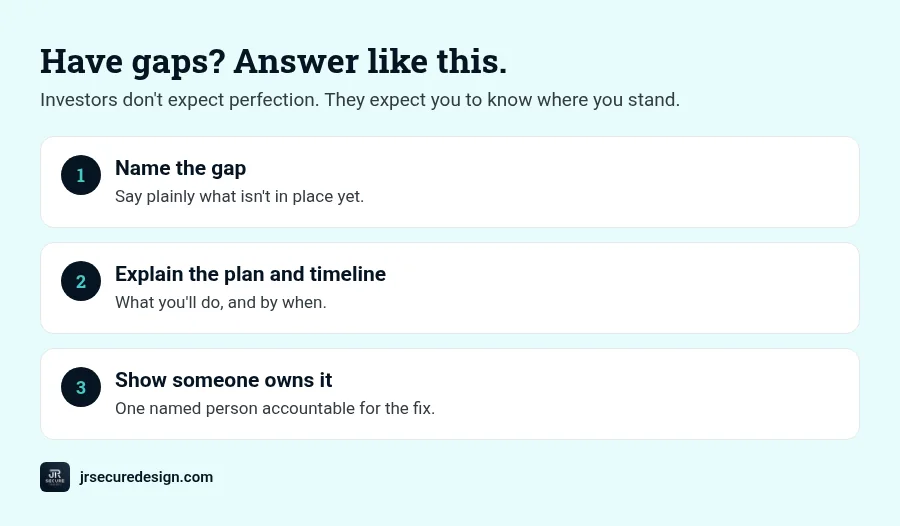
You will, and that’s normal at an early stage. Investors don’t expect perfection. They expect you to know where you stand. Name the gap, explain the plan and timeline, and show that someone owns it. If no one on the team owns technology and security decisions, our post on whether you need a CTO at pre-seed walks through the options.
Get feedback before investors see it
JR Secure Design is hosting a free, online pitch deck competition on Wednesday, Oct 28 at 7 PM ET. Upload your pitch deck as a PDF at jrsecuredesign.com/startups by Sunday, Oct 25. Founders get feedback on story, feasibility, and investor readiness from C-suite advisors, and the winner gets James DeCrescenzo as a free advisor to their company. Our pitch deck submission guide shows how to upload.
Want a technical partner beside you when the questions come? Our Fractional CTO service can help.
Frequently asked questions
What do investors ask about security in due diligence?
Common questions cover who owns accounts and code, who has access, where customer data lives, how it is protected, which AI tools touch it, and what you would do after an incident.
What is technical due diligence for a startup?
A review of your product, code, infrastructure, team, and risks, to check the company can build and run what it promises. Depth varies by stage and investor.
How do I prepare for technical due diligence?
Keep a short written summary of your stack, account ownership, access, data handling, AI-tool rules, and backups. Our pre-seed checklist is a good starting point.
What if my startup has security gaps?
Say so, and show the plan and timeline to fix them. Honest answers with a plan build more trust than vague claims.
Do early-stage startups get technical due diligence?
It varies. Some pre-seed investors ask only a few questions; later rounds and enterprise customers usually go deeper. Being ready early costs little.
Ready to submit?
Ready for the hard questions? Get feedback from C-suite advisors first.
Free, online pitch deck competition: Wednesday, Oct 28, 7 PM ET. Get feedback on story, feasibility, and investor readiness. The winner gets James DeCrescenzo (25+ years in technology and security) as a free advisor to their company.
Upload your pitch deck (PDF) at jrsecuredesign.com/startups by Sunday, Oct 25. Then call or book a 30-minute call.
Or email sales@jrsdi.com.
Related reading: Pre-Seed Tech & Security Checklist · What Investors Look For at Pre-Seed · Do You Need a CTO at Pre-Seed? · Startups at JR Secure Design
If you can think it, we can build it securely. Artificial Intelligence · Security · Applications · Hardware