
Do you need a CTO at pre-seed? Three options compared.
- 3 options compared
- 5 questions to decide
- Free deck competition Oct 28
Do you need a CTO at pre-seed? It means you need accountable technical leadership, not always a full-time hire. A technical co-founder, a fractional CTO, or an agency can fill the gap. The right choice depends on how central tech is to your product, how much equity you can give, and how fast you need to ship.
Key takeaways
- At pre-seed you need technical leadership, not necessarily a full-time CTO.
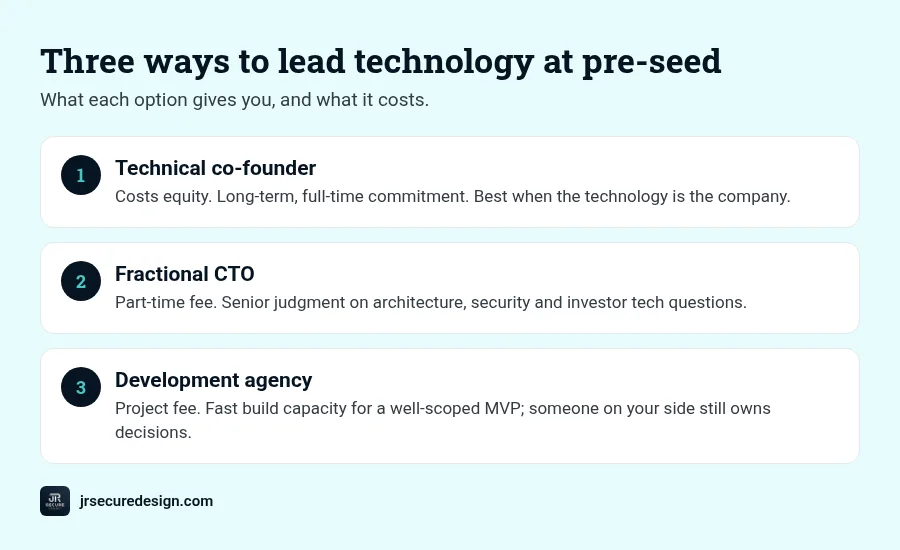
- A technical co-founder costs equity but brings long-term commitment. Best when tech is the product.
- A fractional CTO gives senior judgment part-time: architecture, security, hiring, and investor tech questions.
- An agency gives build capacity, but you still need someone on your side who owns the decisions.
- Whatever you choose, your pitch deck must show who builds the product and how.
If you’re a non-technical founder, this is one of the first big decisions you’ll make. Get it wrong and you can lose months to rebuilds, a stack nobody can maintain, or a product that leaks customer data. Get it right and your deck’s feasibility story gets much stronger.
Not sure who should own your technical decisions?
Talk with JR Secure Design.
What a CTO actually does at pre-seed
At this stage a “CTO” is less about managing a big team and more about making good early calls:
- Choosing the architecture and stack so the MVP can grow without a rewrite.
- Deciding build vs buy for each feature.
- Setting security basics early, such as access control, data handling, and safe use of AI tools.
- Hiring or managing builders, whether employees, freelancers, or an agency.
- Answering investor tech questions on calls and in due diligence.
- Keeping the roadmap realistic so you don’t promise what can’t ship.
QUICK CHECK: If an investor asked “who owns your technical decisions?” tomorrow, could you name one person and explain why? If not, start here.
Option 1: Technical co-founder
A co-founder who builds and owns the product, usually in exchange for meaningful equity.
Best when: the technology is the company (deep tech, AI models, complex platforms) and you’ll need full-time technical leadership for years.
Pros
- Long-term commitment and aligned incentives.
- Investors often like to see technical depth on the founding team.
- Fast day-to-day decisions.
Cons
- Finding the right person can take a long time, and a poor fit is hard to undo.
- Costs significant equity.
- A great builder isn’t always strong on security, architecture, or leading a team.
Option 2: Fractional CTO
An experienced technology leader who works with you part-time, often a few hours a week, for an agreed scope.
Best when: you need senior judgment now (architecture, security, vendor choice, investor questions) but not a full-time executive yet, or you’re still searching for a technical co-founder.
Pros
- Senior experience without giving up co-founder equity.
- Can start quickly and scale up or down.
- Can manage agencies or freelancers on your behalf and check their work.
- Strengthens the feasibility and team slides in your deck.
Cons
- Part-time, so not your full-time builder.
- Works best with a clear scope and regular check-ins.
For a deeper explanation, see What Is a Fractional CTO?
Option 3: Development agency
An outside firm that designs and builds your product for a fee.
Best when: you have a clear, well-scoped MVP and need build capacity fast.
Pros
- A full team (design, development, testing) available quickly.
- Predictable deliverables for a defined scope.
Cons
- Agencies build what you specify. If the spec is wrong, the product is wrong.
- You may not own the knowledge of how the system works when the contract ends.
- Security and long-term maintainability vary widely between firms.
WARNING: Hiring an agency without anyone technical on your side is the riskiest combination. You can’t judge estimates, review the code, or spot shortcuts until they cost you.
Side-by-side comparison
Side-by-side: co-founder vs fractional CTO vs agency
| Technical co-founder | Fractional CTO | Agency | |
|---|---|---|---|
| Main cost | Equity | Part-time fee | Project fee |
| Commitment | Full-time, long-term | Part-time, flexible | Per project |
| Strategic judgment | Varies by person | High (core of the role) | Limited to the scope |
| Build capacity | One person to start | Guides the builders | High |
| Owns security decisions | If experienced | Yes | Rarely, unless contracted |
| Investor tech questions | Yes | Yes | Not usually |
| Time to start | Slow (search) | Fast | Fast |
Many pre-seed teams combine them
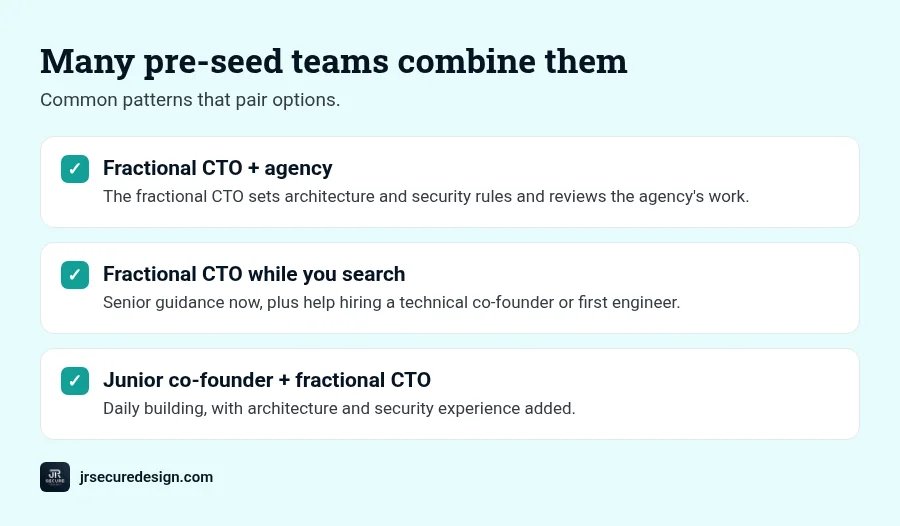
The options aren’t exclusive. Common patterns we see:
- Fractional CTO + agency: the fractional CTO sets the architecture and security rules, writes or checks the scope, and reviews the agency’s work.
- Fractional CTO while you search: senior guidance now, plus help interviewing and onboarding a future technical co-founder or first engineer.
- Junior technical co-founder + fractional CTO: the co-founder builds every day while the fractional CTO adds architecture and security experience.
How to decide: five questions
- Is technology your core advantage? If yes, keep searching for a technical co-founder, and get senior help in the meantime.
- How much equity can you give? If not much, a fractional CTO or agency keeps the cap table cleaner.
- Is your MVP well defined? If yes, an agency can build it, ideally with technical oversight. If not, you need strategy before code.
- Will you handle sensitive data or AI? If yes, someone must own security from day one.
- What will you tell investors? Your deck’s team and feasibility slides need a clear answer. Our guide to the slides investors expect shows where it goes.
Need senior technical judgment now?
A fractional CTO can start quickly.
Where JR Secure Design fits
JR Secure Design offers Fractional CTO help for early-stage founders: architecture, security-first builds, AI decisions, vendor and agency oversight, and investor tech questions. James DeCrescenzo brings 25+ years of experience in technology and security, and our approach is aligned to recognized security practices.
Have a deck already? Put it in front of advisors first. Our free, online pitch deck competition is Wednesday, Oct 28 at 7 PM ET. Upload your PDF at jrsecuredesign.com/startups by Sunday, Oct 25 to get feedback on your story, feasibility, and investor readiness from C-suite advisors. The winner gets James DeCrescenzo as a free advisor to their company. Our pitch deck submission guide covers the upload steps.
Frequently asked questions
Does a pre-seed startup need a CTO?
Not always a full-time one. A pre-seed startup needs someone accountable for technical decisions such as architecture, security, and who builds the product. That can be a technical co-founder, a fractional CTO, or an advisor overseeing an agency.
What does a fractional CTO do for a startup?
A fractional CTO provides part-time senior technology leadership. They choose the architecture and stack, set security basics, oversee developers or agencies, keep the roadmap realistic, and help answer investor tech questions.
Should I hire an agency to build my MVP?
An agency can work well for a clearly scoped MVP, but have someone technical on your side to check estimates, review the work, and own security and long-term decisions. Without that, you take on extra risk.
Do investors care if I don’t have a technical co-founder?
Investors want to know who builds the product and whether the team can deliver. If you don’t have a technical co-founder, show a clear plan, such as a fractional CTO, an experienced advisor, or a vetted build partner.
When should a startup hire a full-time CTO?
Usually when technology work needs daily leadership: a growing engineering team, a complex product, or funding to support a senior hire. Until then, a fractional CTO can cover the role.
Ready to submit?
Show investors who builds it. Start with your deck.
Free, online pitch deck competition: Wednesday, Oct 28, 7 PM ET. Get feedback on story, feasibility, and investor readiness from C-suite advisors. The winner gets James DeCrescenzo (25+ years in technology and security) as a free advisor to their company.
Upload your pitch deck (PDF) at jrsecuredesign.com/startups by Sunday, Oct 25. Then call or book a 30-minute call.
Need technical leadership now? Our Fractional CTO service can help.
Or email sales@jrsdi.com.
Related reading: Security Questions Investors Ask in Due Diligence · Pre-Seed Tech & Security Checklist · Common Pitch Deck Mistakes (and Quick Fixes) · The Slides Investors Expect in a Pre-Seed Pitch Deck · How to Submit a Pitch Deck · What Is a Fractional CTO? · Startups at JR Secure Design
If you can think it, we can build it securely. Artificial Intelligence · Security · Applications · Hardware
Follow JR Secure Design
Follow JR Secure Design: LinkedIn · Facebook · X · Instagram · YouTube · TikTok · Pinterest · Reddit · Medium
A simple way to decide this week
Write down the next 90 days of product work. If most of it is invention you cannot specify yet, you need a technical co-founder or a fractional CTO who can own architecture and hiring. If most of it is known build work with clear acceptance criteria, an agency can ship while a fractional CTO stays on your side for decisions, security, and investor tech questions. If you already have a strong technical co-founder, keep them focused on product and use outside help only where it speeds delivery without splitting ownership.
Your pitch deck should name who owns technology, how the product gets built, and what is already working. Vague feasibility slides are one of the fastest ways a pre-seed conversation stalls. If you want a second set of eyes on that story, upload your PDF at our Startups page by Sunday, October 25, or walk through the checklist in How to Submit a Pitch Deck.