
AI search engines don’t show ten blue links. They write one answer and cite a few sources. Here’s how to rank in AI search and make your business one of those sources, without exposing anything that should stay private.
- ChatGPT search
- Google AI Overviews & AI Mode
- Perplexity & Copilot
- Free checklist
Sophia is JR Secure Design’s AI strategic advisor, and she’s free to use. Type or talk, tell her what you need, and she’ll get you started. Prefer a person? Call (202) 892-7189.
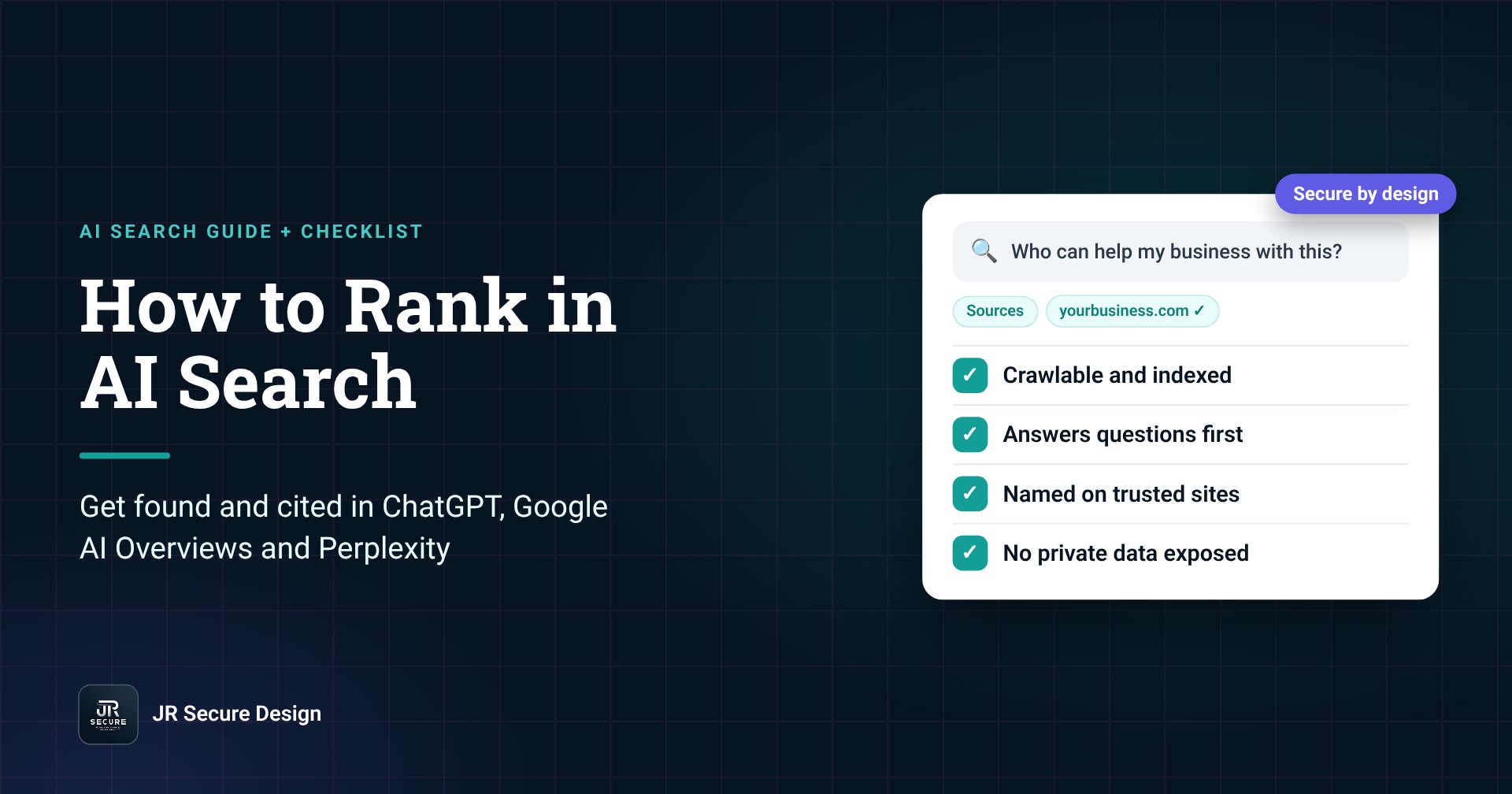
To rank in AI search, make sure AI search engines can crawl and index your pages, answer your customers’ questions directly in plain text, and get your business described the same way on sites those engines already trust. Google’s AI Overviews and AI Mode draw on Google’s normal search index. ChatGPT search depends on OpenAI’s OAI-SearchBot crawler. Perplexity uses PerplexityBot. If those can’t reach you, nothing else on this page matters.
Key takeaways
- Ranking in AI search means being cited or named in the answer, not sitting at position #1 in a list.
- Google says there are no extra technical requirements for AI Overviews or AI Mode: the page must be indexed and eligible to show a snippet.
- ChatGPT and Perplexity each have their own search crawler. Block it, and you can’t be shown in their search answers.
- Lead every page with a direct answer, use your customers’ own questions as headings, and back claims with sources.
- Third-party mentions and consistent business details help engines trust that you are who you say you are.
- Don’t trade security for visibility: no hidden text for bots, no private data on public URLs.
Not sure where to start?
Tell Sophia, our free AI strategic advisor, about your business and what you want to build. Sophia is free to use. Or talk it through with our team, who bring 25+ years in technology and security.
Or call (202) 892-7189. Or email sales@jrsdi.com.
What does it mean to rank in AI search?
When someone asks ChatGPT, Google’s AI Mode or Perplexity a question, the engine turns it into one or more searches, reads the pages it finds, writes an answer, and links a handful of sources. Google calls this “query fan-out”: issuing multiple related searches across subtopics to build a response. Ranking in AI search means your page is one of those sources, or your business is the one named in the answer.
You’ll hear three names for this work. They overlap far more than the acronyms suggest:
| Term | What it means | Goal |
|---|---|---|
| SEO | Search engine optimization for classic results pages | Rank in the list of links |
| AEO | Answer engine optimization: being the direct answer to a question (snippets, voice assistants, AI answers) | Be the answer |
| GEO | Generative engine optimization: being cited or named inside AI-generated answers | Be a cited source |
In practice, the same crawlable, clear, trustworthy pages win in all three. You don’t need a separate “AI website.”
How do you rank in ChatGPT search?
Allow OAI-SearchBot, get indexed in Bing, and publish pages that answer the exact questions your buyers type. OpenAI says sites that opt out of OAI-SearchBot will not be shown in ChatGPT search answers (apart from navigational links), and that robots.txt changes take about 24 hours to register.
- Check robots.txt and your firewall. OAI-SearchBot is the search crawler. GPTBot is the separate training crawler; OpenAI treats each setting independently, so you can allow search and still opt out of training.
- Verify your site in Bing Webmaster Tools. OpenAI’s help center names Bing among the third-party search providers ChatGPT search can use.
- Ask ChatGPT your customers’ questions with search on, and note which sources it cites. Those are the pages and sites you need to match or appear on.
- Say plainly who you serve, where, and what you do on your home, service and about pages, so the model can categorize you.
How do you show up in Google AI Overviews and AI Mode?
Do solid SEO: be indexed, be snippet-eligible, and be the most helpful page on the question. Google says that to appear as a supporting link in AI Overviews or AI Mode, a page must be indexed and eligible to be shown in Google Search with a snippet, with no additional technical requirements, and no special AI text files or markup needed.
- Allow Googlebot in robots.txt and at your CDN or hosting firewall.
- Don’t put
noindex,nosnippetor a tightmax-snippeton pages you want cited. - Keep important content in text, link to it from other pages on your site, and make sure any structured data matches what’s visible.
- In Search Console, check that your site is included under Settings > Search generative AI (inclusion is the default).
How do you get cited by Perplexity and Microsoft Copilot?
Allow PerplexityBot and Bingbot, keep pages fresh and specific, and earn mentions on sites your industry trusts. Perplexity recommends allowing PerplexityBot in robots.txt and its published IP ranges for your site to appear in its results. Microsoft Copilot and Bing’s AI summaries use Bing’s index, and Bing Webmaster Tools now has an AI Performance report that shows which of your pages get cited.
What should an AI search optimization checklist include?
Five things: access for AI crawlers, answer-first pages, trust signals, security basics, and a way to measure. Work through it top to bottom. The first block is pass/fail; the rest compounds over time. Want a quick starting point? Get your free AI search score from Sophia, our AI assistant, for a 0–100 readiness check with up to 3 fixes.
1. Access
- robots.txt allows Googlebot, Bingbot, OAI-SearchBot and PerplexityBot, and your CDN or firewall doesn’t block them
- Key pages are indexed in Google Search Console and Bing Webmaster Tools
- No
noindexornosnippeton pages you want cited - Main content is real text in the page, not only in images, PDFs or script-loaded widgets
2. Answers
- One page per real customer question, with the direct answer in the first one or two sentences
- Headings use the words customers actually search with
- Specifics included: who you serve, where, what you do, steps, and a visible “updated” date
- Any figure links to its original source
- Structured data (Organization, FAQPage) matches the visible text
3. Trust
- Business name, address, phone and one-line description match on your site, Google Business Profile, LinkedIn and directories
- Mentions on reputable sites your customers read (reviews, industry directories, communities), earned rather than bought
- A named author with real, relevant experience on key pages
4. Security
- No customer data, internal documents or staging pages on public, crawlable URLs
- No hidden text or hidden instructions aimed at AI crawlers
- AI training (GPTBot, Google-Extended) decided separately from AI search (OAI-SearchBot, Googlebot)
- WordPress, plugins and themes patched, with admin accounts protected by strong sign-in
5. Measurement
- A short list of customer prompts you test each month in ChatGPT, Google and Perplexity, noting who gets cited
- Bing Webmaster Tools AI Performance and Google Search Console reports reviewed monthly
Want a second set of eyes on your site?
Start with Sophia, our free AI advisor: tell her about your business and website, and she’ll get you started. Or book 30 minutes with our team.
Sophia is free to use. She’s an AI assistant and can make mistakes.
How do you rank in AI search without opening a security hole?
Skip any tactic that hides content from people, exposes private data, or leaves your site unpatched, and control AI training separately from AI search. If you can think it, we can build it securely, and that applies to visibility, too. Some “AI SEO” tactics create real risk:
- Hidden prompts and text for bots. Google’s spam policies cover attempts to manipulate generative AI responses and list hidden text as abuse. Instructions hidden in a page are also how prompt injection attacks work, so don’t normalize them on your own site.
- Over-sharing to look authoritative. Case studies, pricing sheets and client lists posted as crawlable files can end up quoted in AI answers. Publish what you’d say to a stranger, and nothing more.
- Unpatched sites. Google lists hacked content as spam; injected pages and hidden links can sink a site’s visibility. Patching is an AI search task now.
- Mixing up training and search. You can stay out of AI model training and still appear in AI search, because the crawlers are controlled separately.
Thinking about putting an AI assistant on your own site? Read Is ChatGPT safe for business? and our guide to a private LLM for business.
How can you tell if AI search optimization is working?
Test the questions your buyers ask in each AI engine every month, and check the citation reports Bing and Google provide.
- Pick 10 to 20 prompts your buyers would ask, such as “who can help with [your service] in [your city]?”
- Run them monthly in ChatGPT (with search), Google and Perplexity. Record whether you’re cited, named, or missing, and who is cited instead.
- Check the official reports. Bing’s AI Performance report shows citations across Copilot and Bing AI summaries. Google points site owners to Search Console’s Generative AI performance report.
- Fix the gaps: a missing page, a weak answer, or a site where your competitors are mentioned and you aren’t.
No engine publishes a guaranteed timeline, and no one can promise a citation. Anyone who does is guessing.
Frequently asked questions
How do you rank in AI search?
Make sure AI search engines can crawl and index your pages, answer customer questions directly in plain text, and get your business described consistently on sites those engines trust. Google’s AI Overviews and AI Mode use Google’s normal index, ChatGPT search relies on OAI-SearchBot, and Perplexity uses PerplexityBot.
What is generative engine optimization (GEO)?
GEO is the practice of making your content easy for AI systems like ChatGPT, Google AI Overviews and Perplexity to find, trust and cite in their generated answers. The term comes from a 2023 research paper on arXiv.
What’s the difference between GEO, AEO and SEO?
SEO aims to rank in classic search results. AEO aims to be the direct answer to a question. GEO aims to be cited or named inside AI-generated answers. The same crawlable, clear and trustworthy pages support all three. For a plain-English breakdown, read GEO vs AEO vs SEO: what it means for a small business.
How do I get my business to show up in ChatGPT?
Allow OAI-SearchBot in robots.txt and your firewall, verify your site in Bing Webmaster Tools, publish pages that answer your buyers’ questions plainly, and earn mentions on sites ChatGPT already cites for your category.
How do I get indexed by ChatGPT?
You don’t submit your site to ChatGPT directly. Getting indexed by ChatGPT means letting its search crawler, OAI-SearchBot, reach your pages in robots.txt and your firewall, and making sure Bing has indexed them, since OpenAI names Bing among the search providers ChatGPT search can use. OpenAI says robots.txt changes take about 24 hours to register. For the step-by-step version, see our guide on how to show up in ChatGPT.
How do I show up in Google AI Overviews?
Google says a page must be indexed and eligible to show a snippet, with no additional technical requirements. Focus on crawlability, helpful people-first content, internal links, and structured data that matches the visible page.
Do I need an llms.txt file to rank in AI search?
Google says you don’t need new machine-readable files, AI text files or markup to appear in AI Overviews or AI Mode. Allowing the right crawlers and publishing clear answers matters far more.
How long does it take to show up in AI answers?
No AI engine publishes a timeline. OpenAI and Perplexity say crawler setting changes can take about 24 hours to register, but being cited also depends on indexing and on whether your page is the best answer.
Can I see how often AI cites my website?
Partly. Bing Webmaster Tools has an AI Performance report for Microsoft Copilot and Bing AI summaries, and Google points site owners to the Generative AI performance report in Search Console. For ChatGPT and Perplexity, test your key prompts and note the cited sources.
Get found, securely
Ready to show up where your customers ask questions?
Talk to Sophia, our free AI strategic advisor, or book a call with a team that brings 25+ years in technology and security. See all our services and the AI Strategic Advisor Marketing Platform.
Or call (202) 892-7189. Or email sales@jrsdi.com.
Related reading: What Is Prompt Injection? · Is ChatGPT Safe for Business? · AI Security for Small Business · Private LLM for Business
If you can think it, we can build it securely. Artificial Intelligence · Security · Applications · Hardware