
What to show when you’re early.
- What counts as traction
- A 10-minute slide check
- Decks due Sunday, Oct 25
Your traction slide should show the strongest honest proof that people want what you’re building, with real numbers and dates. At pre-seed that might be a waitlist, active users, pilots, letters of intent, repeat usage, or clear learning from customer conversations. One or two honest metrics with a trend beat a crowded chart every time.
Key takeaways
- Traction is any honest proof that people want what you’re building.
- Pick one or two metrics that matter, and show the trend with dates.
- Never stretch a number. Label intent as intent and pilots as pilots.
- If you’re very early, show what you’ve learned and the next milestone.
- Decks are due Sunday, Oct 25. Upload your PDF at jrsecuredesign.com/startups for our free online pitch deck competition.
Founders often skip the traction slide or stuff it with every number they have. Both send the wrong signal. Investors use this slide to answer one question: is there real evidence that customers want this? Public guides such as Y Combinator’s How to build your seed round pitch deck put traction near the front for that reason. Here’s how to build a strong one, even when you’re early, drawing on 25+ years of building technology products.
Want feedback on your traction slide before you raise?
Talk with JR Secure Design.
Or call (202) 892-7189. Or email sales@jrsdi.com.
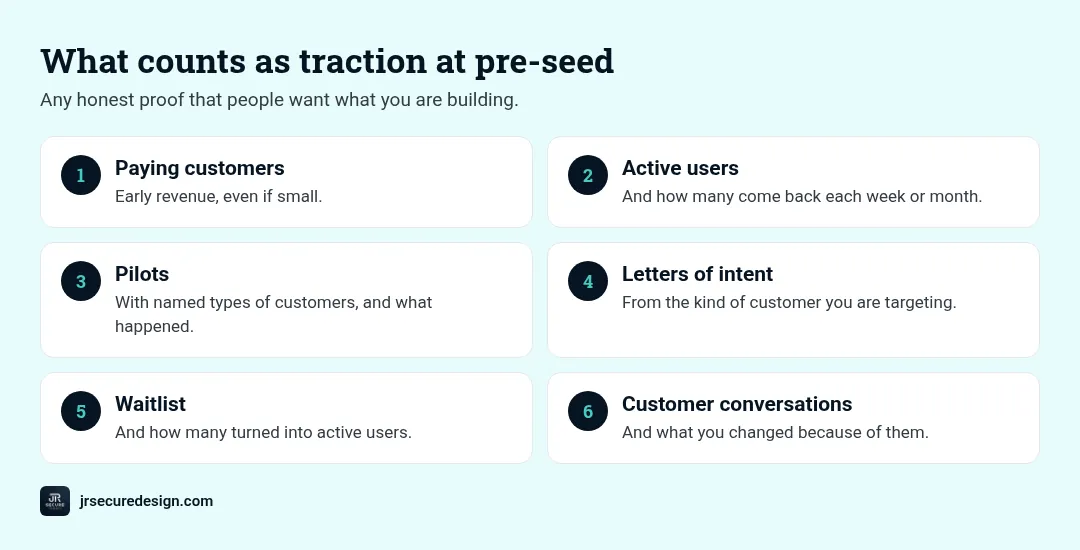
What counts as traction at pre-seed
Revenue is great, but it isn’t the only proof. Depending on your stage, traction can include:
- Paying customers or early revenue, even if small
- Active users, and how many come back each week or month
- Pilots with named types of customers, and what happened
- Letters of intent (LOIs) from the kind of customer you’re targeting
- A waitlist, and how many turned into active users
- Customer conversations, and what you changed because of them
QUICK CHECK: Ask yourself which single number best shows that customers want this. Lead with it.
Pick one or two metrics that matter
More numbers don’t make a stronger slide. They make it harder to read. Choose the one or two that best show demand for your product, then make them easy to understand:
- Name the metric plainly. “Weekly active users,” not “engagement.”
- Show the trend. Three or four points over time, with dates, say more than one big number.
- Add a one-line meaning. “Clinics in the pilot used it every working day.”
Be honest about what each number is
WARNING: One stretched figure makes investors doubt the rest of your deck. Label intent as intent, pilots as pilots, and free users as free users.
- Don’t count sign-ups as customers.
- Don’t present an LOI as signed revenue.
- Don’t hide the start date of a chart to make growth look steeper.
- If a number is small, say so and explain why it matters anyway.
Investors talk to many founders. Honest small numbers build more trust than big unclear ones. Our post on common pitch deck mistakes covers more ways numbers go wrong.
If you have almost no traction yet
That’s normal for many pre-seed companies. Rename the slide “Validation” or “Progress” and show:
- What you’ve built, such as a working prototype or first release
- What you’ve learned, such as the top problems customers told you about
- Early signals, such as a pilot that’s starting, a waitlist, or intro calls
- Your next milestone, and the date you expect to hit it
This turns “we’re early” into “we’re learning fast,” which is what investors at this stage want to see. Our guide on what investors look for at pre-seed explains why.
Not sure your numbers come from a system, not a guess?
We can help you set up tracking you can defend.
Or call (202) 892-7189. Or email sales@jrsdi.com.
Make sure you can measure it
Traction you can’t measure is hard to defend. Before you raise, make sure your product tracks basic usage, sign-ups, and retention, and that the numbers come from a system, not a guess. If you can’t answer “how many people used it last week?” in a minute, fix your tracking first. Our post on MVP tech stack mistakes covers adding analytics from day one.
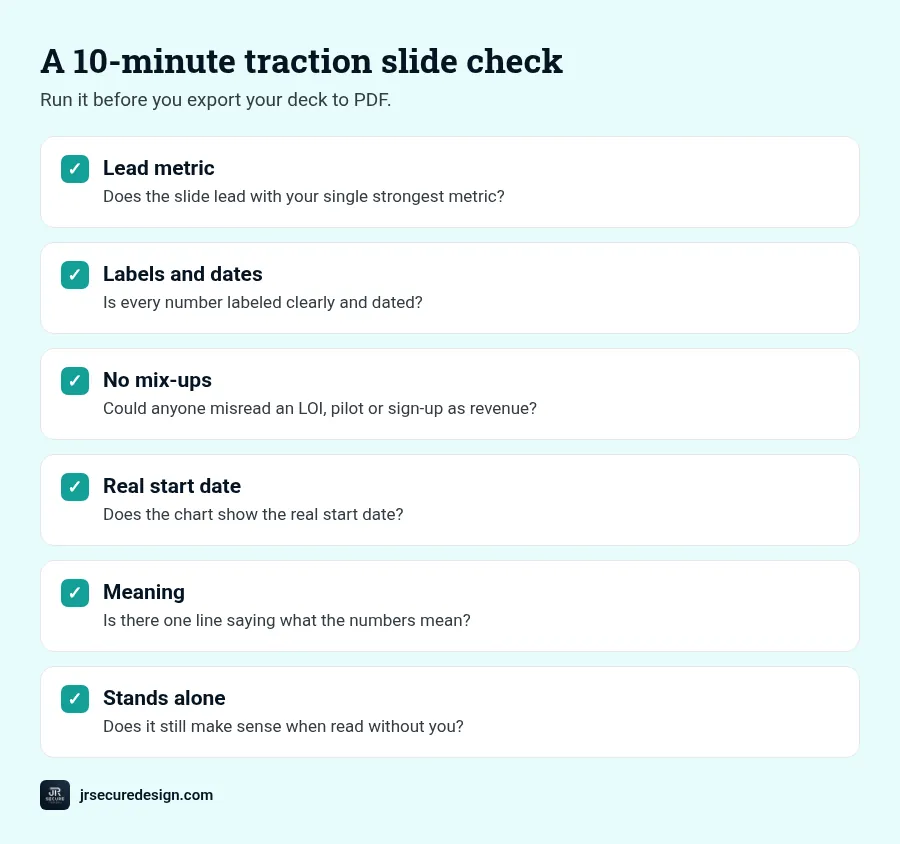
A 10-minute traction slide check
- Does the slide lead with your single strongest metric?
- Is every number labeled clearly and dated?
- Could anyone misread an LOI, pilot, or sign-up as revenue?
- Does the chart show the real start date?
- Is there one line saying what the numbers mean?
- Does it still make sense when read without you?
Then export your deck to PDF. Our pitch deck submission guide shows how, and decks are due Sunday, Oct 25.
Get feedback before investors see it
JR Secure Design is hosting a free, online pitch deck competition on Wednesday, Oct 28 at 7 PM ET. Upload your pitch deck as a PDF at jrsecuredesign.com/startups by Sunday, Oct 25. Founders get feedback on story, feasibility, and investor readiness from C-suite advisors, and the winner gets James DeCrescenzo as a free advisor to their company. Our pitch deck submission guide shows how to upload.
Need help showing the product can be built and measured? Our Fractional CTO service can help.
Frequently asked questions
What should a traction slide include?
Your strongest honest proof that people want what you’re building, with numbers, dates and a short note on what it means. Pick one or two metrics, not ten.
How do I show traction with no revenue?
Use what you have: a waitlist, active users, pilots, letters of intent, repeat usage, or clear learning from customer interviews. Show the trend and what you’ll prove next.
Do letters of intent count as traction?
They can help, especially from the kind of customer you’re targeting. Be clear they are intent, not signed revenue.
Which metrics matter at pre-seed?
The ones that show real demand for your product: active users, retention, pilot results, conversion from waitlist to use, or paying customers if you have them.
Should I include a traction slide if I have no users yet?
Yes, but call it “Validation” or “Progress” and show what you’ve learned and built, plus the milestone you’ll hit next.
Ready to submit?
Traction slide ready? Get feedback from C-suite advisors.
Free, online pitch deck competition: Wednesday, Oct 28, 7 PM ET. Get feedback on story, feasibility, and investor readiness. The winner gets James DeCrescenzo (25+ years in technology and security) as a free advisor to their company.
Upload your pitch deck (PDF) at jrsecuredesign.com/startups by Sunday, Oct 25. Then book a 30-minute call.
Or call (202) 892-7189. Or email sales@jrsdi.com.
Related reading: The Slides Investors Expect · Common Pitch Deck Mistakes · What Investors Look For at Pre-Seed · Startups at JR Secure Design
If you can think it, we can build it securely. Artificial Intelligence · Security · Applications · Hardware