
Pitch deck slides, in the order investors expect.
- 10 slides, in order
- The feasibility slide
- Free deck competition Oct 28
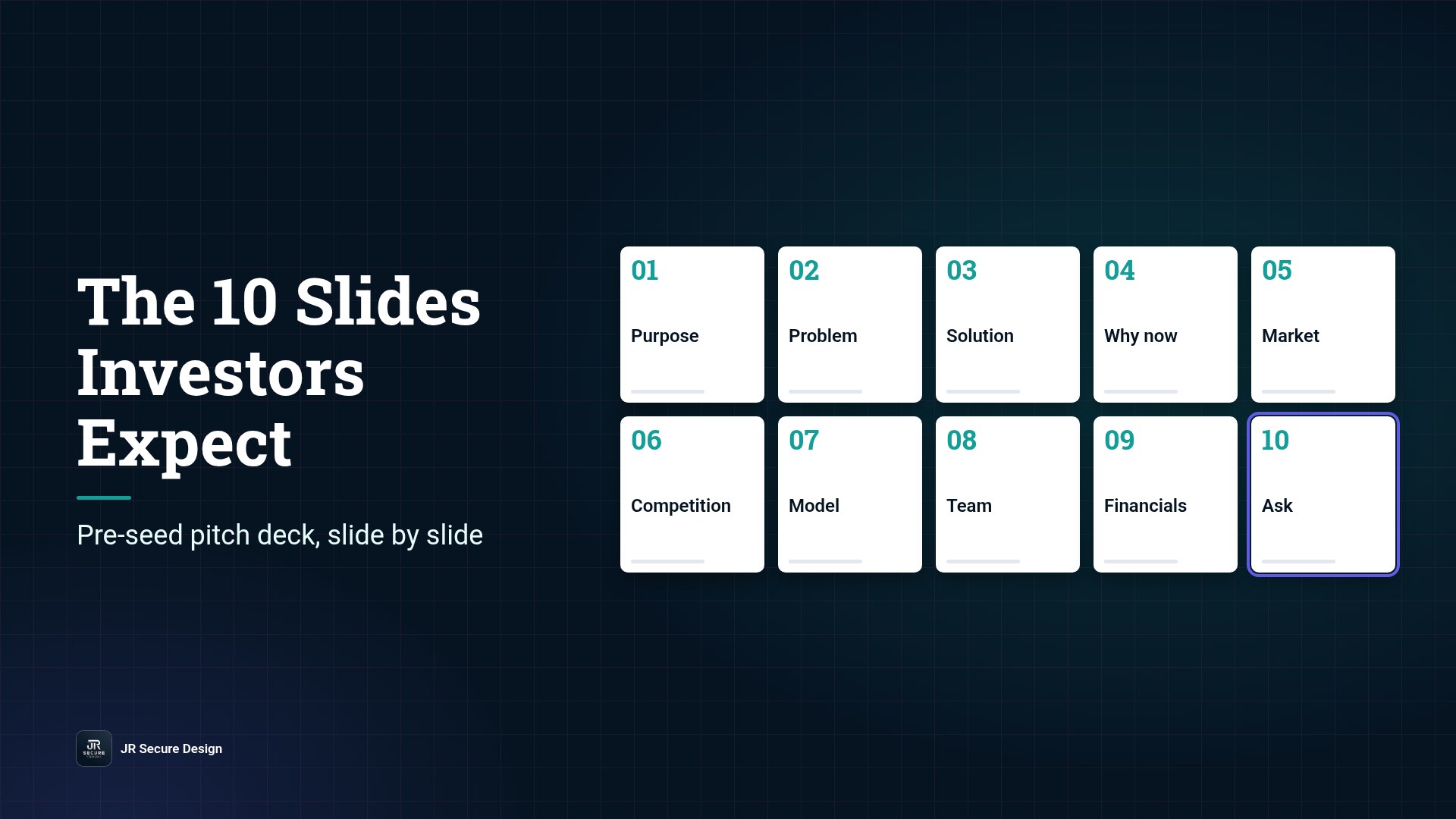
Pitch deck slides means the ordered pages of your pre-seed story. Investors expect about ten: purpose, problem, solution, why now, market, competition, business model, team, financials, and the ask. Each slide answers one question. If a slide does not answer its question in one clear sentence, cut it or rewrite it before you share the deck.
Key takeaways
- About ten slides cover what investors expect at pre-seed: purpose, problem, solution, why now, market, competition, business model, team, financials, and the ask.
- Each slide should answer one question in one sentence before any detail.
- At pre-seed, the team and the problem carry the most weight. Your numbers can be early, but they must be honest.
- Show how the product gets built (feasibility). Many first decks go vague here.
- Got a deck ready? Upload your PDF at jrsecuredesign.com/startups by Sunday, Oct 25 for our free online pitch deck competition.
You don’t need a designer or a template marketplace to build a good first deck. You need a clear story and the slides that tell it, in the order an investor expects to hear it.
The list below follows the structure Sequoia lays out in its public guide, Writing a business plan, and the advice in Y Combinator’s How to build your seed round pitch deck. We’ve added notes from 25+ years of building technology, because the tech and feasibility questions are where we see founders lose the room.
Want feedback on your deck before you raise?
Talk with JR Secure Design.
Why slide order matters
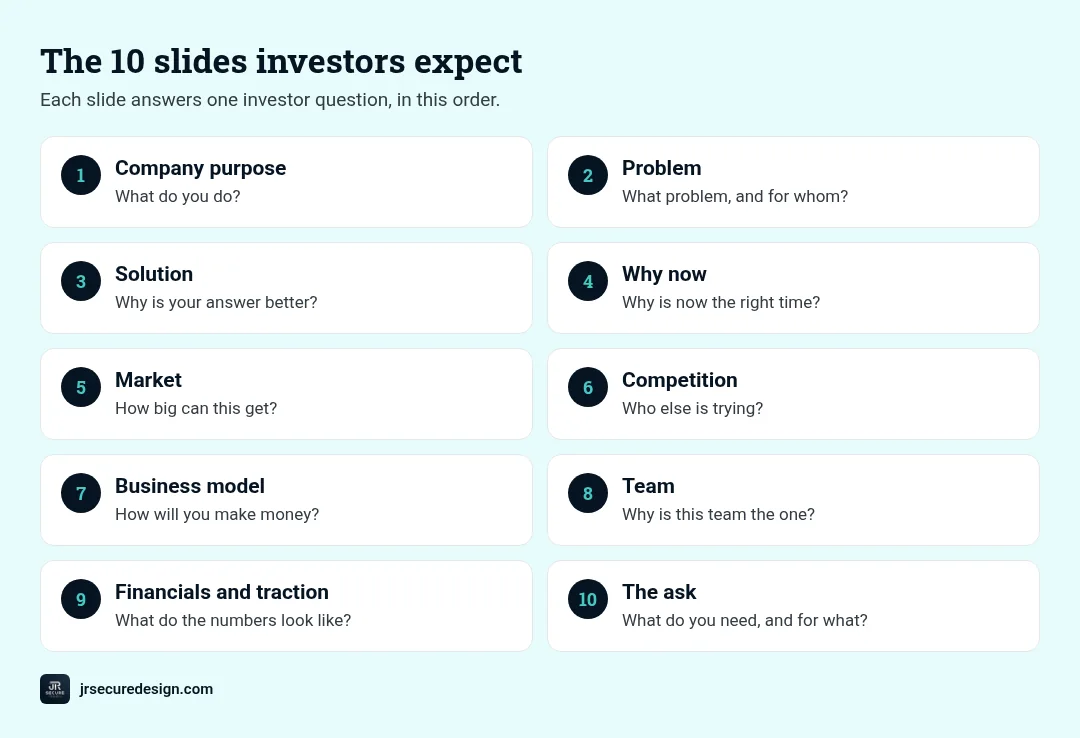
Investors read a lot of decks, often quickly and often without you in the room. A familiar order helps them find the answers they need. Think of the deck as a sequence of questions:
- What do you do?
- What problem do you solve, and for whom?
- Why is your answer better?
- Why is now the right time?
- How big can this get?
- Who else is trying?
- How will you make money?
- Why is this team the one to do it?
- What do the numbers look like?
- What do you need, and what will you do with it?
Every slide below answers one of those questions.
QUICK CHECK: Read only the headline of each slide, in order. Does it tell your whole story in under a minute? If not, rewrite the headlines before you touch the design.
The 10 slides investors expect
Company purpose
One sentence that says what you do. No buzzwords. “We help small clinics book patients without a front-desk hire” beats “AI-powered healthcare transformation platform.” If a stranger can’t repeat it back, keep editing.
Problem
Describe the pain, who feels it, and how they handle it today. Specific beats big. Name the customer, the moment the problem shows up, and what it costs them in time, money, or risk. If you have customer quotes from your own interviews, this is the place for one.
Solution
Show how your product solves that exact problem. Screenshots or a simple flow beat a feature list. Explain why your approach works where today’s workaround doesn’t.
Why now
What changed that makes this possible or urgent today? It could be a new technology, a regulation, a cost drop, or a shift in how customers buy. Investors want to know why this didn’t already exist and why it won’t wait.
Market
Who buys, how many of them there are, and how you reach the first ones. Build the number from the bottom up (customers × price) rather than quoting a giant industry figure. If you use any outside market figure, cite a current source on the slide.
Competition and alternatives
Every startup has competition, even if it’s a spreadsheet or “do nothing.” List the real alternatives and say plainly where you win. “We have no competitors” is a red flag, not a strength.
Business model
How you make money: who pays, how much, how often, and roughly what it costs you to deliver. At pre-seed, a clear, believable plan matters more than a perfect one.
Team
Why you are the people to build this. Show relevant experience, how long you’ve worked together, and who builds the product. If you don’t have a technical co-founder yet, say who is building it and how. That question will come up either way (see our guide Do You Need a CTO at Pre-Seed?).
Financials and traction
Show what you actually have: users, pilots, letters of intent, revenue, waitlist, or nothing yet. Then show a simple plan for the next 12–18 months. Never inflate early numbers. One honest, small number is more convincing than a hockey stick nobody believes.
The ask
How much you’re raising, what it pays for, and which milestones it gets you to. Tie the money to outcomes: “This round gets us to launch and our first 50 paying customers,” not “general operations.”
The slide most founders skip: feasibility
Investors also ask a quieter question: can this actually be built, by this team, on this budget? Many first decks answer it with a logo wall of tools or nothing at all.
WARNING: A vague tech story reads as risk. If the product depends on AI, customer data, or payments, expect questions about security and how you’ll scale.
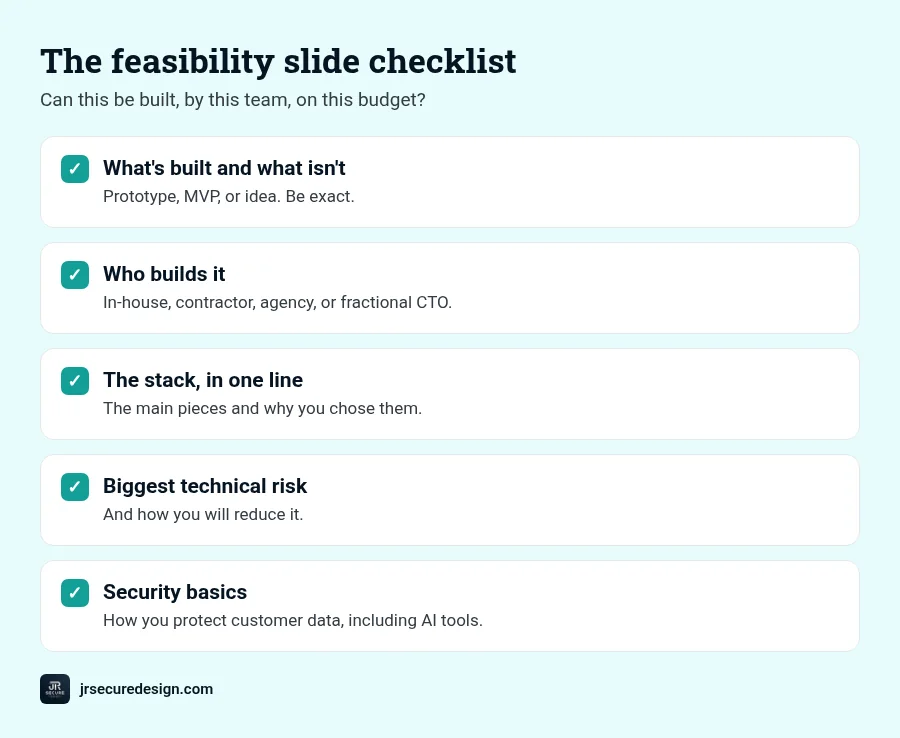
Add one slide (or a clear section of your Solution slide) that covers:
- What’s built and what isn’t. Prototype, MVP, or idea. Be exact.
- Who builds it. In-house, a contractor, an agency, or a fractional CTO.
- The stack, in one line. Name the main pieces and why you chose them.
- The biggest technical risk and how you’ll reduce it.
- Security basics. How you protect customer data, especially if you use AI tools that touch it.
This is the slide we see founders struggle with most, and it’s where a technical advisor helps fastest.
Is your feasibility slide the weak spot?
We can help you plan the build and answer investor tech questions.
Design and format tips
- Ten to twelve slides for the main deck. Put extras in an appendix.
- One idea per slide, with a headline that states the point.
- Readable without you. Many decks are read before any meeting, so the slides should stand on their own.
- Send a PDF. It looks the same on every device and opens without special software. Our pitch deck submission guide walks through exporting and uploading yours.
- Check the basics: your company name, contact email, and date on the first or last slide.
Put your deck in front of experienced advisors
JR Secure Design is hosting a free, online pitch deck competition on Wednesday, Oct 28 at 7 PM ET. Upload your pitch deck as a PDF at jrsecuredesign.com/startups by Sunday, Oct 25. You’ll get feedback on your story, feasibility, and investor readiness from C-suite advisors, and the winner gets James DeCrescenzo as a free advisor to their company.
If your feasibility slide is the weak spot, our Fractional CTO service can help you plan the build, choose the stack, and answer investor tech questions with confidence.
Frequently asked questions
How many slides should a pre-seed pitch deck have?
Most pre-seed decks work best with about ten to twelve main slides. That covers purpose, problem, solution, why now, market, competition, business model, team, financials, and the ask. Put supporting detail in an appendix.
What slides do investors expect in a pitch deck?
Investors generally expect company purpose, problem, solution, why now, market size, competition, business model, team, financials or traction, and the ask. This mirrors the structure in Sequoia’s public business plan guide.
Do I need financials in a pre-seed deck?
Yes, but keep them simple and honest. Show what traction you have today, even if it’s small, plus a basic 12–18 month plan and what the money you’re raising pays for. Don’t inflate early numbers.
What should a technology or product slide show?
It should show what’s built today, who builds it, the main pieces of the stack, the biggest technical risk, and how you protect customer data. Its job is to prove the product can be built by this team on this budget.
What format should I send my pitch deck in?
Send a PDF. It keeps your layout intact on any device. For the JR Secure Design pitch deck competition, upload your PDF at jrsecuredesign.com/startups by Sunday, Oct 25.
Ready to submit?
Your deck is ready. Put it in front of C-suite advisors.
Free, online pitch deck competition: Wednesday, Oct 28, 7 PM ET. Get feedback on story, feasibility, and investor readiness. The winner gets James DeCrescenzo (25+ years in technology and security) as a free advisor to their company.
Upload your pitch deck (PDF) at jrsecuredesign.com/startups by Sunday, Oct 25. Then call or book a 30-minute call.
Or email sales@jrsdi.com.
Related reading: Common Pitch Deck Mistakes (and Quick Fixes) · Pre-Seed Tech & Security Checklist · How to Submit a Pitch Deck · Startups at JR Secure Design · What Is a Fractional CTO? · Fractional CTO
If you can think it, we can build it securely. Artificial Intelligence · Security · Applications · Hardware