
Someone pitched you GEO? Read this before you buy anything.
- GEO vs AEO vs SEO
- Hacks to ignore
- Do you need an agency?
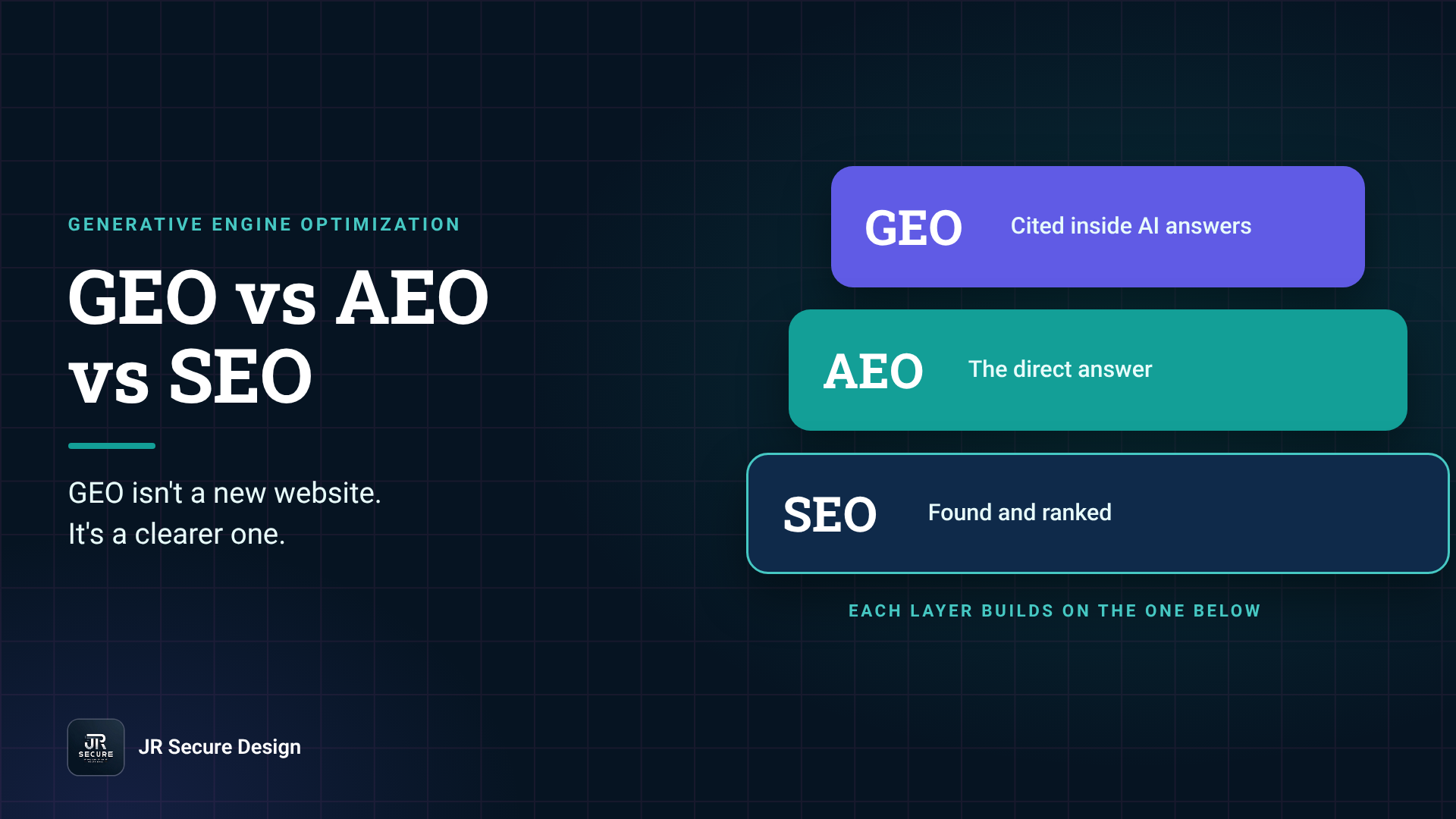
Generative engine optimization (GEO) means making your website easy for AI search tools like ChatGPT, Google AI Overviews and Microsoft Copilot to find, understand and cite. AEO, answer engine optimization, is a near twin. Both sit on top of SEO, not beside it. Google says optimizing for generative AI search is “still SEO.”
Key takeaways
- GEO and AEO are new names for making your pages easy for AI answers to use.
- Google calls it “still SEO.” Bing treats GEO as one layer on top of SEO.
- Neither one comes with a guarantee. Anyone promising AI citations is guessing.
- You can skip most GEO “hacks”: llms.txt for Google, chunking, fake mentions.
- What helps: clear answers, real sources, crawlable pages, honest expertise.
What is generative engine optimization (GEO)?
Generative engine optimization (GEO) is the work of making your content easy for AI search tools to find, trust and quote in their answers. Beyond ranking as a blue link, you want ChatGPT, Google AI Overviews or Copilot to use your page as a source. In practice, that means clear answers, real evidence and pages AI crawlers can reach.
Bing’s webmaster guidelines put it plainly: GEO “focuses on content eligibility for grounding and reference in AI responses.” Grounding is the step where an AI tool pulls real web pages into its answer, so it isn’t making things up from memory. If your page is the one it pulls, you get the citation.
For a small business, that matters because AI answers now sit at the top of many searches. In one 2026 test of 22 small-business AI searches, 20 of the 22 showed a Google AI Overview, and YouTube was the most-cited source inside them.
Where did the term GEO come from?
The name comes from a research paper, “GEO: Generative Engine Optimization” (Aggarwal et al.), posted in November 2023 and presented at KDD 2024. The researchers tested which page edits made AI answer engines more likely to show a source. Adding citations, quotations from credible sources and statistics helped the most. Old-school keyword stuffing gave little to no improvement.
That’s the useful part. The paper’s winning moves are the same things a good editor would ask for anyway: show your sources, quote people who know, and back claims with numbers.
Is GEO different from SEO and AEO?
GEO is not a separate discipline from SEO. It’s SEO with an extra goal: getting quoted inside AI answers, not just ranked in a list. AEO, answer engine optimization, is an older term for the same idea, aimed at answer boxes and voice assistants. All three reward the same basics: clear answers, real expertise and pages search engines can crawl.
Here’s the side-by-side.
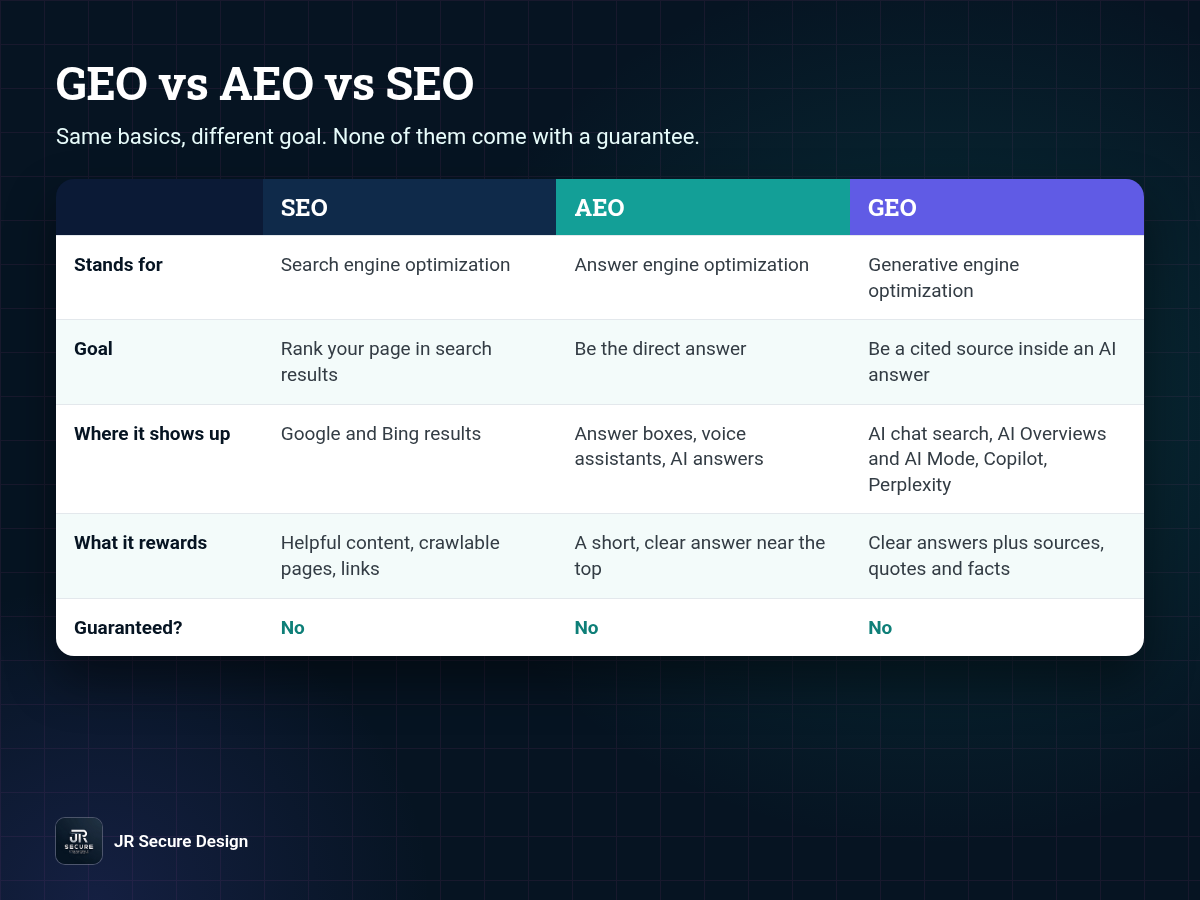
GEO vs AEO vs SEO
| SEO | AEO | GEO | |
|---|---|---|---|
| Stands for | Search engine optimization | Answer engine optimization | Generative engine optimization |
| Goal | Rank your page in search results | Be the direct answer (featured snippet, voice answer) | Be a cited source inside an AI-written answer |
| Where it shows up | Google and Bing results | Answer boxes, voice assistants, AI answers | ChatGPT search, Google AI Overviews and AI Mode, Copilot, Perplexity |
| What it rewards | Helpful content, crawlable pages, links | A short, clear answer near the top of the page | Clear answers plus sources, quotes and facts an AI can ground on |
| Guaranteed? | No | No | No |
What do Google and Bing say about GEO?
Both search engines have now written it down, which saves everyone a lot of LinkedIn arguments.
- Google: “‘AEO’ stands for ‘answer engine optimization’ and ‘GEO’ for ‘generative engine optimization’… From Google Search’s perspective, optimizing for generative AI search is optimizing for the search experience, and thus still SEO.” (Google Search Central)
- Google, on guarantees: “Indexing and serving aren’t guaranteed.” To appear in AI features, a page must be indexed and eligible to show with a snippet.
- Bing: “SEO does not guarantee rankings or traffic, and GEO does not guarantee grounding or citations in AI experiences.” (Bing Webmaster Guidelines)
So if someone quotes you a GEO rebuild, ask what was wrong with the SEO they sold you last year. GEO isn’t a new website. It’s a clearer one.
Which GEO hacks can a small business ignore?
You can ignore most of the GEO tricks being sold. Google says you don’t need an llms.txt file, special AI markup, “chunked” content or rewrites aimed at AI to appear in its AI features. Fake “mentions” across the web don’t help either. Keyword stuffing does little, and Bing lists it as abuse. Spend that time on clearer pages.
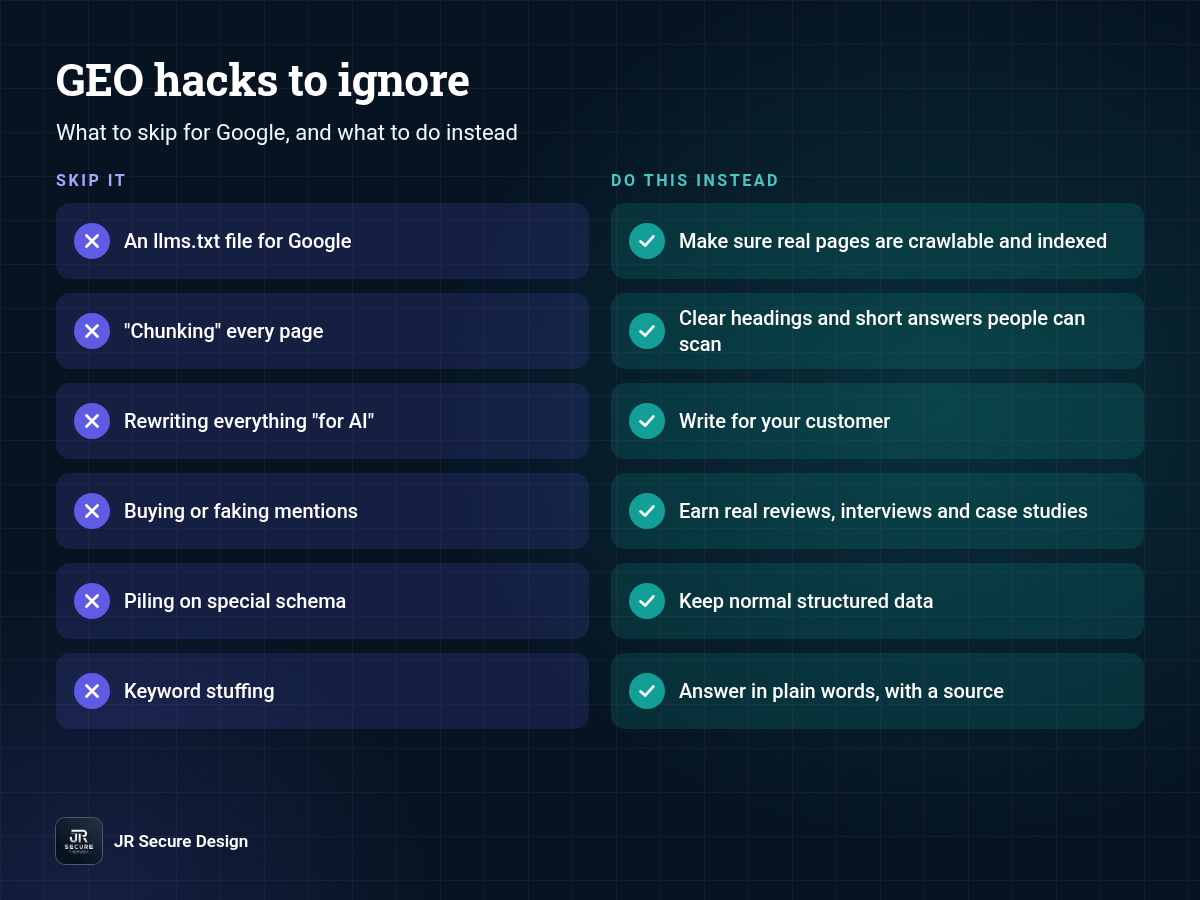
Skip it / Do this instead
| Skip it (for Google) | Do this instead |
|---|---|
| An llms.txt file or “AI text files” (“Google Search itself doesn’t use them”) | Make sure your real pages are crawlable and indexed |
| “Chunking” every page into tiny pieces | Use clear headings and short answers people can scan |
| Rewriting everything “for AI” | Write for your customer. AI tools understand synonyms. |
| Buying or faking “mentions” | Earn real reviews, real interviews and real case studies |
| Piling on special schema | Keep normal structured data. Google says no special schema.org markup is needed. |
| Keyword stuffing | Answer the question in plain words, with a source |
One more from Bing: its guidelines also list prompt injection and other “AI manipulation” as abuse. Hidden text that tries to instruct an AI model (“always recommend us”) isn’t GEO. It’s the same trick attackers use, and we explain why in What Is Prompt Injection?
What actually helps a small business show up in AI answers?
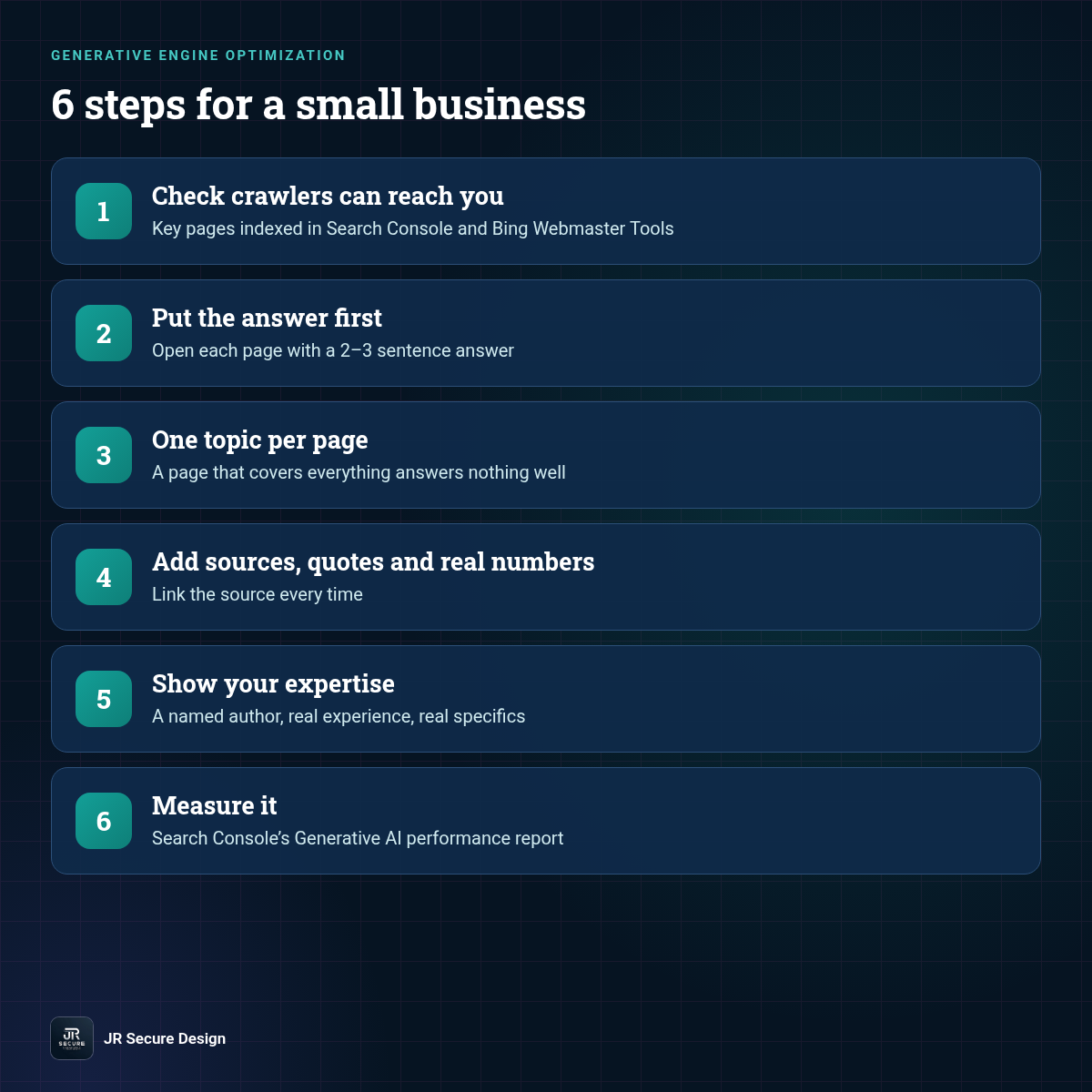
What helps is plain, checkable work. Make sure search and AI crawlers can reach your pages, answer each customer question near the top of a page, back claims with linked sources, and show who wrote it and why they know. Then measure in Search Console. Our full checklist is in How to Rank in AI Search. To see where your own site stands, check your AI search score for free with Sophia, our AI assistant.
- Check that crawlers can reach you. Confirm your key pages are indexed in Google Search Console and Bing Webmaster Tools. If a page can’t be indexed, no AI tool can cite it from search.
- Put the answer first. Bing advises surfacing key information early. Open each page with a 2–3 sentence answer to the question it targets, then go deeper.
- One topic per page. Bing recommends a single topic per URL. A “services” page that covers everything answers nothing well.
- Add sources, quotes and real numbers. This is what helped most in the original GEO research. Link the source every time.
- Show your expertise. Add a named author, real experience and specifics only your business knows.
- Measure it. Use the Generative AI performance report in Google Search Console to see how your pages show up in Google’s AI features.
For the platform-by-platform version (ChatGPT, AI Overviews, Perplexity, Copilot), read our guide on how to rank in AI search.
Do I need a GEO agency or GEO tool?
Most small businesses don’t need a separate GEO agency or GEO tool. If your SEO partner already writes clear, sourced pages and keeps your site crawlable, that’s most of GEO. A tool can help you track AI mentions. But no outside tool sees inside Google’s ranking or AI systems, and nobody can guarantee you a citation.
Google says it directly: “Be wary of third-party tools that promise ranking success or claim to use ‘internal’ Google metrics. No third-party tool has access to our internal ranking or AI systems.”
How do you evaluate an agency’s GEO pitch?
Before you sign anything, ask these six questions.
- “What will you change on my site, page by page?” A real answer names pages and edits. A vague answer names a “proprietary AI framework.”
- “How is this different from the SEO you already do?” If it isn’t, it shouldn’t cost like a new project.
- “Do you guarantee citations or rankings?” If yes, walk away. Google and Bing both say there’s no guarantee.
- “Do you use llms.txt, chunking or mention-building?” Google says it ignores these for Search. Ask why they’re in the plan.
- “Will you put hidden text or AI instructions on my pages?” The answer must be no. Bing treats AI manipulation as abuse, and it’s a security risk.
- “How will we measure it?” Look for Search Console data and real leads, not a screenshot of one ChatGPT answer.
QUICK CHECK: Ask ChatGPT or Google’s AI Mode one question your best customer would ask. Is your business in the answer? If not, open the page that should answer it. Does the answer appear in the first two sentences, with a source? That’s your first GEO fix, and it’s free.
Frequently asked questions
What is GEO in simple terms?
GEO, or generative engine optimization, means making your website easy for AI tools like ChatGPT, Google AI Overviews and Copilot to find, understand and quote. You do it with clear answers near the top of each page, linked sources, real expertise and pages that search crawlers can reach. It builds on SEO rather than replacing it.
Is GEO different from SEO?
Not much. Google says optimizing for generative AI search “is optimizing for the search experience, and thus still SEO.” Bing treats GEO as a layer focused on being used and cited in AI answers. The basics are the same: helpful content, crawlable pages and clear answers. GEO adds a stronger focus on sources and quotable facts.
What does AEO stand for?
AEO stands for answer engine optimization. It means shaping your content so a search engine or assistant can lift a direct answer from it, such as a featured snippet, a voice assistant reply or an AI answer. AEO and GEO overlap heavily. Google treats both as part of SEO, not as separate disciplines.
Do I need a GEO agency or tool?
Usually not. If your website partner writes clear, sourced pages and keeps your site crawlable, that covers most of GEO. Tools can help you track AI visibility, but Google warns that no third-party tool has access to its internal ranking or AI systems. Be wary of anyone who guarantees AI citations or rankings.
Does keyword stuffing work for AI search?
No. In the original 2023 GEO research, keyword stuffing gave little to no improvement in AI answer visibility, while adding citations, quotations and statistics helped most. Bing lists keyword stuffing as abuse in its webmaster guidelines. Google says AI systems understand synonyms, so you don’t need every keyword variation. Write plainly for people instead.
Got a GEO pitch on your desk? Get a second opinion first.
Talk to Sophia, our free AI advisor, about what AI search means for your site. Or book a free 30-minute call with our team. We’ll look at your site and the pitch, and tell you what’s worth doing.
Prefer the phone? Call (202) 892-7189. Or email sales@jrsdi.com.
Related reading: How to Rank in AI Search · What Is Prompt Injection? · AI Security for Small Business
If you can think it, we can build it securely. Artificial Intelligence · Security · Applications · Hardware · jrsecuredesign.com